Defence industries race to build $5,000 drone interceptors as Iran war exposes cost of traditional missiles
The Iran conflict has accelerated a global shift toward cheaper drone interceptors as militaries seek alternatives to using multimillion-dollar missiles against low-cost attack drones, with production expanding from Ukraine to the UAE.
Iran war's new defence lesson: From India to US, race to build $5,000 drone killers
The Iran war has crystallised one of modern warfare's most challenging calculations: how sustainable is it to deploy sophisticated missiles costing millions of dollars to neutralise relatively inexpensive attack drones?
That question is now driving a fundamental transformation across the global defence industry.
During the first 96 hours of Operation Epic Fury, U.S. and Gulf partner Patriot missile defence batteries fired 943 rounds, including PAC-3 MSE interceptors priced at approximately $4.5 million each. The scale of ammunition consumption has intensified the search for more economical solutions.
A new generation of interceptors, with unit costs as low as $5,000, is emerging as militaries worldwide seek affordable methods to counter mass drone attacks while reserving their most advanced missiles for ballistic and other high-end threats.
The strategic shift, initially accelerated by the war in Ukraine, has gained fresh momentum from the Iran conflict. Defence companies are now racing to expand production of lower-cost interceptor systems.
Lessons from Ukraine's battlefield
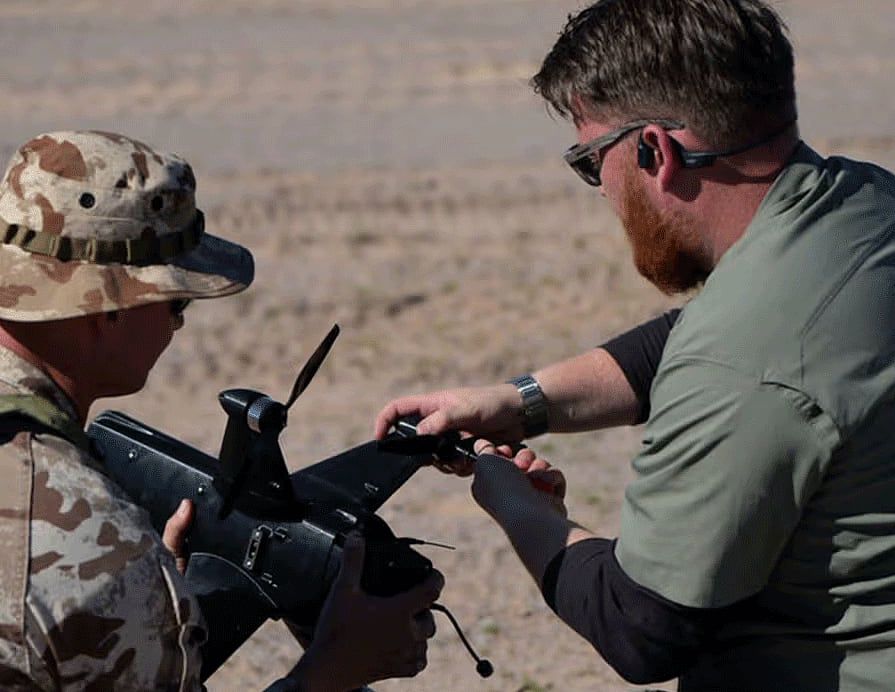
At the centre of this evolution is Guardian, an interceptor developed by Florida-based startup Powerus and derived from Ukrainian technology that demonstrated effectiveness against Russia's Iranian-designed Shahed drones.
The weapon functions as a small, purpose-built system designed to collide with incoming drones before they reach their targets. Guardian carries a price tag of roughly $5,000, dramatically less than the sophisticated missiles traditionally deployed in air-defence networks.
Ukraine's experience has proven the concept works at scale. Ukrainian interceptor drones now achieve 70 percent of all air defence interceptions, according to a Ukrainian military official, representing a dramatic operational shift from negligible levels just years earlier.
Ukrainian manufacturers including Wild Hornets produce interceptor drones costing between $1,400 and $2,100 per unit, with production rates reaching 10,000 units monthly. Russia launched more than 14,700 one-way attack drones at Ukraine from September 2022 through December 2024, according to Ukraine's air force, with most being Shahed-type systems.
These weapons cannot intercept ballistic missiles, meaning they do not replace systems such as Lockheed Martin's PAC-3. Instead, the strategy creates layered defence: inexpensive interceptors against inexpensive drones and advanced missiles against the most dangerous threats.
That distinction has become increasingly critical as drones are launched in large salvos designed partly to overwhelm defences. Swarm drone tactics deliberately exploit cost asymmetry by forcing defenders to expend expensive interceptors on low-cost decoys mixed with higher-value attack drones, progressively depleting ammunition stockpiles.
The economics of air defence
The challenge extends beyond whether a drone can be destroyed. The fundamental question is the cost of destruction.
Using missiles worth hundreds of thousands or millions of dollars against far cheaper drones may make tactical sense when lives or critical infrastructure face imminent threat. Repeating that equation hundreds or thousands of times, however, becomes economically unsustainable.
The latest PAC-3 MSE interceptor unit price has risen to approximately $5.3 million according to the U.S. Army's 2027 fiscal year budget, up from a historical average of around $4 million. An attacker does not necessarily need to penetrate an air-defence network to impose significant costs. By forcing defenders to repeatedly launch expensive interceptors, cheap drones can gradually drain valuable ammunition reserves.
Global production expansion
Cost represents only half the equation. Production speed constitutes the other critical element.
Factories affiliated with Powerus currently produce roughly 3,000 drone interceptors monthly. The company aims to establish a global manufacturing network capable of producing 15,000 monthly by mid-2027.
Guardian has been deliberately engineered for relatively straightforward assembly, utilising commercially available microchips and GPS modules. Powerus has established production facilities in the United Arab Emirates producing 3-D printed components and assembling Guardian interceptors since July 2026.
The company has also partnered with a defence firm near Mumbai to manufacture interceptors in India.
This approach marks a departure from the traditional defence-industry model, where sophisticated weapons can require years to develop and are typically produced at a limited number of highly specialised facilities.
Major contractors adapt
Established defence giants are responding to the same market pressures.
Lockheed Martin announced in July 2026 its PAC-3 Adapted Capability Effector (ACE), designed to cost approximately $2 million per unit—roughly half the price of a PAC-3 MSE. The company said in July that it planned to produce a lower-cost interceptor in Europe with European partners, although testing is not expected until 2028.
The U.S. Army is separately seeking proposals for a new Patriot interceptor with a unit cost under $1 million, about one-fifth the price of current PAC-3 MSE missiles, to improve cost-per-intercept ratio against lower-tier threats.
Raytheon markets its Coyote interceptor, with an estimated cost of approximately $126,500. California startup Neros is developing its Bandit interceptor drone, with its basic model priced around $5,000.
In April 2026, the Pentagon and Lockheed Martin agreed to a $4.7 billion contract to accelerate PAC-3 MSE production, with plans to triple annual output from 500 to 1,500 missiles over seven years, demonstrating parallel expansion of both high-end and low-cost solutions.
The price range illustrates how rapidly a new market segment is developing between ultra-cheap attack drones and the enormously sophisticated missile systems traditionally tasked with destroying airborne threats.
Strategic implications beyond current conflicts
Limitations exist within the cheap-interceptor revolution. Systems such as Guardian are designed primarily for drones and cannot substitute for high-end missile defences. Iran could develop faster and more sophisticated drones, forcing defenders to continually adapt.
However, the broader strategic lesson is likely to endure beyond current hostilities.
Ukraine demonstrated that relatively inexpensive drones could transform battlefield dynamics. The Iran war has reinforced the complementary equation: nations require affordable methods to neutralise them.
The next phase of the arms race, therefore, may focus less on building the fastest missile or most sophisticated air-defence system and more on achieving cost-effective layered defence capable of sustained operations against mass drone threats.