Seven siblings from Gaza reunite with sister in Israel after losing parents in war
After nearly two years of separation and the death of their parents in an airstrike, seven Gaza-born siblings have successfully obtained Israeli passports and joined their eldest sister in Nazareth, overcoming legal barriers and a yearslong bureaucratic struggle.
A family split by history and law
When Mais Al Gharam last saw her seven younger siblings in Gaza two months before the war began, she could not have imagined the ordeal that would follow. An Israeli airstrike would kill her parents and youngest brother. She would spend nearly two years fighting through legal obstacles to bring her surviving siblings to safety. And when they finally walked through the gates at Kerem Shalom crossing this month, it would mark the end of a separation that had tested the limits of family bonds.
"We never stopped being a family," said Mais, 23, the eldest of eight siblings. "But every day I wondered whether I'd see them again."
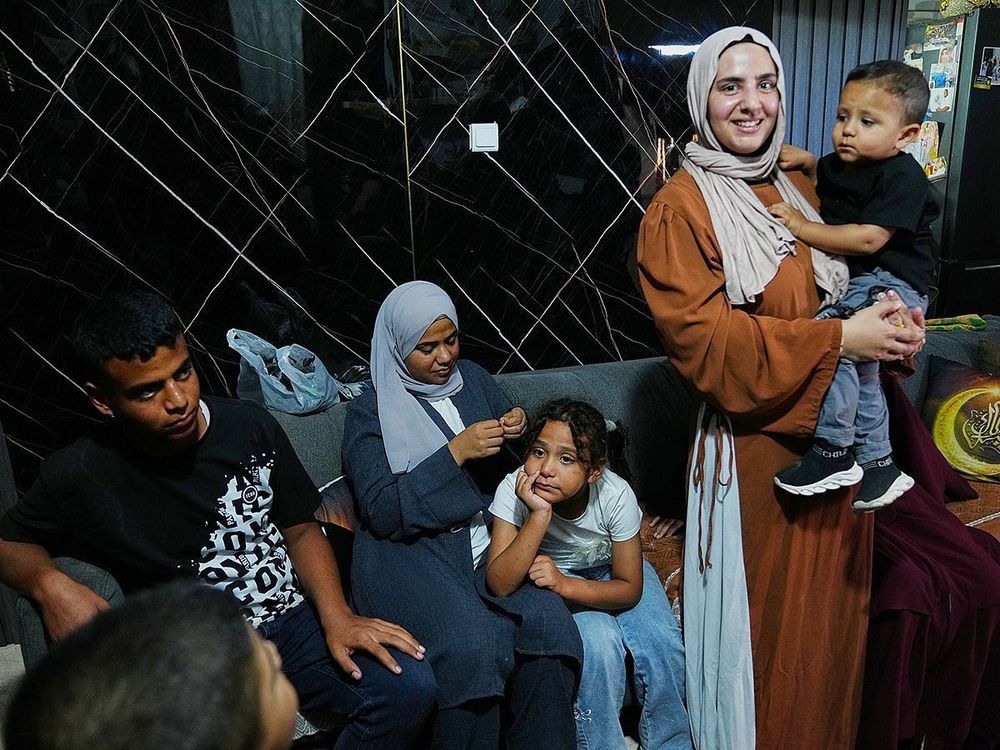
The reunion in Nazareth this July brought together siblings aged 8 to 22, all now holding Israeli passports after a complex legal process assisted by HaMoked, an Israeli human rights organization that helps Palestinians navigate issues including family reunification and residency rights. The organization, founded in 1988, provides free legal assistance to hundreds of Palestinians monthly from the West Bank, Gaza Strip, and East Jerusalem.
A family split by history and law
The Al Gharam family's story begins in 2002, when Murad Al Gharam, a construction worker from Gaza, met Amal Karim, a Palestinian citizen of Israel, while working in Israel on a temporary permit. They married and had their first child, Mais, but the timing proved fateful. Their relationship began during the Second Intifada, the Palestinian uprising that lasted from 2000 to 2005, when Israel severely restricted work permits for Palestinians as violence escalated.
With Murad's legal status in Israel in jeopardy, the young family relocated permanently to Gaza, settling in Nuseirat, a densely populated refugee camp in the territory's central region. There, Murad worked as a taxi driver, and the couple had seven more children: Zuhour, 22; Jwaher, 21; Sabreen, 20; Ghfran, 17; Fady, 16; Maisara, 11; and Arjwan, 8.
"We lived here together as a family and never lacked anything," Zuhour recalled.
The family became part of what rights groups estimate to be more than 300 "divided families" with members on both sides of the Gaza-Israel border. Broader estimates suggest tens of thousands of Palestinian couples and families across Israel and the occupied Palestinian territories live apart due to separation policies between Gaza, the West Bank, and Israel.
The legal barrier preventing families like the Al Gharams from reuniting stems from Israel's Citizenship and Entry into Israel Law, first enacted in 2003 during the Second Intifada as what was described as a temporary security measure. The annually renewed law generally bars Palestinian spouses of Israeli citizens from obtaining permanent residency or citizenship, with limited exceptions. Before the law's passage, an estimated 130,000 Palestinians had received Israeli citizenship or residency through family unification with Israeli spouses.
War forces an impossible choice
When Hamas-led militants from Gaza attacked southern Israel on October 7, 2023, killing approximately 1,200 people and taking 251 hostage, the Al Gharams faced a wrenching decision. Mais had already emigrated to Nazareth, where she married and found work. Her seven Gaza-born siblings could theoretically apply for Israeli citizenship through their mother, but their father had no such option under Israeli law.
"We said, 'Either we all leave together, or we all stay together,'" Zuhour explained. The family chose to remain united in Gaza.
As Israel launched its retaliatory offensive, Mais waited anxiously for updates from approximately 160 kilometers away. Communication proved difficult after Israel disrupted Gaza's electricity and telecommunications networks. The family was displaced at least seven times in early 2024, eventually reaching Rafah in southern Gaza before Israeli forces invaded there as well.
They returned to Nuseirat, about 10 kilometers south of Gaza City, moving back into their childhood home. The area became both refuge and danger zone, with regular airstrikes on buildings that Israel claimed were being used by Hamas.
An airstrike changes everything
At 6 a.m. on July 10, 2024, an airstrike destroyed the Al Gharam home, collapsing walls and sending debris through the ceiling. The dazed and wounded siblings fled into the street, piled into cars, and rushed to Al Aqsa Hospital in Deir Al Balah, where doctors pronounced their mother, father, and 11-year-old brother Maisara dead. Jwaher suffered fractured bones in her leg and fingers.
"Suddenly the burden fell on us," Sabreen said.
The surviving siblings had to assume adult responsibilities overnight. Together, they cooked, cleaned, collected firewood, and opened a neighborhood bakery to earn money while relying on charity and funds from relatives in Nazareth. "We were forced—each of us—to take on a role that wasn't ours," Fady said.
The Israeli military did not respond to requests for comment on the strike.
A sister's fight for reunion
On the day of the airstrike, Mais contacted HaMoked to begin the paperwork required for reunification. The process proved arduous. She needed entry permits, a court order appointing Zuhour as legal guardian to the minor children, and six successful citizenship applications.
According to HaMoked, the Israeli Interior Ministry initially rejected the divided family reunification request because the siblings' mother was deceased. The family then underwent DNA testing to prove the siblings' biological relationship to Mais, an Israeli citizen. After receiving the results, the siblings made another trip to Kerem Shalom—the primary crossing point at the southernmost tip of the Gaza-Israel border, approximately 4 kilometers west of Rafah—to sign paperwork for their Israeli passports.
Nearly two years to the day after the deadly strike, on July 8, 2026, the siblings finally crossed into Israel. Mais waited at Kerem Shalom, scanning for her brothers and sisters as they emerged through the gates.
A new beginning, shadowed by loss
The half-day journey to Nazareth took the siblings past irrigated fields and modern cities, a stark contrast to the rubble they left behind. At their mother's family home, relatives showered them with embraces and homemade food.
The reunion carried both joy and grief. While they had found one another, they could never reclaim what was lost.
"It's like coming back from the grave," said Faraj al-Gharam, their maternal grandfather, speaking of his grandchildren. In Gaza, he added, "human life has no value."
The siblings spoke of ordinary hopes: spending time with relatives, attending school, seeing doctors. They had achieved what mattered most—reuniting as a family.
"Family," Jwaher said simply, "is the most important thing."