UN Secretary-General makes historic visit to Syria amid political transition
António Guterres arrives in Damascus for a three-day visit, the first by a UN chief since 2009, to support Syria's transition under President Ahmed al-Sharaa following the overthrow of Bashar al-Assad.
UN Secretary-General makes historic visit to Syria amid political transition
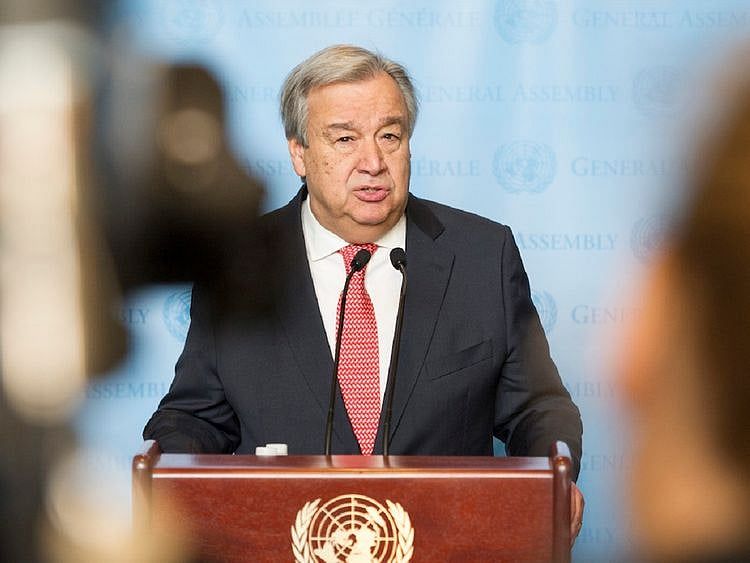
United Nations Secretary-General António Guterres arrived in Damascus on Saturday for a landmark three-day visit to Syria, marking the first time a UN chief has traveled to the country since 2009, according to state media reports.
Foreign Minister Asaad al-Shaibani received Guterres and his delegation at Damascus international airport, state news agency SANA reported. The visit comes more than a year and a half after Syria's new authorities, led by President Ahmed al-Sharaa, overthrew longtime ruler Bashar al-Assad in December 2024, ending more than 13 years of devastating civil war.
During his stay, Guterres will reaffirm the United Nations' support for Syria's ongoing political transition and meet with President al-Sharaa. The Syrian leader made history last year by becoming the first Syrian president in decades to address the UN General Assembly.
The visit represents a significant diplomatic milestone. The last UN Secretary-General to visit Damascus was Ban Ki-moon in January 2009, when he traveled to Syria as part of a broader Middle East mission addressing the Gaza crisis that included stops in Egypt, Jordan, Israel, the Occupied Palestinian Territory, Turkey, Lebanon, and Kuwait.
Supporting Syria's transition
UN spokesman Stéphane Dujarric emphasized that Guterres will stress that Syria now has an opportunity not only to recover from conflict but also to build foundations for a more stable, inclusive and prosperous future for all Syrians. The Secretary-General will reaffirm the UN's role in accompanying and supporting the Syrian people through this transition.
Guterres is scheduled to address Syria's new transitional parliament, which held its inaugural session on July 13, 2026. The parliament comprises 206 members out of 210 total seats and operates under a renewable 30-month mandate focused on drafting a new constitution.
The UN chief will also meet with representatives from Syrian civil society and non-governmental organizations working on women's issues, underscoring the international community's emphasis on inclusive governance that represents all components of Syria's multi-ethnic, multi-confessional society.
Regional security challenges
A key component of the visit includes a trip to the United Nations Disengagement Observer Force (UNDOF) stationed in the Israeli-occupied Golan Heights. UNDOF, established in May 1974 following the 1973 Arab-Israeli War, maintains the ceasefire between Israel and Syria with more than 1,100 peacekeepers currently deployed. The Security Council extended its mandate until June 30, 2026.
Tensions in the region remain elevated following Assad's overthrow. Israel deployed troops into the UN-patrolled buffer zone and has conducted strikes and repeated incursions deeper into Syrian territory. Israeli officials have indicated their intention to maintain forces in a southern Syria security zone, seeking a broader demilitarized area.
Despite these tensions, Syria's new authorities and Israel have held several rounds of direct talks and agreed to establish an intelligence-sharing mechanism, though this has not prevented Israeli military actions that have drawn condemnation from the UN and international community.
Context of conflict and transition
Syria's civil war erupted in 2011 after government forces brutally repressed pro-democracy protests that began following the arrest and torture of children in Daraa for spray-painting anti-regime graffiti. The conflict killed more than half a million people, with estimates from various monitors ranging between 528,000 and over 650,000 deaths.
The international community has urged Syria's new Islamist authorities to build strong institutions and establish governance systems that include all segments of society. According to recent UN reports, approximately 90 percent of Syria's population currently lives below the poverty line, though 1.7 million Syrian refugees and 1.9 million internally displaced persons have returned to their communities since Assad's fall.
UN special envoy to Syria Claudio Cordone stated earlier this week that Guterres would reaffirm the United Nations' commitment to supporting the Syrian government and people during this defining period in the country's history.
Several senior UN officials have visited Syria since Assad's overthrow, including human rights chief Volker Türk and nuclear watchdog head Rafael Grossi, while a UN Security Council delegation of ambassadors made its first-ever visit to the country late last year.