Philippines and China clash over South China Sea water cannon incident near Scarborough Shoal
Manila and Beijing exchange accusations following confrontation on July 24, 2026, as Chinese Coast Guard vessels allegedly fired water cannons at Philippine ships delivering supplies to fishermen near disputed waters.
Philippines and China clash over South China Sea water cannon incident near Scarborough Shoal
The Philippines and China have traded sharp accusations following a maritime confrontation on July 24, 2026, in the disputed South China Sea, with both nations blaming each other for escalating tensions near Scarborough Shoal.
The Philippine Coast Guard reported that Chinese Coast Guard vessels repeatedly fired water cannons at Philippine government ships and executed dangerous manoeuvres during a mission to deliver fuel subsidies and food supplies to Filipino fishermen. China rejected the allegations, asserting that Philippine vessels had illegally entered its territorial waters and that its coast guard responded with restraint.
The incident occurred approximately 120 nautical miles west of Luzon, the Philippines' main island, in waters that Manila considers part of its exclusive economic zone under international law. Scarborough Shoal lies more than 800 km southeast of Hong Kong.
Latest in series of confrontations
The confrontation follows a similar incident reported on July 23, underscoring persistent friction in one of the world's most contested maritime zones. Rear Admiral Jay Tarriela, spokesperson for the Philippine Coast Guard, said the vessels were subjected to water cannon attacks and dangerous manoeuvres by Chinese Coast Guard ships during the Kadiwa ng Bagong Bayaning Mangingisda programme, a government initiative providing fuel and essential supplies to Filipino fishing boats.
According to Philippine authorities, CCG vessel 3107 fired a water cannon at the PCG vessel BRP Cape San Agustin from approximately 400 metres away while the ship was conducting a maritime patrol about 15 nautical miles northeast of Bajo de Masinloc, the Philippine name for Scarborough Shoal. The vessel was shadowed by at least six CCG vessels and Chinese maritime militia ships.
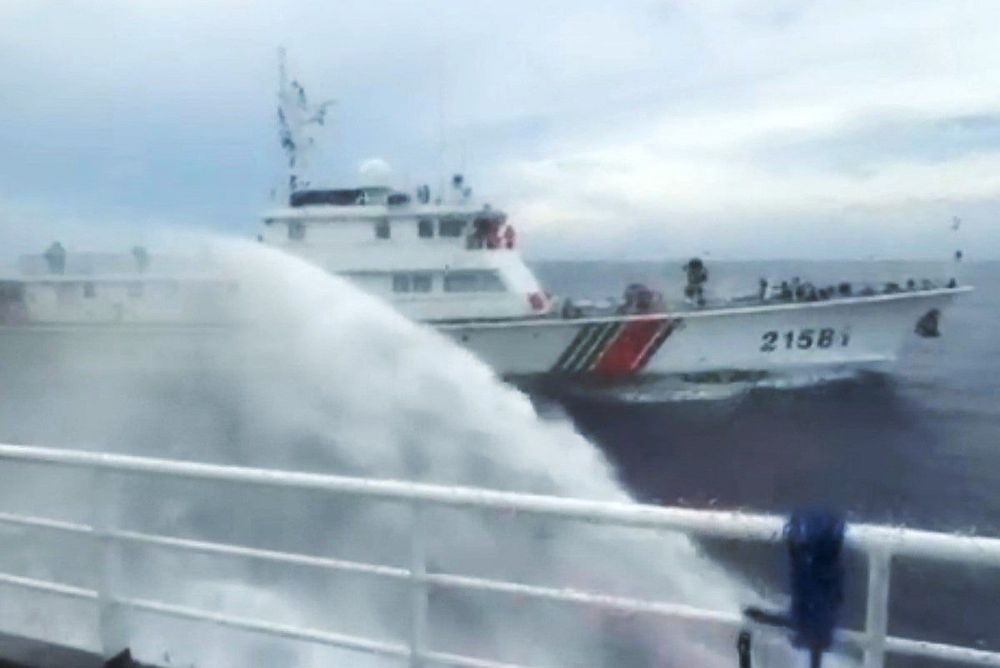
In another encounter, CCG vessel 21581 allegedly fired water cannons at the BFAR vessel BRP Datu Paduhinog, which was en route to conduct a fisheries monitoring mission. The Chinese vessel came within seven metres of the Philippine ship's port bow, creating what the PCG described as a serious collision risk. Philippine officials noted that the CCG vessel had deliberately switched off its Automatic Identification System, violating international navigation safety regulations.
The BFAR vessel BRP Datu Paduhinog was struck directly by water cannon blasts three times and temporarily lost satellite internet connectivity before communications were restored. A Chinese maritime militia vessel was also observed towing a rope about 100 metres behind another BFAR vessel, BRP Datu Sumakwel, posing an additional navigational hazard. Later, CCG vessel 3303 fired a water cannon at BRP Datu Cabaylo from about 300 metres astern.
Despite the confrontations, Tarriela confirmed that all Philippine Coast Guard and Bureau of Fisheries personnel remained safe and the vessels sustained their presence in the area to support Filipino fishermen. The PCG monitored 26 vessels during the mission, including three PCG vessels, seven BFAR vessels, 12 CCG vessels, and three Chinese maritime militia vessels.
Manila condemns Chinese actions
The Philippine Coast Guard condemned what Tarriela characterised as China's illegal, coercive, aggressive, and deceptive actions. He reiterated Manila's position that Bajo de Masinloc forms part of Philippine territory and that surrounding waters fall within the country's territorial sea and exclusive economic zone, which extends 200 nautical miles from its baselines under the United Nations Convention on the Law of the Sea.
Tarriela cited the 2016 arbitral award, which affirmed that Bajo de Masinloc is a traditional fishing ground for Filipino fishermen whose rights cannot be lawfully impeded by any foreign power. The tribunal found that China had no legal basis to claim historic rights to resources within its nine-dash line and that any pre-existing rights were extinguished when China became a party to UNCLOS. However, the ruling did not address sovereignty over the shoal itself.
Scarborough Shoal is part of a marine ecosystem with high fish density and abundant fishing grounds that sustain thousands of livelihoods in the Philippines, making it economically significant beyond its strategic value.
Tarriela emphasised that the coast guard would continue to protect Filipino fishermen, uphold the rule of law, and defend the country's sovereignty, sovereign rights, and jurisdiction in the West Philippine Sea without escalating tensions and in accordance with international law.
Beijing rejects Philippine claims
The Chinese Embassy in Manila rejected the Philippine account and accused Tarriela of distorting the facts. In a Facebook post, the embassy stated that Philippine vessels had illegally intruded into the waters of Huangyan Dao in two consecutive days and ignored repeated warnings from the CCG.
Chinese authorities said they took necessary law enforcement measures to warn the Philippine vessels and regulate their movements.
The operation was lawful, justified, professional, well-regulated, and conducted with the utmost restraint.
The embassy accused Tarriela of removing context, exaggerating the response, labelling every law enforcement measure as an attack, and rushing to social media to push a false narrative.
It was the Philippine vessels that created the incident, and the CCG responded with the utmost restraint.
Historical context and ongoing dispute
The confrontation took place near Scarborough Shoal, known in the Philippines as Bajo de Masinloc and in China as Huangyan Dao. The shoal lies within the Philippines' exclusive economic zone under international maritime law but has been under China's effective control since 2012, when a major standoff occurred between Philippine and Chinese vessels. After weeks of confrontation, China seized effective control of the shoal, deploying coast guard and maritime militia vessels that have maintained a presence there since.
China's nine-dash line claim, which first appeared on maps produced in 1947 by the Republic of China government under the Kuomintang party, originally had eleven dashes but was reduced to nine in 1952 when Chairman Mao Zedong abandoned Chinese claims to the Gulf of Tonkin. Beijing claims sovereignty over nearly the entire South China Sea, including waters that overlap with the exclusive economic zones of Brunei, Indonesia, Malaysia, Vietnam, and the Philippines.
Both the Philippines and China signed UNCLOS in 1982, with the Philippines ratifying it in 1984 and China in 1996, making both countries legally bound by its provisions. Under UNCLOS Annex VII, arbitral awards are final and binding without appeal and must be complied with by the parties to the dispute. However, China consistently rejected the 2016 ruling and does not recognise it.
In late 2016, following President Rodrigo Duterte's inauguration, China Coast Guard vessels stationed at Scarborough began to allow Filipino fishing vessels to operate along the exterior of the reef, though they were not permitted to fish inside the lagoon, representing a partial easing of restrictions. The current confrontations suggest a deterioration from that limited accommodation.
Regional tensions and US involvement
The latest maritime tensions came days after Southeast Asian foreign ministers concluded regional meetings in Manila attended by Chinese Foreign Minister Wang Yi and US Secretary of State Marco Rubio. During the meetings, Rubio reaffirmed Washington's support for the Philippines, a US treaty ally. Under the 1951 US-Philippines Mutual Defense Treaty, the United States has mutual defense obligations that extend to armed attacks on Philippine armed forces, public vessels, or aircraft—including those of its coast guard—anywhere in the South China Sea, according to official US government statements.