Saudi Arabia, Pakistan and Turkey pledge stronger defence cooperation in Riyadh meeting
Defence chiefs of the three nations condemned attacks on Mecca and agreed to accelerate implementation of their trilateral security pact signed in August 2026.
 Sara Khan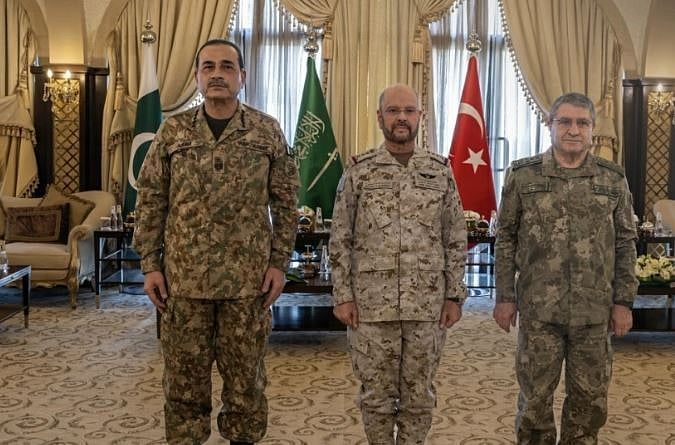
NATO-style collective security framework
The military chiefs of Saudi Arabia, Pakistan and Turkey convened in Riyadh on Friday to strengthen their collective defence commitments under the Mecca Joint Defence Agreement, according to the Saudi Press Agency.
The trilateral meeting followed heightened security concerns after Saudi forces intercepted a Houthi drone near Mecca on September 16, 2026, marking the first security alert in the holy city in nearly a decade. The three defence leaders condemned attacks targeting Mecca, which houses the Al-Masjid Al-Haram, the holiest site in Islam where millions of worshippers gather and toward which all Muslims worldwide face during their five daily prayers.
The commanders praised the Saudi Armed Forces for their vigilance in protecting citizens, residents and the Kingdom's civilian and economic infrastructure. They reviewed current security threats facing Saudi Arabia and discussed ways to translate their defence commitments into operational military cooperation.
NATO-style collective security framework
The Mecca Joint Defence Agreement, signed on August 7, 2026, built upon an earlier Strategic Mutual Defence Agreement between Pakistan and Saudi Arabia from September 17, 2025. The pact is modeled on NATO's Article 5, stipulating that any armed attack against any one of the three states shall be regarded as an attack against them all.
The three nations command combined active military personnel of approximately 1.4 million, with Pakistan contributing 660,000, Turkey 481,000, and Saudi Arabia 247,000. Turkey brings NATO's second-largest army and an increasingly sophisticated domestic defence industry, including drone production capabilities and the Kaan fighter jet program.
Pakistan and Saudi Arabia have maintained military cooperation since 1967 through a defence protocol, with the relationship expanding in 1982 to include troop deployments, training, defence production and joint exercises. This partnership has already yielded concrete results, with Pakistan deploying approximately 8,000 troops, a squadron of JF-17 fighter jets, drone units and a Chinese HQ-9 air defence system to Saudi Arabia in early April 2026.
Enhanced intelligence sharing and coordination
During Friday's meeting, the defence chiefs agreed to strengthen cooperation through enhanced intelligence sharing, military coordination and integration of capabilities to bolster deterrence and collective defence. They emphasized the longstanding ties and mutual trust between their peoples and armed forces.
The renewed focus on defence cooperation comes as regional security dynamics have shifted. A UN-brokered truce in April 2022 had largely halted Houthi attacks on Saudi territory, but hostilities escalated again in July 2026 when the group declared a blockade on Saudi shipping and gained control of critical nodes on Yemen's Bab al-Mandeb coastline.
The participants said the Riyadh meeting reflected the strength of their defence partnership and their determination to implement the agreement effectively. However, the pact does not establish a joint command, standing forces, or any specified trigger mechanism, and the full text has not been publicly released.
The three nations reaffirmed their commitment to collective defence and stressed their determination to protect regional security and stability through coordinated military action when necessary.