Spanish PM denies being blackmailed by Morocco over Ceuta migration crisis
Prime Minister Pedro Sanchez dismisses opposition allegations of Moroccan blackmail, insisting Spain lacks solid proof Rabat orchestrated the July migrant surge into Ceuta that saw over 70,000 people cross the border.
 Sara Khan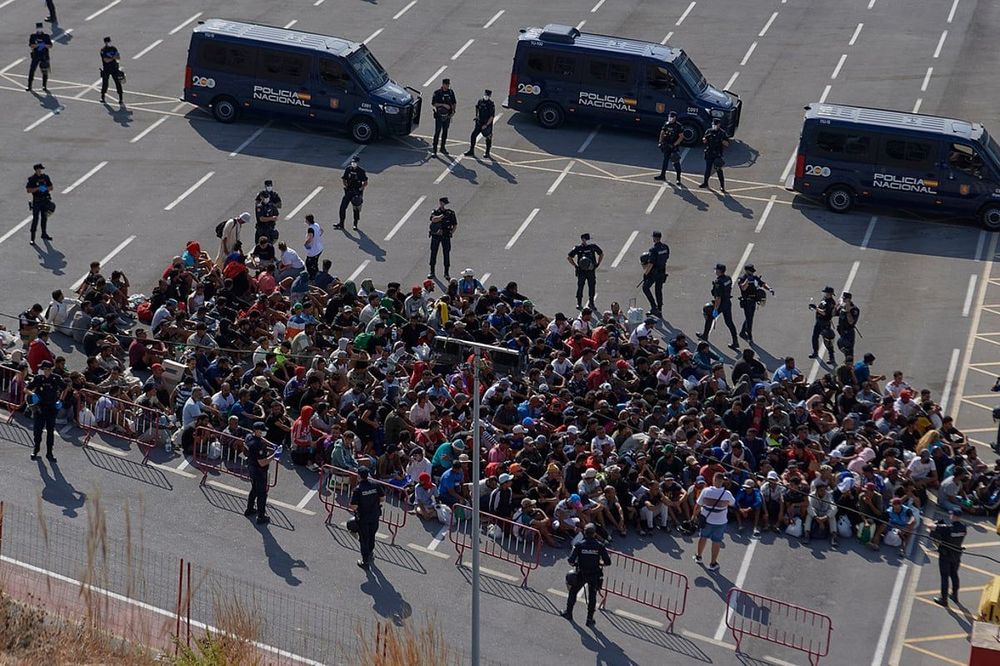
Spanish PM denies being blackmailed by Morocco over Ceuta migration crisis
Prime Minister Pedro Sanchez on Monday rejected allegations that Morocco is blackmailing Spain over the migration crisis in the North African enclave of Ceuta, dismissing opposition claims as fiction worthy of a streaming series rather than serious policy debate.
The accusations, which have gained traction among opposition parties and segments of Spanish public opinion, center on Sanchez's reluctance to directly confront Morocco over a massive migrant surge in late July that saw more than 70,000 people stream into Ceuta from Moroccan territory.
Speaking Monday evening, Sanchez emphasized that bilateral relations must be grounded in facts rather than speculation. "Relations between countries, and particularly with neighbours, must be based on respect and on facts, not on wild speculation or contempt," he said.
The prime minister specifically addressed persistent rumors that Morocco might possess compromising information obtained through hacking one of his phones. "These false reports circulating about the mobile phone or other matters — well, perhaps for a Netflix series they're great, but reality must be built on facts and not on false news," Sanchez stated.
The phone hacking allegations reference a 2022 incident when Spanish authorities revealed that Sanchez's device had been compromised with Pegasus spyware. Spanish intelligence services concluded in June 2022 that Morocco was not responsible for the breach, though speculation about Moroccan involvement has persisted in opposition political circles.
Lack of Evidence Against Morocco
Sanchez maintained his position that Spain currently possesses no concrete evidence linking Morocco to the orchestrated movement of migrants. "I have never said that we would not respond firmly to Morocco if it is proven that Morocco is behind what happened on July 30 and 31," he said. "But as of today, there is no information that solidly establishes Morocco's responsibility for the wave we faced on July 31."
The July crisis bears striking similarities to events in May 2021, when approximately 8,000 to 9,000 people entered Ceuta after Moroccan authorities appeared to loosen border controls. That incident was widely interpreted as retaliation for Spain's decision to admit Polisario Front leader Brahim Ghali for medical treatment, highlighting how migration has previously been used as a pressure point in bilateral tensions.
Ceuta, a Spanish autonomous city of approximately 85,000 people located on Morocco's northern coast at the Mediterranean entrance to the Strait of Gibraltar, has been under Spanish control since 1580. Morocco does not officially recognize Spanish sovereignty over Ceuta and its sister enclave Melilla, viewing them as occupied territories and demanding their return since gaining independence from France in 1956.
Complex Diplomatic Landscape
The current crisis unfolds against a backdrop of Sanchez's controversial 2022 decision to endorse Morocco's autonomy plan for Western Sahara, marking a historic shift from Spain's traditional neutrality on the issue. While the move improved relations with Rabat, it drew criticism domestically and from the Polisario Front.
The July migrant surge may also be linked to domestic Spanish policy. In January 2026, Sanchez announced a mass regularization program for migrants living illegally in Spain. More than one million people, primarily of Latin American and Moroccan origin, subsequently applied, exceeding government projections by roughly a quarter. Opposition parties criticized the program as unconstitutional.
The regularization initiative drew sharp rebuke from European partners. On August 1, 22 EU heads of government wrote to European Commission President Ursula von der Leyen calling for strengthened external borders, prompting an emergency EU meeting over the Ceuta crisis. The concern is understandable given that Ceuta and Melilla represent the European Union's only land borders with Africa, though Ceuta is not part of the EU's customs territory or the border-free Schengen area.
Ongoing Humanitarian Challenge
While most migrants who entered Ceuta on July 30 and 31 returned to Morocco within hours, several thousand have remained in the Spanish enclave for weeks. The situation has deteriorated, leading to episodes of violence and near-daily demonstrations by local residents.
Spanish authorities face the complex task of identifying thousands of migrants to determine asylum eligibility, while unaccompanied children cannot be summarily deported under international law. The challenge is compounded by economic factors driving migration: official Moroccan statistics show youth unemployment at 37.2% for those aged 15 to 24 in 2025, despite the nationwide rate falling to 13%.
The tensions between Spain and Morocco occur within a framework of substantial economic interdependence. Spain is Morocco's second-largest trading partner and economic investor after France, with trade and economic relations remaining relatively stable despite frequent diplomatic frictions over territorial issues and migration.
Popular Party leader Alberto Nuñez Feijoo has been among the most vocal critics of Sanchez's handling of the crisis, pressing the government to take a firmer stance with Rabat. The prime minister, however, continues to insist that any response must be proportionate to verifiable facts rather than political pressure or unsubstantiated allegations.