Israel constructs massive earthen barrier in Gaza, solidifying territorial division
Satellite imagery reveals Israel has built over 23 kilometers of earthen barriers along the ceasefire line in Gaza, raising Palestinian fears that the temporary division is becoming permanent as reconstruction stalls and violence continues.
Israel constructs massive earthen barrier in Gaza, solidifying territorial division
The Israeli military has constructed an extensive earthen barrier system running through central Gaza, satellite imagery shows, physically dividing the territory along the ceasefire line established nine months ago and deepening concerns among Palestinians that Israel intends to maintain permanent control over more than half the coastal enclave.
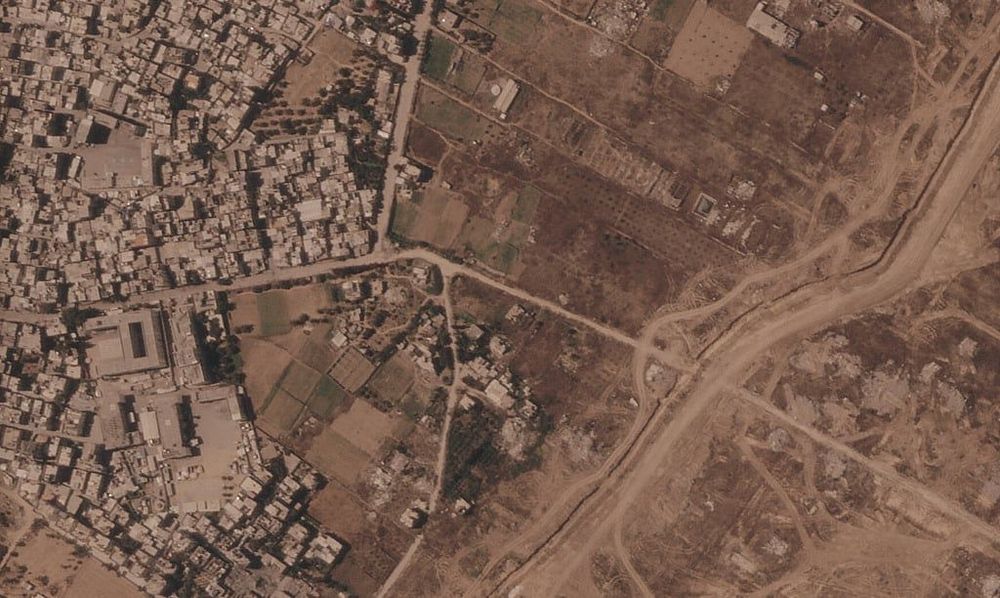
More than 23 kilometers of berms have been erected in recent months, carving through demolished Palestinian communities and separating Israeli-controlled areas from the densely packed coastal zone where over 2 million Palestinians remain crowded into tent camps. The barrier now extends across more than half the length of the Gaza Strip, which measures approximately 41 kilometers from north to south.
When presented with satellite images from Planet Labs PBC, the Israeli military confirmed it has constructed a physical barrier along the so-called yellow line, the boundary established under the October 2025 ceasefire agreement signed in Sharm el-Sheikh, Egypt. That agreement, mediated by the United States, Egypt, Qatar and Turkey, was based on President Donald Trump's 20-point peace plan and envisioned the line as a temporary division pending full Israeli withdrawal.
Military describes 'security zone' along barrier
The military told The Associated Press it has developed a "security zone" around the barrier, equipped with intelligence and technological assets to prevent infiltration and protect Israeli troops and nearby Israeli communities. It declined to specify how far the barrier system would extend or provide details about its planned route.
IDF Chief of Staff Lt. Gen. Eyal Zamir described the yellow line as "a new border line" during a visit to Gaza in December 2025, stating it serves as "a forward defensive line for the communities and an offensive line." His characterization underscored Palestinian fears that what was presented as a temporary ceasefire boundary is hardening into a permanent partition.
According to analysis by the research group T-Politography, the yellow line places approximately 57.8 percent of Gaza under direct Israeli control, including 68.3 percent of Khan Younis Governorate, 62.9 percent of Rafah Governorate and 64.3 percent of Gaza City Governorate. The division has effectively split one of the world's most densely populated territories, with pre-war population density reaching approximately 6,000 people per square kilometer across Gaza's 365 square kilometers.
Rapid construction extends barrier network
Construction of the berm network has accelerated in recent weeks. A portion in southern Gaza extended by more than 2 kilometers in just two weeks this month, satellite images show. The barrier measured about 500 meters on July 1 but reached approximately 2.4 kilometers by July 15, separating the Israeli-controlled ruins of Rafah from Muwasi, where some of Gaza's largest displaced persons camps are located.
If construction continues in its current direction, this southern section will connect with the longest stretch of barrier, which runs nearly unbroken for around 17 kilometers from Khan Younis northward toward Gaza City. That section began construction in February, with more than a kilometer added between June 21 and July 7 alone, running close to an Israeli military base built on the ruins of the town of Bani Suheila.
In northern Gaza, several disconnected stretches of berms run outside the largely demolished town of Beit Lahia. The exact height of the barriers remains unclear, and in some locations the berms appear to extend beyond the yellow line itself.
Widespread demolition on Israeli-controlled side
Satellite imagery shows Israeli forces have demolished the vast majority of buildings on their side of the yellow line using bulldozers and explosives, virtually erasing several towns including Rafah, which previously housed more than 250,000 people. The military has carved new road networks through the ruins and established military bases on the sites of former Palestinian communities. The military says it is destroying infrastructure used by Hamas.
West of the yellow line, Gaza's entire population has been compressed into the coastal area, with most residents living in squalid tent camps and dependent on humanitarian aid for survival.
The military said it is working to clearly mark the yellow line route "to reduce friction and prevent harm to uninvolved individuals." However, Israeli forces have killed Palestinians who approached or crossed the line. While the military says it fires on those believed to be militants threatening troops, victims have included children and other civilians apparently unaware of the boundary's location. Some soldiers have reported they do not always know who they are firing on and have orders to shoot anyone crossing the boundary.
Over 1,100 killed since ceasefire began
Israeli forces have killed more than 1,100 Palestinians since the ceasefire took effect on October 10, 2025, most in airstrikes and drone strikes throughout Gaza. Militant attacks have killed five Israeli soldiers in the same period. According to UN monitoring, between October 10, 2025 and April 14, 2026, Israeli forces shot at civilians 921 times, raided residential areas beyond the yellow line 97 times, bombed and shelled Gaza 1,109 times, and demolished properties on 273 occasions.
Early Tuesday, an Israeli strike in Gaza City killed Firas Al Masri, his wife and their four children, ages 6 to 13, according to Shifa Hospital. The military said only that it conducted a strike on Hamas militants in the area at that time.
Ahmad Al Masri, Firas' brother who lives nearby, said he heard the children calling out at the moment of the blast. "They were calling out to me, 'Uncle! Uncle!'" he said. "But the fire was raging, and we couldn't do anything."
Ceasefire implementation stalled for months
Under the ceasefire agreement, Israel is eventually supposed to withdraw its troops to the very edges of Gaza, to be replaced by an International Stabilization Force authorized by UN Security Council Resolution 2803, adopted in November 2025 with 13 votes in favor and two abstentions. The force would train vetted Palestinian police and work with Jordan and Egypt, with Israeli withdrawal linked to agreed milestones and demilitarization timelines. However, implementation has stalled for months.
Hamas released all 20 remaining living Israeli captives along with the remains of 25 deceased hostages on October 13, 2025, in exchange for approximately 250 Palestinians serving long sentences and 1,700 Palestinians detained since October 7, 2023. Israel confirmed all hostages and remains were returned by January 26, 2026.
A former UN diplomat now coordinating the ceasefire has blamed Hamas' failure to disarm for the stalled implementation. Sporadic talks to reach a formula for decommissioning Hamas weapons appear to have made little progress, and Hamas accuses Israel of violating the ceasefire terms.
Trump's Board of Peace, chaired by the president himself with executive members including Secretary of State Marco Rubio, former UK Prime Minister Tony Blair, Trump's son-in-law Jared Kushner and others, was established to oversee Gaza's transition. However, the World Bank estimates reconstruction will cost more than $70 billion, while the Board had collected only hundreds of millions of dollars as of May 2026, far short of the $17 billion initially pledged. Neither US Central Command, which monitors the ceasefire, nor the Board of Peace commented on the barrier construction.
War's origins and toll
The conflict began after Hamas-led militants attacked Israeli communities on October 7, 2023, killing around 1,200 people, mostly civilians, and taking 251 others hostage. Israel responded with a military offensive that has killed more than 73,000 people, according to the Gaza Health Ministry, which was part of the recently dissolved Hamas-run government.
The ministry maintains detailed records viewed as generally reliable by UN agencies and international organizations. It does not distinguish between civilians and militants but says women and children make up around half of all fatalities.