India joins US-led global alliance to shape next-generation 6G telecommunications networks
India has become the 26th nation to join a US-led initiative coordinating government strategies for 6G technology development, following bilateral talks at the G20 Innovation Ministers' meeting in North Carolina.
 Sara Khan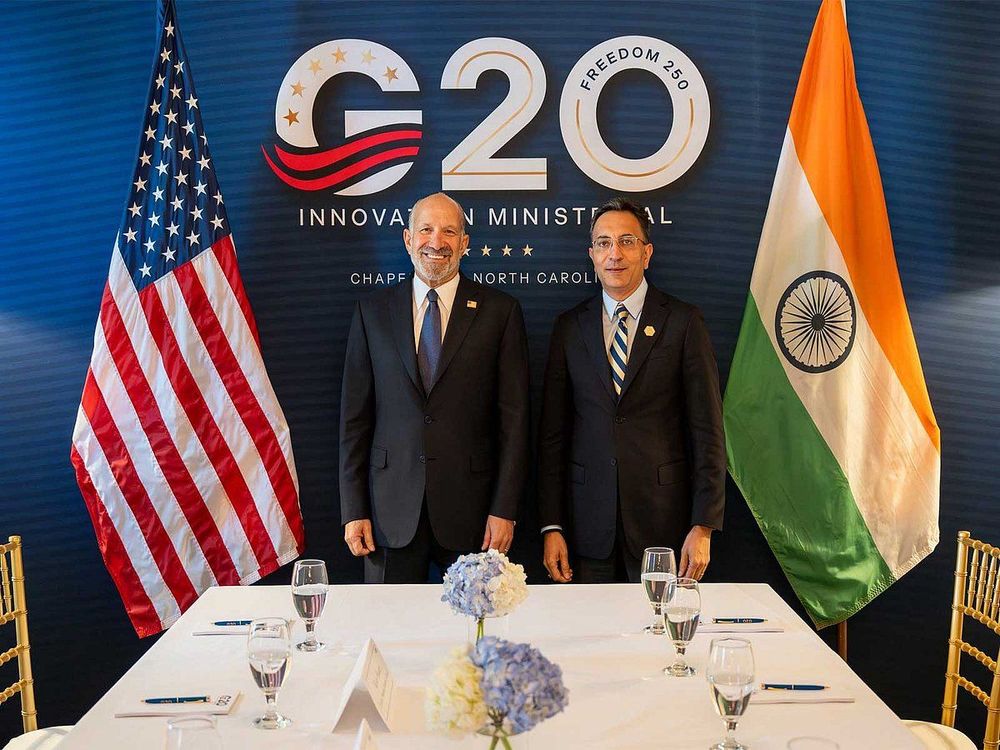
India joins US-led global alliance to shape next-generation 6G telecommunications networks
India has joined a United States-led global initiative to guide the development and deployment of next-generation 6G telecommunications networks, the US Department of Commerce announced on Monday. The agreement makes India the 26th member of an alliance originally formed in late July 2026 by the National Telecommunications and Information Administration (NTIA), which already included South Korea, the United Kingdom, Germany, Japan, Australia, and Canada.
The announcement followed a bilateral meeting between US Commerce Secretary Howard Lutnick and Union Minister of State for Commerce and Industry Jitin Prasada on the sidelines of the G20 Innovation Ministerial held on September 1-2 in Chapel Hill, North Carolina.
"Secretary Lutnick met with Indian Minister of State for Commerce Jitin Prasada on the sidelines of the G20 Innovation Ministerial to discuss the future of 6G. Today, we are pleased to announce that India has joined the U.S. and 24 other countries in the effort to ensure that next generation networks reflect our shared security interests, strengthen our competitiveness, and drive innovation in 6G."
The alliance aims to coordinate governments' strategies, share technical resources, and lay groundwork for commercial deployment of 6G technology, which is expected to begin replacing 5G networks in the 2030s. Unlike previous generations of mobile networks that focused primarily on faster connectivity, 6G is expected to integrate artificial intelligence, sensing and computing capabilities, with networks designed to be AI-native from the outset.
Strategic technology cooperation
During the bilateral discussion, Lutnick and Prasada exchanged views on strengthening cooperation across semiconductors, artificial intelligence, and data centers. The Indian minister encouraged the possibility of increased US investments in India's Semiconductor Mission 2.0 (ISM 2.0), which was approved by the Union Cabinet in July 2026 with a fiscal outlay of ₹1,27,500 crore (approximately $15.3 billion), significantly expanding from ISM 1.0's ₹76,000 crore outlay.
Under the earlier ISM 1.0 program, twelve semiconductor manufacturing units were approved with cumulative investment of over ₹1.64 lakh crore, including silicon fabs, silicon carbide fabs, and packaging units across six states.
"Semiconductors. AI. Data centres. These are critical building blocks of the emerging digital economy. In my bilateral discussion with Mr. Howard Lutnick, US Secretary of Commerce, we exchanged views on strengthening cooperation across these areas and advancing technology-led opportunities between India and the United States."
Prasada also proposed strengthening AI technology partnership and shared a mechanism for safeguards for AI during the discussions. Lutnick, who was confirmed as the 41st United States Secretary of Commerce on February 18, 2025, by a 51-45 Senate vote, has made technology cooperation a priority.
High-profile innovation summit
The G20 Innovation Ministers' meeting was hosted by the US Department of Commerce and the White House Office of Science and Technology Policy. The event featured fireside chats with prominent technology leaders including OpenAI CEO Sam Altman and Nvidia CEO Jensen Huang, with virtual participation by Elon Musk, underscoring the high-profile nature of the gathering.
Prasada led the Indian delegation to the ministerial, accompanied by Ajit Kumar, Joint Secretary at the Ministry of Electronics and Information Technology (MeitY), and senior officials from MeitY, the Department of Science and Technology, and the Department for Promotion of Industry and Internal Trade, as well as officials from the Embassy of India in the United States.
At the conclusion of the ministerial, G20 ministers released a joint statement recognizing that "emerging technologies have the potential to unlock prosperity, enhance productivity, and expand opportunity for all our peoples."
The 3rd Generation Partnership Project (3GPP), the global body responsible for mobile network standards, initiated 6G standardization work in 2023 and plans to start development of 6G technology specifications in mid-2025, with commercial deployment targeted around 2030. The timing of alliance formation reflects countries' desire to shape 6G standards before they are finalized.
The engagements during the visit underscored India's growing role in shaping the global technology and innovation agenda and reaffirmed its commitment to building strategic partnerships that translate advances in AI, semiconductors, digital public infrastructure, robotics and other emerging technologies into greater opportunities for innovation, economic growth and improved quality of life for its citizens.