Crude oil breaks below $80 as Economies.com sees further downside risk
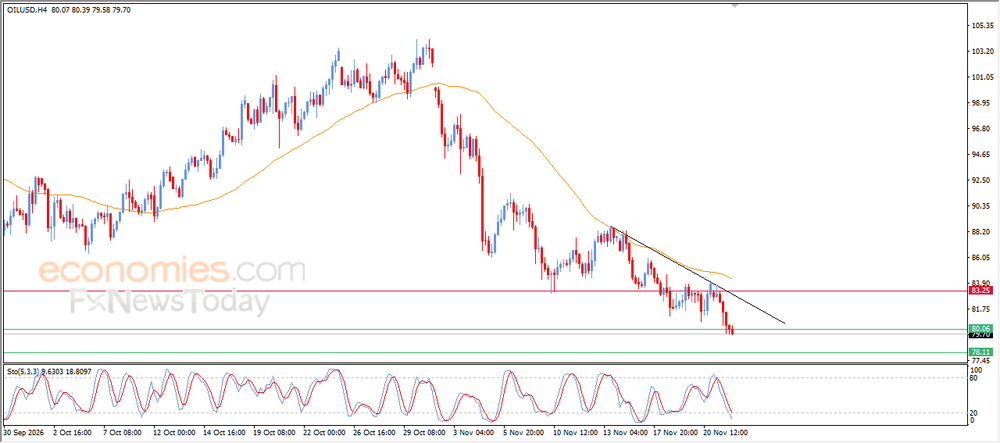
Crude oil fell through the $80 support level in intraday trading, reaching beyond Economies.com's earlier downside target. In its November 24 analysis, the site said technical indicators continued to favor a short-term decline despite deeply oversold conditions.
 Omar Al Nuaimi
Technical weakness and lower settlements
Economies.com based its bearish assessment partly on crude trading below the EMA50 exponential moving average and following a minor downward trend line. It also pointed to negative signals from relative strength indicators, saying they suggested the possibility of further near-term losses even after prices had become deeply oversold.
Settlement figures also showed the recent weakness. In the session covered by Investing.com via Yahoo Finance on November 22-23, 2026, U.S. West Texas Intermediate crude finished at $79.17 a barrel, its first close below $80 since August 7. January Brent settled at $86.78, the lowest since August 26. Brent had lost 4% over the preceding week, while WTI had lost 5%.
The decline followed Brent's settlement near $118 a barrel on October 30, its highest since April. By November 20, its loss for the month was nearly 20%, according to Trading Economics data cited by Admirals.
IEA forecasts a return to surplus
The International Energy Agency reversed its earlier forecast for a fourth-quarter supply deficit in its November 13, 2026, Oil Market Report. The agency now expected supply to exceed demand in the final quarter of 2026 for the first time since the war in Iran began.
The IEA estimated fourth-quarter supply at about 105 million barrels per day, exceeding projected demand by 1.7 million barrels per day. Separately, OPEC figures reported by Reuters put OPEC+ crude production in October at 41.23 million barrels per day. That was about 2.04 million barrels per day above September output and represented 97% of February's pre-war volume.
Price forecasts and disruption risks
Mid-November forecasts offered different paths for Brent. Goldman Sachs' November 15 forecast called for a 2027 average of $88 a barrel, with prices easing to $78 by December 2027. In its November 10 projection, the EIA put Brent near $100 in November and December 2026 and at an average of $86 in 2027. Morgan Stanley's November 16 forecast put the 2027 average at $86.30.
UBS strategist Giovanni Staunovo argued in a research note that prices should recover. He pointed to visible inventories that remained far below pre-war levels, the completion of most emergency stock releases and a substantial reduction in speculative positioning. In his assessment, those conditions left little cushion against another supply disruption.
Security risks persisted in late November even as prices declined. Yemen's Iran-aligned Houthi militants claimed they had attacked a Saudi Arabian oil refinery. The UK Maritime Trade Operations Centre also reported several incidents involving commercial ships in the Gulf and near the Strait of Hormuz. U.S. President Donald Trump said he was inclined to resume strikes on Iran after the New Year if negotiations failed.
Climate talks end without a broad agreement
Separately, the COP31 climate conference in Antalya, Turkey, concluded without an overarching political agreement, the first such outcome since 2009. Talks broke down over whether the final text should explicitly call for a transition away from fossil fuels. Saudi Arabia and other major oil producers opposed including that language.
OPEC+ to set 2027 production policy
OPEC+ ministers are scheduled to meet on November 29, 2026, to determine the group's 2027 output policy, including new production baselines.
Ahead of that meeting, the seven members participating in voluntary cuts agreed on November 1 to leave required production for December at September levels, marking a third consecutive pause. Those countries are Saudi Arabia, Russia, Iraq, Kuwait, Kazakhstan, Algeria and Oman.