Venezuela restores access to censored news websites in freedom of expression move
Venezuela's telecom regulator has unblocked access to some previously censored news sites ahead of US-backed transition talks, though digital rights groups warn that nearly 200 websites remain inaccessible.
 Mariam Al Mansoori
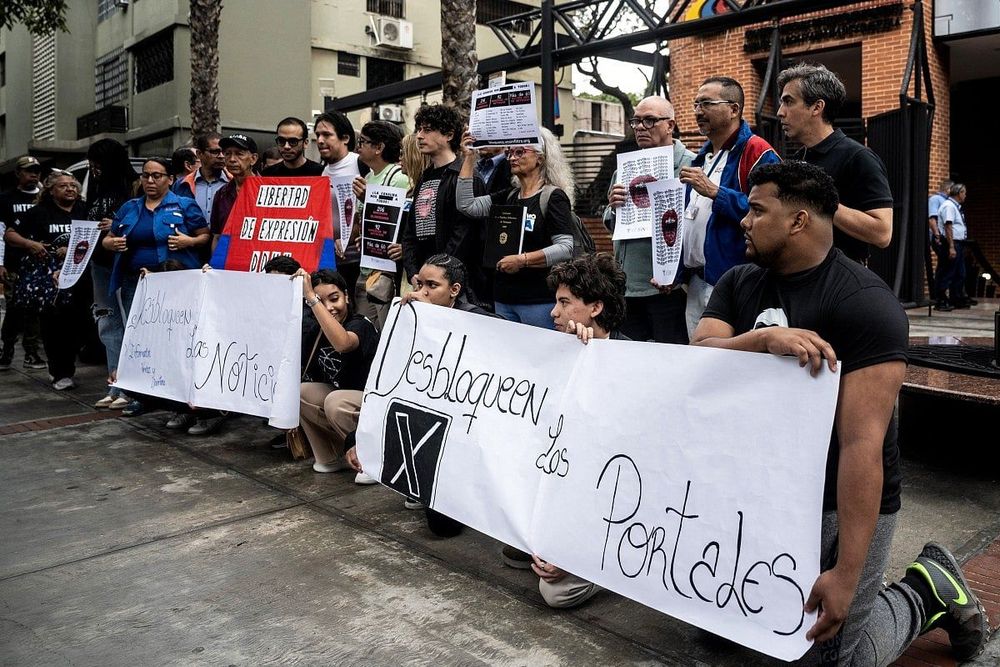
Venezuela's telecommunications regulator announced Thursday the restoration of access to several news websites that had been blocked for years, marking the first public acknowledgment of media censorship since 2015 when authorities admitted blocking 1,060 web pages.
The decision by CONATEL comes as the country prepares for the second round of US-backed political transition talks in Caracas, with freedom of expression among the key topics under discussion. The talks aim to rebuild democratic institutions, strengthen the electorate, and guarantee political participation, with observers hoping for a calendar toward new elections.
Former president Nicolas Maduro, who was captured by US forces on January 3, 2026, and transported to New York to face charges including narco-terrorism and drug trafficking, had overseen the censorship of hundreds of websites during his administration. He was replaced two days later by Delcy Rodriguez, who became Venezuela's first woman to perform presidential duties after serving as vice president since 2018.
Access restored to 17 news sites
CONATEL announced the "formal restoration of access to various national and international digital platforms and media outlets." Venezuela Sin Filtro, a digital rights organization that monitors internet censorship using technical criteria, verified that access had been restored to 17 news sites through several internet service providers. The organization's work has been cited by major international outlets including The Washington Post and Time.
However, at least 188 websites remain blocked, including 79 news outlets, according to Venezuela Sin Filtro. More than 200 domains were blocked between July 2024 and January 2025 alone. Since 2017, Freedom House has classified Venezuela as "not free" in its Freedom on the Net report, making it the second country in the region after Cuba to receive this designation.
Government and the censorship system
Deputy communications minister Gustavo Villapol said the decision aimed to end polarization, stating on state television:
"We can never again vilify people without having proof in hand; we cannot use communication for interests that are external to the vital meaning of our nation."
The censorship system operated through CONATEL's ability to order website blocks without due process, requiring internet service providers to comply within 24 hours or face sanctions including potential loss of their concessions.
Reactions from media and opposition
Luis Ernesto Blanco, editorial director of the previously blocked site Runrunes, described the measure as an official acknowledgment that public debate had been stifled.
"They had censored them basically because they wanted to; there was no administrative ruling, no court order requiring it," he said.
Colombian news channel NTN24, which was taken off the air in 2014 during Venezuelan protests for allegedly "promoting violence," confirmed its content was visible again but later reported intermittent access, as did other outlets.
Dinorah Figuera, head of the opposition delegation to the transition talks, called the decision "a first step," writing on X:
"Many outlets are still missing, and they all have to come back, fully and permanently."
Victor Amaya, whose online outlet TalCual was blocked in July 2024, expressed skepticism about whether all censored sites would become accessible.
"Hopefully it doesn't turn out like it does with some releases from prison, where they announce 100, but 60 are confirmed, 70 are confirmed," he told AFP via WhatsApp, referring to Rodriguez's promise to release political prisoners.
Amaya said TalCual had lost 60 percent of its traffic and significant advertising income due to the blockage.
"We've managed to hold on, we've managed to improvise, and we've made it this far alive," he said, hoping for "a normalised communication environment."
Election promises and internet access
The unblocking comes as Rodriguez recently told the UN General Assembly on September 23 that Venezuela would hold elections as part of a transition to "full democracy," though she did not provide a specific date, stating that national institutions are being prepared for the electoral process. Venezuela has one of the lowest internet penetration rates in Latin America, ranking fifth in the region below the average of 76.64 percent.