France's Halloween protests draw 320,000 as isolated clashes break out
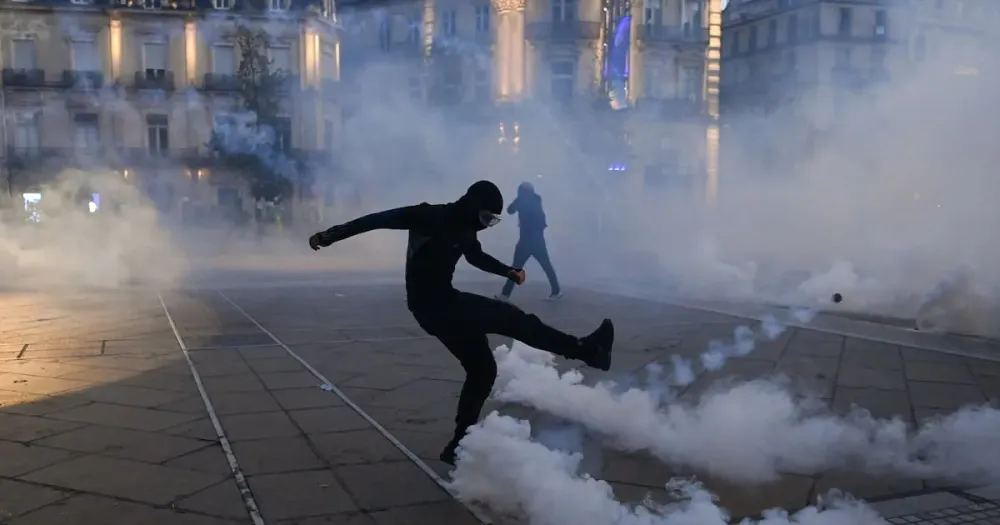
Demonstrators protesting rising living costs and strained public services marched across France on October 31 under heavy police security. The rallies remained largely peaceful through the afternoon, though clashes broke out in Paris and several other cities, and attendance fell for a second consecutive Saturday.
 Mariam Al Mansoori
Lower turnout under tighter security
The interior ministry counted 320,000 demonstrators nationwide, with 70,000 in Paris. A week earlier, 410,000 people had taken part; on October 17, the figure was 550,000.
About 70,000 police and gendarmes were deployed nationwide, according to PBS NewsHour, citing the Associated Press. In Paris, authorities moved the march to boulevards along the city's eastern edge, keeping it away from central shopping areas. Unions had challenged a ban on marching between Nation and Bastille, but France's top administrative court upheld it.
The interior ministry said security forces stopped "radical elements" from leaving marches to damage property and loot in Bordeaux, Toulouse, Lyon and Marseille. Officers conducting checks on roads and at railway stations also found people carrying objects that could serve as weapons, the ministry said.
Paris police imposed overnight restrictions at Place de la République and Les Halles, barring entry from 11 p.m. to 6 a.m. on Saturday and Sunday. Unaccompanied minors faced a separate 9 p.m. curfew around the Champs-Élysées, PBS NewsHour reported. A Paris court had suspended an earlier curfew for minors, ruling that it unlawfully infringed on freedom of movement.
Interior Minister Laurent Nunez warned against a repeat of the October 17 violence. Authorities said Halloween masks could conceal the identities of people causing trouble, and Nunez noted that police can prohibit face coverings when public order is threatened. The US embassy advised travelers to stay away from planned demonstrations and large gatherings.
A student movement draws wider support
Students began mobilizing in September over deteriorating schools, crowded classrooms and a university admissions system widely regarded as unfair. The movement gained momentum late that month as Macron's minority government began negotiations over the 2027 budget.
Trade unions and a smaller Yellow Vest contingent have joined the marches, broadening the demands to include relief from high fuel prices, inflation and other living costs. Government pledges to improve education and ease fuel costs have not quieted the protests.
"The French economy is doing badly no matter what happens, because today we're being run by a group of incompetents who juggle billions, while families are struggling with a few cents," protester Jerome Rodriguez said at the Paris march. He said demonstrators would keep pressing their demands in hopes of a response, "although that seems very unlikely".
The French movement has inspired youth-led "Gen-Z" demonstrations elsewhere in Europe. Several German cities held protests on Saturday, and demonstrations also took place in Italy.
The toll of earlier unrest
Security forces were caught off guard when the October 17 protests descended into riots and looting, damaging shops, businesses and public buildings. Almost 2,400 people were arrested and nearly 1,000 police officers and gendarmes were injured, according to interior ministry figures reported by CNBC. A protester died of cardiac arrest during the Paris demonstrations. In Limoges, an arson attack largely destroyed the 143-year-old town hall.
Retailers' losses now exceed €1 billion ($1.1 billion), the Chamber of Commerce estimates. Other estimates reach twice that amount when uninsured damage and lost revenue are counted. Hermès, Louis Vuitton and Burberry outlets were among the stores targeted during earlier unrest. On major Paris shopping boulevards, early Christmas lights hang around windows covered with boards or protected by security grilles.
Budget pressure as the economy contracts
The protests coincide with worsening economic figures and pressure on the government's finances. Insee reported on October 30 that GDP contracted 0.1% in the third quarter of 2026. Output had been flat in the second quarter after a 0.2% decline in the first.
That same day, Fitch Ratings left France's long-term sovereign rating at "A+" but changed its outlook from stable to negative. The unscheduled review reflected weaker growth, higher borrowing costs and a larger deficit than in its August 2026 assessment. Fitch said "the persistence of political fragmentation" and "a difficult social climate" involving mass protests "further complicate the implementation of a lasting fiscal consolidation".
With public debt approaching 120% of economic output and borrowing costs increasing, Macron's government faces pressure to reduce spending, constraining its options. Prime Minister Sébastien Lecornu's minority government is pursuing €54 billion ($61 billion) in savings through its 2027 budget to bring down the deficit, according to CNBC.
The unrest has also strengthened far-right leader Marine Le Pen politically. She leads opinion polls ahead of April's presidential election, while potential centrist successors to Macron remain divided.