Sonia Gandhi's memoir revisits family conflicts, her 2004 decision and India's political history
Sonia Gandhi's memoir, Belonging: A Journey of Love, was released worldwide on November 10, 2026, recounting the fears behind her refusal to become India's prime minister, disputes within the Gandhi family and her experiences of loss. Her accounts of some of India's most contentious political events have already drawn criticism from the BJP.
 Mariam Al Mansoori
The decision not to become prime minister
In excerpts reported by IANS, ANI and Times of India, Gandhi describes how Congress's unexpected election victory in 2004 brought pressure from alliance leaders for her to become prime minister. Her children, Rahul and Priyanka, opposed the prospect: after the assassinations of their grandmother Indira Gandhi and father Rajiv Gandhi, they feared their mother could meet the same fate.
When she appeared ready to accept the position, the two confronted her. "Both of them came striding towards me with perturbed expressions on their faces," she writes. She describes her children as her protectors after Rajiv's assassination and says she ultimately declined the post because her inner voice would not permit her to accept it.
Gandhi instead chose Manmohan Singh from among several possible senior Congress candidates. Her account emphasizes his economic expertise, integrity and administrative experience, as well as his lack of ties to any one party faction. "I knew that our beloved country would be safe in his hands," she writes. Singh was initially reluctant but agreed to take the job, beginning a decade of Congress-led rule under the United Progressive Alliance.
Her children's fears echoed her own earlier objections to Rajiv's political career. "Two decades earlier, I had begged Rajiv not to enter politics, not to throw himself and all of us into that menacing world," she writes. But she did not oppose Rahul's decision to run from Amethi in 2004, saying his interest in politics was longstanding and that he understood the risks. "This time I did not resist it."
Living with Indira Gandhi
The memoir also looks back at Gandhi's early years as Rajiv's wife, when she found her mother-in-law's temper frightening. Times of India reports her recollection of Indira ordering a staff member to stand in a corner after repeatedly forgetting an appointment. In another episode, Sonia encountered a senior Congress politician standing still and facing a wall, apparently as punishment.
Indira sometimes expressed anger by refusing to speak to people for days or by pushing away her dinner plate. "But until I got to know her well, I'd quake in my seat," Sonia writes. Rajiv assured her that the anger would soon subside. In Sonia's telling, Indira usually regretted these episodes, but seldom forgave people she felt had betrayed her.
The book recounts a separate conflict between Indira and her younger daughter-in-law, Maneka Gandhi, after Sanjay Gandhi died in 1980. Sonia says Maneka sought a political role, while Indira thought she was too young and should devote her attention to her infant son, Varun. Their worsening relationship ended with Maneka leaving the family home.
According to Sonia's account, Indira's repeated inability to see her grandson led to legal proceedings. Sonia says that when she took birthday presents to Varun's nursery school, Maneka accused her of attempting to kidnap him. This is Sonia's account of the family dispute.
Gandhi also recalls accompanying her bleeding mother-in-law to the hospital after Indira was shot by her own security guards on October 31, 1984. Later that day, Rajiv told her he had been asked to become prime minister. When she pleaded with him to turn it down, she recalls his reply: "They will kill me anyway."
Contested memories of the Emergency and communal violence
Gandhi calls Indira's imposition of the Emergency in June 1975 a mistake, according to India Today. She recalls Rajiv opposing the decision while Sanjay encouraged their mother toward confrontation. In her assessment, "keeping Sanjay in check could have prevented much of the damage that followed."
Her account of Operation Blue Star describes watching Indira view footage of the aftermath of the 1984 military operation at Amritsar's Golden Temple. Sonia says she saw tears on Indira's face and understood them as pain and regret at the deaths and destruction. Political opponents have challenged whether that recollection demonstrates genuine remorse.
The memoir also describes Sonia weeping as she watched the Babri Masjid demolition on television on December 6, 1992. She writes of "a long battle" to defend the secular ideals of Mahatma Gandhi, Jawaharlal Nehru and the freedom movement. BJP spokesperson Sudhanshu Trivedi responded by accusing Congress of continuing to identify with Babur.
BJP spokesperson C.R. Kesavan separately accused Gandhi of sanitizing the Nehru-Gandhi family's history and suggested Whitewashing as an alternative title for the book. His criticism focused on her treatment of the Emergency, Operation Blue Star and the 1984 anti-Sikh violence.
Limited exchanges with Modi
Gandhi says she and Prime Minister Narendra Modi have had little conversation despite attending official events together over many years. She describes his greeting as a formal namaste, usually without sustained eye contact. "He tends to look away, avoiding eye contact," she writes.
She contrasts those encounters with the cordial relations she recalls between political adversaries in earlier decades. Her account also acknowledges that Modi has sometimes asked about her health after hospital treatment and that they have exchanged formal greetings.
Marriage, citizenship and private loss
Alongside political recollections, the memoir describes Gandhi's adjustment to life in India. Excerpts reported by The New Indian Express recall tandoori chicken as one of the first dishes she tried: its red color, slight charring and mouth-burning heat stayed in her memory.
She admired the sari as one of the world's most elegant garments but struggled to wear it. For her engagement, she selected one in jade green and pale yellow. Her wedding sari was woven from yarn Jawaharlal Nehru had spun in prison during the freedom struggle.
Gandhi writes that she relinquished Italian citizenship and became an Indian citizen in 1983, completing the formalities at the Italian ambassador's residence. She connects the decision to a life increasingly centered in India, particularly after Rajiv entered public life.
The book also discloses her breast cancer diagnosis and the family's choice to keep her treatment away from media attention, Moneycontrol reports. She recalls traveling to Milan, Italy, for surgery by the renowned Italian surgeon Dr. Umberto Veronesi. She also writes about losing her first child.
Recollections of international figures
Gandhi's memories of international figures include former US President Bill Clinton's visit to India in 2000. She says he repeatedly glanced at women during a reception and described Kashmir as one of the world's most dangerous places. The memoir also covers former French President Nicolas Sarkozy's 2008 visit.
She recalls first seeing Princess Diana at Diana's 1981 wedding to Prince Charles and meeting her again during the princess's visit to India in 1992.
Publication and family dedication
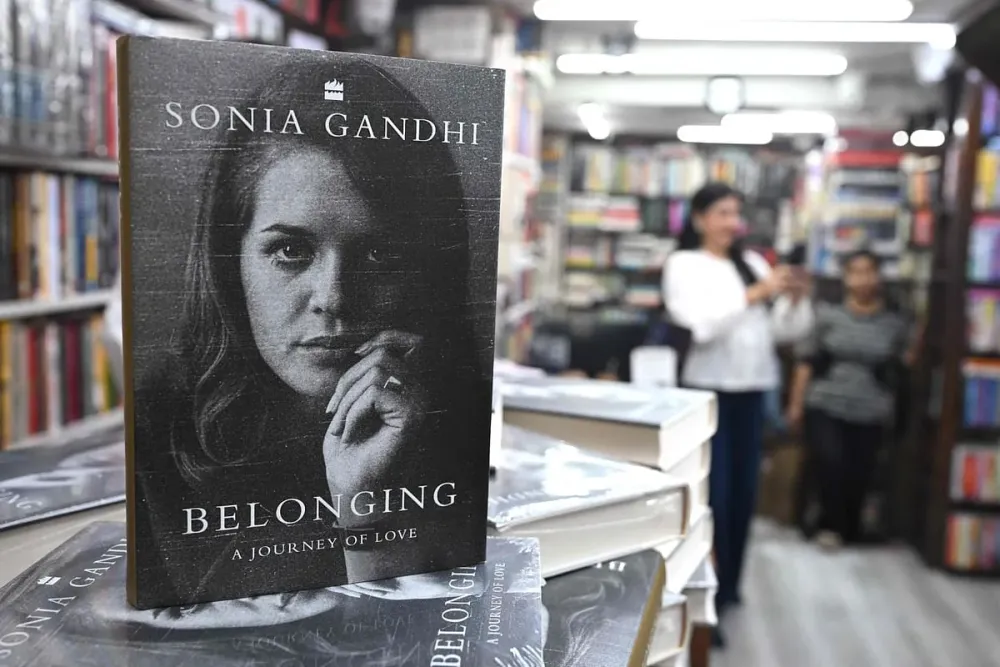
Gandhi, 79 and known for guarding her privacy, describes a life shaped by "love, duty, loss and finding a place to belong". HarperCollins India publishes the 544-page hardcover at a list price of ₹1,299; Alfred A. Knopf publishes the US edition.
According to The Sunday Guardian, the seven-chapter memoir arrived in Indian bookstores on November 10 without a formal launch event. Its cover photograph was reportedly taken by Rajiv in 1966. The book opens with verses from the Rigveda and is dedicated to Gandhi's children, Rahul and Priyanka, and grandchildren, Raihan and Miraya.