Iran unveils dual missile launcher as Trump puts off strike decision until 2027
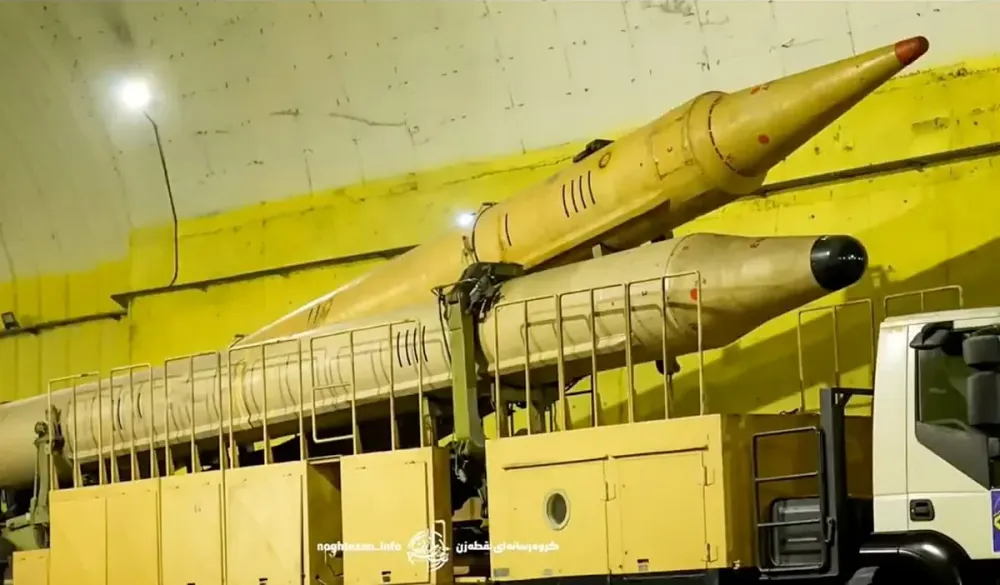
Iran's Revolutionary Guards have displayed an underground launcher that state television says can fire two liquid-propellant missiles at once. Its performance remains independently unverified, and the display appeared intended as a warning to Washington as President Donald Trump considers renewed strikes against Iran.
 Mariam Al Mansoori
The launcher and its claimed capabilities
IRGC commander Ahmad Vahidi and aerospace chief Seyed Majid Mousavi inspected the launcher and a newly unveiled missile base, according to state news agency IRIB. State television described the presentation as the launcher's first public appearance.
The footage depicted a tunnel network extending for kilometers, with hundreds of missiles and launchers, including dual-launch systems. Iranian reports described the weapons stored there as upgraded, new-generation missiles offering greater range and precision, with Iranian-developed guidance that does not depend on GPS.
Those reports did not identify the missile model. Neither the claimed range and accuracy nor the ability to operate without GPS has been independently assessed. The Independent reported that the launcher appeared to build on an earlier system capable of launching two solid-fuel missiles.
Liquid propellant offers greater efficiency and allows adjustments to a missile's speed and trajectory. But analyst Eva Renon cautioned that the launcher does not necessarily increase Iran's overall missile capability, according to The Telegraph. She noted that liquid-fueled weapons can require hours of preparation and had performed poorly in previous attacks.
Trump's decision moves into the new year
The display comes after Trump pushed back the timetable for deciding whether to strike Iran again. On November 19, 2026, he told Reuters, "I'll talk to you about it after the beginning of the year," and told Fox News, "We'll see what happens after January 1." He had previously linked that decision to the November 2026 U.S. midterm elections.
Rob Geist Pinfold, a lecturer in international security at King's College London, told Al Jazeera that sweeping Republican losses in the midterms had left Iran "more emboldened than ever" to assert its military capabilities. In his assessment, Trump "looks more like the boy who cried wolf."
Iran links the display to a broader doctrine
Vahidi described what was happening to Iran's enemies as "merely the beginning." Mousavi said the aerospace division had expanded its capabilities between the two wars, producing "surprising and highly effective products designed to intimidate and deter."
State television framed the missile-city inspection as an implementation of Supreme Leader Mojtaba Khamenei's October 31, 2026, directive. It said a "new defensive doctrine" had taken effect under his order to meet threats of any scale or type with an "immediate and effective response without geographical restrictions."
Iran had also announced a change to its declared missile-range policy days before a separate base unveiling on November 10. IRGC spokesman Hossein Mohebbi said the force had dropped its self-imposed 2,000-kilometer ceiling for ballistic missiles: "That restriction has been lifted for us." He gave no replacement limit and did not say whether Iran had weapons able to exceed the old one.
Earlier bases and underground production
The November 10 facility housed ballistic and cruise missiles using solid and liquid fuels. World Israel News reported that footage from that unveiling showed some of Iran's most powerful systems, including the long-range Khorramshahr and the Fattah, which Iran describes as hypersonic.
Iran has publicized underground missile facilities for more than a decade. In October 2015, then-IRGC Aerospace Force commander Amir Ali Hajizadeh released the first public video from one of the sites. He said Iran had built bases 500 meters underground in all of the country's provinces and cities.
The IRGC says it has also relocated missile and drone production underground to keep manufacturing through bombardment. That claim has not been independently verified. U.S.-Israeli attacks targeted Iran's missile capabilities during the heaviest phase of the war, but the scale of the damage remains unclear.
The latest display leaves key questions unresolved: whether independent imagery or analysts can substantiate the system's capabilities, whether it will be tested or used in combat, and whether Washington will authorize further strikes.