British MPs seek stronger airbase defenses after US aircraft withdrawals
British lawmakers are pressing for more hardened aircraft shelters after reported Iranian threats led the US to withdraw bombers and refueling tankers from two UK bases. An urgent question in Parliament also raised concerns about aircraft parked in the open and the safety of American personnel living off base.
 Mariam Al Mansoori
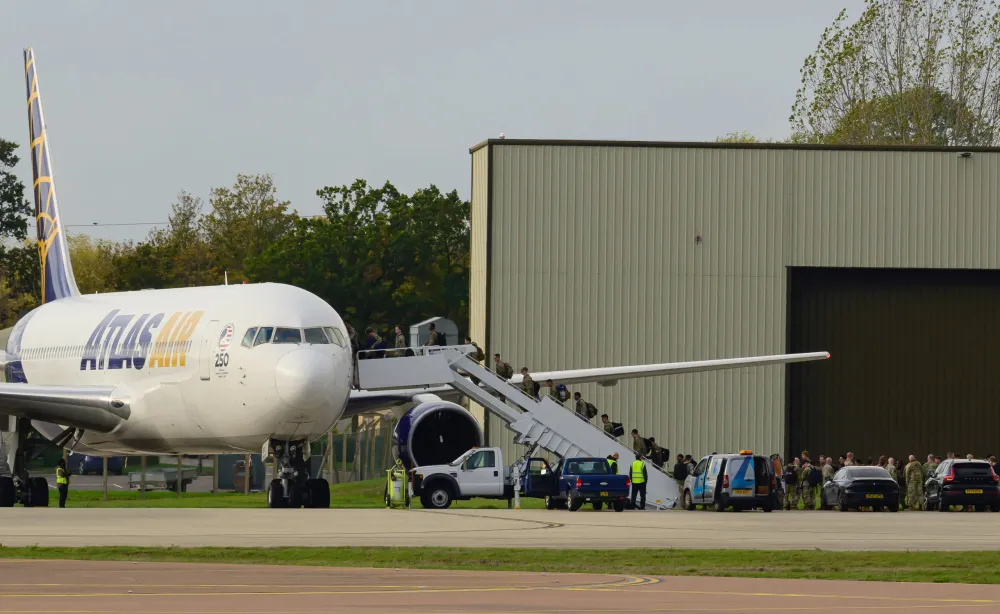
Withdrawals and heightened security
US bombers left RAF Fairford in Gloucestershire in September following reports of a plot to attack the base with drones. Two men have been charged under the National Security Act. This week, all US aerial-refueling tankers departed RAF Mildenhall in Suffolk after another reported Iranian threat.
The departures, amid apparent threats from Iran and Russia, have brought airbase protection under parliamentary scrutiny. They follow last year's break-in at RAF Brize Norton in Oxfordshire, where members of Palestine Action caused £7 million ($9.4 million) in damage to aircraft.
LBC reported that hardline Iranian outlet Hamshahri News published a front-page map of Europe with red pinpoints and a headline saying they would see what happens. Persian text below the map named RAF Fairford, RAF Mildenhall and RAF Lakenheath, all of which are used by the US Air Force.
Security at Mildenhall and Lakenheath was raised to Force Protection Condition Charlie, according to LBC. It is the US Department of Defense's second-highest force-protection level and is used when intelligence indicates that terrorist action is likely.
Aircraft exposed on the ground
Conservative MP John Cooper focused on RAF Lossiemouth, describing "serried ranks" of aircraft parked outdoors at a major base for air defense and maritime surveillance. He asked whether relatively inexpensive protection, such as hardened shelters or revetments, had been considered, calling the arrangement "the Russian drone jockey's dream".
Lossiemouth hosts four Typhoon fighter squadrons and all nine of the RAF's P-8 Poseidon maritime patrol aircraft, which track Russian submarines in the North Atlantic. US Poseidons also regularly operate there and have become targets of an Iranian campaign. Defense Minister Luke Pollard said the government took security at the base "very seriously".
Only a handful of British bases have hardened aircraft shelters: steel-and-concrete structures intended to shield aircraft from bombing, chemical threats and drone attacks.
Francis Tusa, editor of Defence Eye, told The National that Cooper was "entirely correct" and described British airbases as "massively vulnerable". In his assessment, almost all lack sufficient surface-to-air missile defenses, radar coverage, RAF Regiment personnel and hardened shelters.
"They all need air defence," Tusa said. He called for additional shelters, Rapid Ranger counter-drone and air-defense systems, an RAF Regiment squadron at every base and substantially wider radar coverage.
The US defense publication War on the Rocks has raised similar concerns about American aircraft deployed overseas. It urged the Pentagon to "comprehensively harden airfields" through a "multi-year campaign of construction" both within and outside the US to address drone and missile threats.
Security reviews and planned investment
Pollard told Parliament that an airbase security review had been carried out and that "additional policing, guarding and specialist support has been deployed where required". He declined to discuss intelligence or ongoing operations.
Shadow Defense Minister Mark Francois asked what talks had been held with US partners to reassure them about the safety of their aircraft at British bases. Pollard declined to discuss any talks, citing "operational security". He also said the government was addressing concerns about US personnel living in nearby towns and the increasingly complex threats they face.
The Ministry of Defence says it is putting an additional £470 million into military-site security, covering physical protection, surveillance and counter-drone capabilities. It also says £15 million has already been invested in drone and counter-drone technology, while restricted airspace has been introduced over 44 critical defense sites.
A requirement for future hardened aircraft shelters across UK RAF bases has already been identified, ministers confirmed to Parliament in October 2026. They said shelters could also be considered as part of future infrastructure work at RAF Akrotiri in Cyprus.
Separately, the Defence Investment Plan 2026 commits £790 million over four years, through 2029/30, to protection against air, drone and missile threats to the UK homeland and overseas bases. The program includes new radar, sensors and command-and-control systems, plus investment in directed-energy weapons and counter-drone systems under Project Presagium. The RAF will lead homeland integrated air and missile defense.
Threats and competing defense proposals
Pollard described an "evolving range of threats" encompassing hostile reconnaissance, sabotage, espionage, terrorism, organized crime and malicious drone use. He also acknowledged that "we are seeing an increase in misinformation, especially online".
Another Conservative MP said the security incidents had helped create a "ludicrous image" within the US Make America Great Again movement that "somehow the United Kingdom is now a basket case when it comes to security".
The opposition Conservatives pledged on October 6, 2026, to spend up to £10 billion over ten years on an integrated air and missile defense network called "Britannia Shield" if they win the next general election. The proposal combines advanced radar, upgraded command-and-control systems and interceptor missiles with counter-drone capabilities.
The party says the network would be funded within its commitment to spend 3% of GDP on defense by 2030. Earlier in 2026, General Sir Richard Barrons told the Commons defense select committee that an entry-level "iron dome" would probably cost about £80 billion over ten years.