Dubai Approves Metro Link to Al Maktoum Airport, With Service Expected in 2031
Dubai Metro's Route 2020 will gain two stations under a Dh2 billion airport extension approved by Sheikh Hamdan bin Mohammed on November 10. The project is part of a Dh11.59 billion package that also funds community services and facilities through 2040.
 Mariam Al Mansoori
Route 2020 to reach the West Terminal
The approved extension will run 3 kilometers to the West Terminal at Al Maktoum International Airport, with service expected to start in 2031. The Roads and Transport Authority will deliver the Dh2 billion ($544.6 million) project alongside the Dubai Engineering Projects Establishment.
Sheikh Hamdan, Dubai's Crown Prince, Deputy Prime Minister and Minister of Defense, approved the plans during a meeting of Dubai's Executive Council at the UAE Government Annual Meetings 2026 in Abu Dhabi.
The new airport connection will build on Route 2020, the 15-kilometer Red Line extension between Jebel Ali Metro Station and Expo City Dubai. Sheikh Mohammed bin Rashid, Vice President and Ruler of Dubai, launched that route's operations in July 2020.
According to Arabian Business, the planned West Terminal will have seven levels and cover 800,000 square meters, with capacity for 45 million passengers annually.
Sheikh Hamdan described the Metro extension as part of an integrated transport system supporting the airport's expansion. "Al Maktoum International Airport City is one of our most significant strategic projects, reinforcing Dubai's position as a global aviation hub," he said.
Connections to other rail services
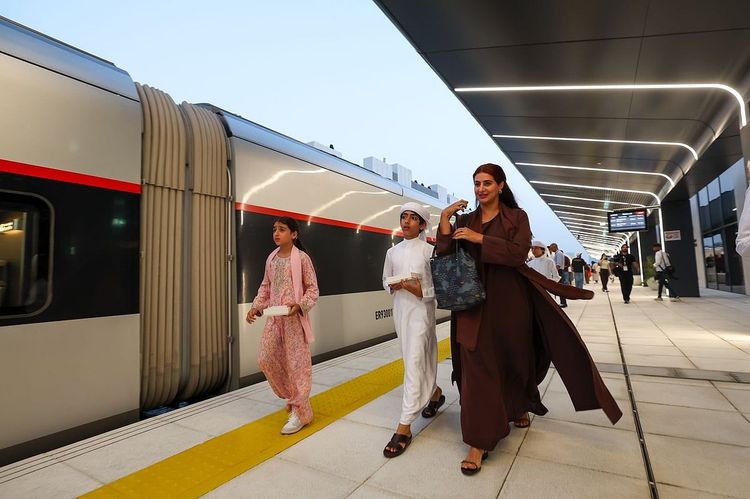
At the West Terminal, the extended Metro route will connect with the Airport Express Line and Etihad Rail's high-speed network. The links are expected to ease journeys for travelers, airport employees and visitors, while improving traffic flow on nearby roads and access to urban centers elsewhere in Dubai.
The Airport Express Line is a separate proposal, not another name for the Route 2020 extension. Gulf Construction reported in June 2026 that the planned 55-kilometer rapid transit route would connect Dubai International Airport in Al Garhoud with Al Maktoum International Airport. Its expected five stations would offer remote airline check-in, baggage drop-off and dedicated security screening.
Another separate project is the Gold Line, approved in April 2026. According to Gulf Construction, the 42-kilometer route is planned to be Dubai's first fully underground Metro line, serving 18 stations. Its target opening date is September 9, 2032.
The airport expansion and airline move
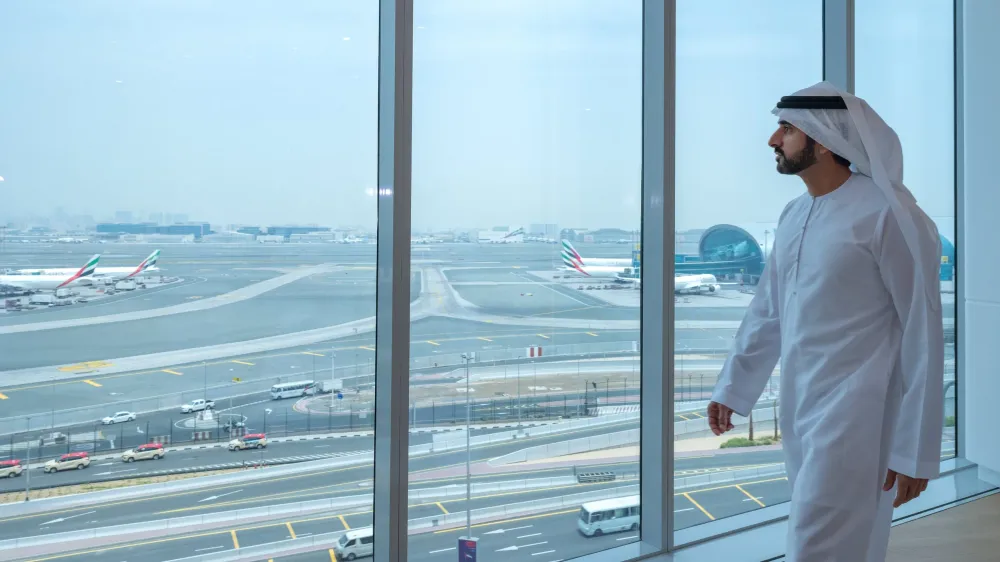
Dubai plans to move all commercial operations from Dubai International to Al Maktoum International between 2032 and 2035 as the latter becomes the emirate's main aviation hub. Also known as Dubai World Central, Al Maktoum began handling cargo on June 27, 2010, and passengers on October 27, 2013, according to Arabian Business.
The wider airport expansion received Sheikh Mohammed bin Rashid's approval in April 2024. Arabian Business puts its total cost at $35 billion (AED128 billion), with a first-phase target of 150 million passengers. The ultimate design calls for annual capacity of 260 million passengers and 12 million metric tons of cargo, with five parallel runways on a site of about 70 square kilometers.
For comparison, Dubai International handled a record 95.2 million passengers in 2025, according to Dubai Airports figures cited by Arabian Business.
Some airline operations could move before the full transfer. In September 2026, Dubai Airports CEO Paul Griffiths told Gulf News that Dubai World Central's second runway was expected to open by the end of 2027. He said flydubai would probably be the first carrier to relocate part of its operation from Dubai International, potentially moving five or six aircraft in 2027.
Community facilities and property planning
The Executive Council's approved package totals Dh11.59 billion ($3.6 billion). Alongside the Metro extension, it includes Dh9.59 billion for public services and facilities across Dubai through 2040.
That program seeks to distribute services efficiently and equitably among both established neighborhoods and planned residential communities as the city grows. Emirati residential areas will take priority. Facilities will address safety, security, health care, education and sports, with amenities for senior Emiratis and places for family and community activities.
"Our goal is for the people of Dubai to experience the benefits of the city's growth in their everyday lives," Sheikh Hamdan said.
The council also approved a Dubai Land Department study of the real estate market. Sheikh Hamdan said the sector remained strong, supported by investor confidence and a broad range of opportunities, and that the study would help shape policy and development decisions in partnership with private businesses.
The study recorded occupancy of 97% for residential properties, 98% for retail space and 94% for offices. By 2030, it forecasts the development of 365,000 homes and approximately 1.1 million square meters of office and retail space.