How your wrist keeps an automatic watch alive
Discover how a mechanical watch powers itself with every movement of your wrist, from the rotor that captures energy to the mainspring that stores it.
From pocket to wrist
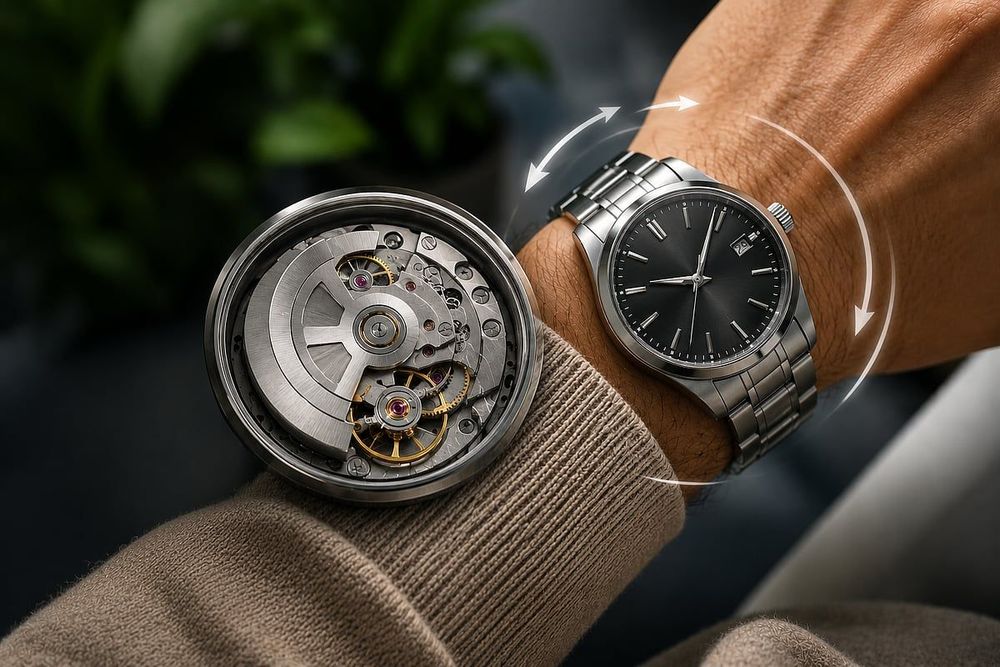
A mechanical watch can keep perfect rhythm without ever asking for a battery because it carries its own tiny power station. Hidden beneath the dial sits a coiled mainspring that stores energy, while a weighted metal rotor swings freely with everyday wrist movement. Every walk, gesture and reach helps rewind that spring. While modern quartz watches achieve accuracy to within approximately 15 seconds per month, mechanical movements typically vary by five to ten seconds per day. Yet few objects reveal engineering quite as beautifully.
The automatic mechanism concept predates wristwatches by more than a century. Swiss watchmaker Abraham-Louis Perrelet created the first self-winding pocket watch in the 1770s, a design that required about 15 minutes of walking to achieve a full wind according to the Geneva Society of Arts. The transition to wristwatches came much later. British watchmaker John Harwood developed the first practical self-winding wristwatch mechanism, filing a Swiss patent in October 1923 that was granted the following year. The Fortis Harwood automatic watch reached the market in 1926, marking the beginning of commercial production.
Refinements continued through the following decades. Rolex introduced a 360-degree winding mechanism in the Oyster Perpetual in 1931, which became the standard design for modern automatic movements. The company later acknowledged in 1956 that full credit for inventing the automatic watch belonged to Harwood. Today's bi-directional winding systems use reversing gears that wind the mainspring during both clockwise and counterclockwise rotor motions, making them far more efficient than early designs that captured energy in only one direction.
How the mechanism works
The rotor is typically made of dense metals such as gold, platinum or tungsten, with the weight concentrated on the outer periphery to increase its moment of inertia and improve winding efficiency. As it spins with wrist motion, the rotor transfers energy into the mainspring through a winding mechanism. The mainspring slowly unwinds, powering a series of gears before the escapement and balance wheel regulate the release of energy into the familiar ticking motion that drives the hands.
Most automatic watches offer a power reserve of between 36 and 48 hours when fully wound, meaning they can run for that duration without being worn or manually wound. To maximize this reserve, a self-winding watch should be worn at least eight hours a day. Most automatic watches also need to be wound manually for about 40 revolutions before they will run automatically for the first time. Modern automatics can also be wound by hand through the crown after they have stopped.
What to look for
Buyers should focus on a reliable calibre with a healthy power reserve, solid water resistance if the watch will be worn daily, and a case size that suits the wrist. Features such as hacking seconds and manual winding add convenience, while an exhibition case back lets the wearer enjoy the moving rotor. Understanding that mechanical watches trade a little precision for craftsmanship and character helps set realistic expectations.
Seiko 5 Sports Automatic
The Seiko 5 name has represented dependable automatic watches since the original Sportsmatic 5 was released in 1963 as the first Japanese automatic day-date watch. The designation refers to five key attributes: self-winding, water resistance, day-date display, recessed crown and durable case design. The Seiko 5 Sports series followed in 1968 as a more upscale model targeting younger buyers with active lifestyles.
Modern Seiko 5 Sports models typically combine an automatic movement with manual winding, a day and date display, durable construction and everyday water resistance. The transparent case back also lets the wearer watch the rotor in motion, turning an invisible mechanism into part of the experience. For many enthusiasts, this remains the benchmark entry into mechanical watch collecting.
Orient Bambino Version 9
The Bambino has built a reputation for delivering classic dress watch styling without abandoning genuine mechanical engineering. Its clean dial, domed crystal and understated proportions suit formal wear, while the automatic movement provides the traditional ownership experience enthusiasts seek. Rather than chasing sporty looks, it focuses on timeless design that can remain relevant for years.
Citizen NH9131-73A Automatic
Citizen is widely known for Eco Drive, yet its mechanical collection demonstrates the company's long experience with traditional movements. The NH9131-73A pairs a stainless steel case and bracelet with an automatic movement, an exhibition case back and a 40mm profile that fits many wrists comfortably. It offers an appealing bridge between classic dress styling and everyday practicality for buyers who want to experience mechanical watchmaking from an established manufacturer.
Mcbazel Watch Winder
A watch winder does not make an automatic watch more accurate, nor is it essential for every owner. It simply keeps a watch running when it is not being worn by rotating it at controlled intervals. That can be useful if the owner regularly alternates between several automatic watches or owns models with calendar complications that take time to reset. Buyers should match the winding programme to their watch movement.
Verdict
Understanding an automatic watch changes the way it is worn. The rotor is not a novelty but a clever solution that transforms ordinary movement into stored energy, keeping the mainspring wound through daily life. For most first-time buyers, the Seiko 5 Sports Automatic remains the easiest recommendation because of its proven design, dependable movement and rich history. Those wanting a more formal look should consider the Orient Bambino, while the Citizen offers an attractive balance of classic styling and mechanical appeal.