Philippine business leaders express alarm over new 12.5% US tariff on forced labor grounds
The Philippine Chamber of Commerce and Industry voiced serious concerns over fresh US tariffs tied to labor practices, warning the levy will hurt competitiveness as Manila seeks urgent talks with Washington.
Philippine business leaders express alarm over new 12.5% US tariff on forced labor grounds
Leading Philippine business organizations have raised the alarm over a new 12.5 percent US tariff imposed on the country's exports, citing forced labor concerns that they say remain unclear and threaten to undermine the competitiveness of Filipino industries.
The levy, announced by the Trump administration, applies to approximately 60 US trading partners accounting for 99 percent of American imports under Section 301 of the Trade Act of 1974, which allows presidents to impose tariffs to counter unfair trade practices. The measure affects China, Japan, South Korea and dozens of other nations, with the administration describing it as the most sweeping international labor rights action ever taken by any country.
George Barcelon, chairman of the Philippine Chamber of Commerce and Industry, said his organization was both very concerned and surprised by the tariff level. He noted the grounds being cited by Washington were very unclear and called the rate very high, adding that it would make industries less competitive. Barcelon said he expected the country's trade department to appeal against the new levy.
Complex tariff history
The fresh tariff comes after a tumultuous year of changing duties on Philippine exports. In July 2025, President Ferdinand Marcos Jr. negotiated a 19 percent tariff down from 20 percent during a White House meeting, agreeing to remove tariffs on US automobile imports in exchange for opening Philippine markets to American vehicles and agricultural goods. That 19 percent rate was later struck down by the US Supreme Court in February 2026 as unconstitutional, a decision the Trump administration criticized as extraordinarily anti-American.
The struck-down tariff was then replaced by a 10 percent surcharge on imports that was set to expire Friday. The new 12.5 percent rate takes its place, though it remains lower than the brief 19 percent levy imposed last year.
Trade Secretary Christina Roque emphasized the Philippines maintains a strong policy against forced labor consistent with various International Labor Organization conventions. She pointed out that three government agencies had just announced the formation of an interagency committee to investigate imports made with forced labor one day before the tariff announcement. Philippine Ambassador to the United States Jose Manuel Romualdez said the country plans to negotiate the levy downward through Undersecretary Allan Gepty, though no timeline has been set for those discussions.
Trade relationship at stake
The stakes are substantial for the Philippine economy. The United States is the country's largest export market, accounting for about 16 percent of goods sold. US imports from the Philippines totaled $17.8 billion in 2025, up 25.4 percent from 2024, while American exports to the Philippines were $9.1 billion, resulting in a US goods trade deficit of $8.6 billion.
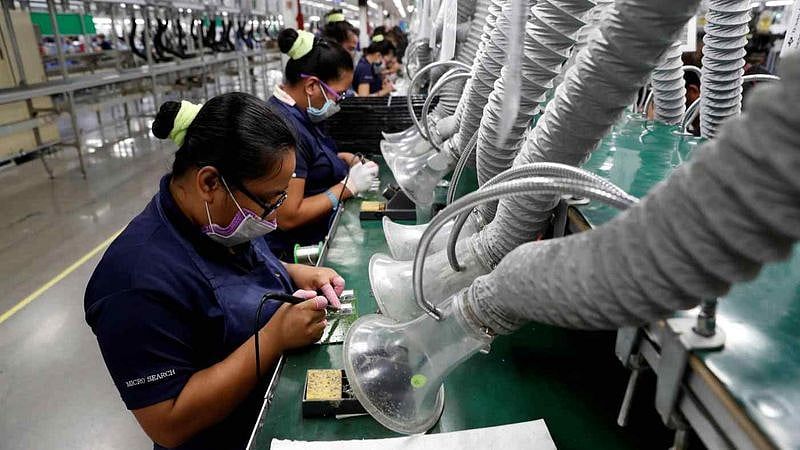
Electronic products dominate Philippine exports, accounting for 59 percent of total shipments in March 2026 with earnings of $4.82 billion for that month alone, making electronics the country's top export commodity. These components, which make up about two-thirds of the country's exports, have previously been exempted from tariffs, though it remains unclear which products might escape the latest tolls.
The timing is particularly sensitive given the Philippines achieved record-breaking exports in 2025, with total annual shipments reaching $84.4 billion despite earlier tariff headwinds, marking the highest level since 1991 according to the Philippine Statistics Authority. The new tariffs threaten to undermine this positive momentum.
Labor concerns
The labor grounds cited by Washington relate to long-standing concerns. A 2024 US labor department report listed Philippine products including coconuts and copra meal as having inputs produced with child labor. Coconut from the Philippines was added to the US International Labor Affairs Bureau's List of Goods Produced by Child Labor or Forced Labor in 2009, and the country is a leading global exporter of coconut oil, representing 46.4 percent of total global exports in 2021.
However, the same US report noted many countries made the list precisely because they were more transparent in dealing with the problem. Cambodia, a fellow Southeast Asian state with well-documented concerns about forced labor at scam centers, was hit with a lower 10 percent rate, raising questions about the consistency of the tariff determinations.
China, Japan, South Korea and dozens of other countries were also subject to the higher 12.5 percent tariff, underscoring the global scope of the Trump administration's trade action.