Dubai gold prices retreat on Friday after volatile July sees rates swing Dh21
Gold prices in Dubai fell on Friday, closing a turbulent month that saw 24K rates move through a range exceeding Dh21 per gram amid Federal Reserve policy decisions and ongoing regional conflict.

Dubai gold prices retreat on Friday after volatile July sees rates swing Dh21
Gold prices in Dubai declined on Friday, capping a month of significant volatility that saw rates for 24-karat gold fluctuate by more than Dh21 per gram as investors navigated Federal Reserve policy decisions and geopolitical tensions stemming from the US-Iran conflict.
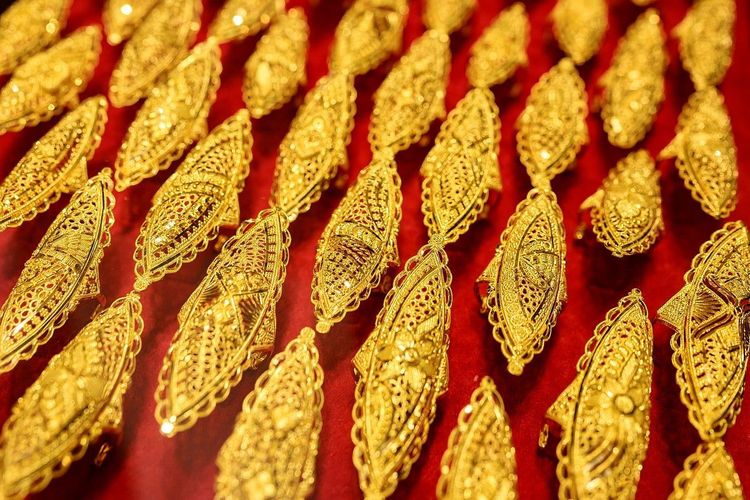
The 24K variety dropped to Dh491.75 per gram from Dh495.50 on Thursday, a decline of Dh3.75. The 22K rate fell by Dh3.25 to Dh455.50 from Dh458.75, giving buyers some relief after prices touched Dh500 earlier in the month.
Friday's closing rate leaves purchasers paying Dh11.25 less per gram for 24K gold than at July's peak of Dh503, recorded on July 4 and July 5.
Wide price swings define July trading
Dubai gold rates moved repeatedly above and below Dh490 throughout July, mirroring sharp movements in international bullion prices and the US dollar. The 24K rate began the month at Dh494.75 on July 2 before climbing above Dh500 during the first week.
After reaching the monthly high of Dh503 on July 4 and July 5, prices retreated sharply to the month's low of Dh481.50 on July 16 and July 17. Rates subsequently recovered to Dh500.75 on July 22 before easing again, falling to Dh485 on July 28 and settling at Dh491.75 to close the month.
The 22K variety followed a similar trajectory, reaching a monthly high of Dh466 on July 4 and July 5 before dropping to Dh446 mid-month. It later climbed to Dh463.75 on July 22 and ended July at Dh455.50.
International gold posts first monthly gain since February
International gold was on course for its first monthly advance since February, rising approximately 2% in July despite having fallen more than 20% since the US-Iran war erupted on February 28. The conflict began when the United States and Israel launched nearly 900 strikes in 12 hours targeting Iranian missiles, air defenses, military infrastructure, and leadership.
Bullion traded near $4,080 an ounce on Friday and was heading for a July gain of almost 2%, despite falling by as much as 0.8% during the session. Gold had reached a peak of $5,414.19 per ounce on January 28, before the war began, and has since traded mostly sideways with an intra-year floor of $4,170 per ounce reached in late March.
The US dollar recovered against the yen on Friday after dropping during overnight trading following apparent intervention by Japan in the foreign-exchange market. A gauge of the dollar fell 0.9% on Thursday, making dollar-priced gold cheaper for many international buyers, before recovering by as much as 0.3% on Friday.
Federal Reserve holds rates amid inflation pressures
Gold has been supported by the US Federal Reserve's decision this week to hold its key interest rate steady at 3.5% to 3.75%, even as inflation linked to the conflict continues to pressure policymakers. The vote was 9-3, with three regional presidents—Beth Hammack of Cleveland, Neel Kashkari of Minneapolis, and Lorie Logan of Dallas—dissenting in favor of a rate hike. This marked the first time since September 2016 that three policymakers dissented with a unified view.
The dissenters cited concerns that inflation has remained above the Federal Reserve's 2% target for more than five years, since 2021. Higher energy costs stemming from the war have added to inflation pressures and increased expectations that interest rates could remain elevated for an extended period.
Higher borrowing costs tend to weigh on gold because the metal does not pay interest, although buying during price declines has helped keep bullion above $4,000 an ounce in recent weeks. Markets currently price in approximately a 63% chance of a Federal Reserve rate hike in September 2026, with some analysts expecting between one and two rate hikes by the end of 2026.
Federal Reserve Chairman Kevin Warsh, who took office on May 22 after being confirmed by the narrowest margin in Fed history with a 54-45 Senate vote, addressed the inflation challenge this week.
If inflation continues to be elevated through the forecast period, interest rates could well be part of that solution, but I wouldn't say it's in isolation,Warsh said.
Jackson Hole symposium in focus
Traders are now watching for further signals on the Federal Reserve's next move. The Jackson Hole Economic Policy Symposium, scheduled for August 27-29 and hosted by the Federal Reserve Bank of Kansas City, could provide the next major indication for gold markets. The symposium's theme this year is Financial Innovation: Implications for Payments and Policy. The Federal Reserve chair traditionally uses the gathering to outline the central bank's policy direction.
Regional conflict continues to impact markets
The US and Iran exchanged strikes again this week, with Washington targeting dozens of sites in Iran on Wednesday following attacks on American military bases in the region. Iran closed the Strait of Hormuz in response to the initial February strikes, and the US imposed a naval blockade on Iran from April 13, which the US Department of Defense estimated cost Iran $4.8 billion in lost oil revenue by May 1.
Saudi Arabia has discussed creating a multinational alliance to protect shipping routes in and around the Red Sea, keeping geopolitical risks and their impact on energy prices in focus. The ongoing conflict has disrupted global trade and travel, with shipping routes being rerouted to avoid the Strait of Hormuz and Red Sea.
For the UAE, the war has had direct implications. The country has intercepted and destroyed 537 ballistic missiles, 2,256 drone attacks, and 26 cruise missiles fired from Iran as of April 9, using THAAD and Patriot missile defense systems. The attacks have killed 13 people in the UAE, including two military personnel and 10 civilians, contributing to market uncertainty in the region.