Learning to drive in Dubai at 45: One woman's journey through anxiety and stereotypes
A Dubai resident shares her experience tackling driving lessons at 45, confronting gender stereotypes and navigating the challenging RTA test that sees only half of candidates pass.
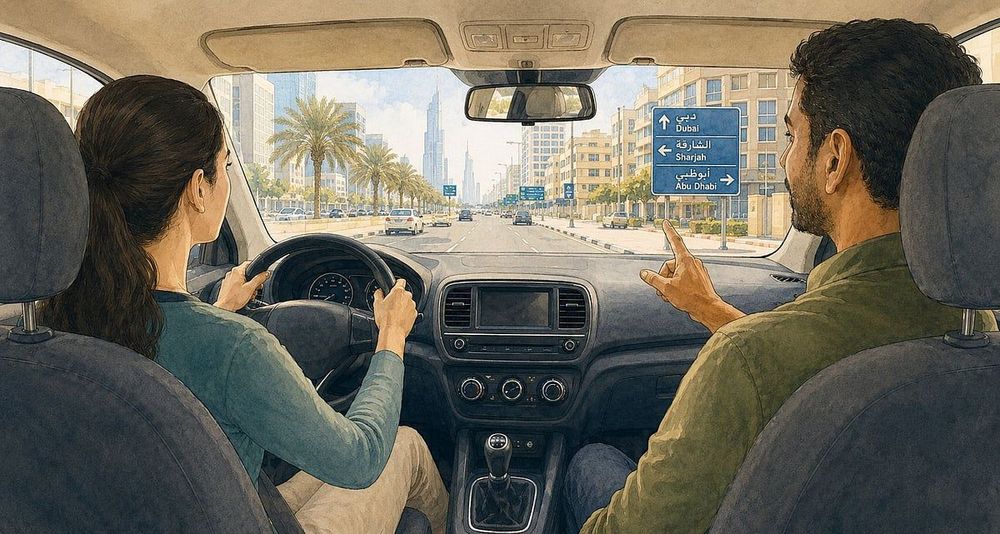
Learning to drive in Dubai at 45: One woman's journey through anxiety and stereotypes
Inspired by the growing number of women drivers on Dubai's roads, Sheethal Manoj enrolled in driving classes at 45, despite having obtained a dormant license in her home country over 15 years ago. What followed was an unexpected journey through anxiety, determination, and a confrontation with deeply ingrained gender stereotypes about driving.
Her first lesson set the tone for what would become a months-long challenge. Her Pakistani instructor, possessing what she described as unmatched driving skills, had to constantly intervene as she navigated the bylanes of Mankhool. Every approaching vehicle, even those in the opposite lane, triggered panic. Soon, she found herself dreading class days, questioning whether 45 was simply too late to learn this skill.
The struggle to persevere
Despite her mounting anxiety, Manoj pushed forward. The financial investment was significant—obtaining a driving license in Dubai typically costs between AED 4,000 and AED 7,000 for first-time applicants, with driving school fees accounting for the majority of that expense. But beyond the money, she refused to give up easily.
The driving institute provided special training sessions, allowing her to log additional hours beyond the typical 20-40 hours of mandatory instruction required for first-time applicants. During this extended training period, she discovered she wasn't alone. Many other women around her age were fighting the same battle, struggling with similar anxieties and skills gaps.
Questioning the stereotype
This realization prompted Manoj to examine a persistent question: why are women often stereotyped as bad drivers? Her conclusion pointed to upbringing and early childhood experiences.
Girls typically receive dollhouses rather than Legos or building toys, she observed. They're rarely encouraged to play games like Minecraft or experiment with remote-controlled cars—the very activities that develop spatial reasoning skills critical for driving. Research supports this observation: studies show that 76% of men frequently played with construction-based toys like Legos as children, compared to just 42% of women.
Scientific evidence backs her theory. Research from the Cooperative Institute for Research in Environmental Sciences found that gender differences in spatial skills disappear entirely when researchers control for childhood play patterns. Young women and men who played with construction-based toys performed equally well on spatial reasoning tests, suggesting the disparity stems from nurture rather than nature.
Manoj's son, who has been an expert on racing cars, car models, and engines since age seven or eight, now guides her on parking maneuvers. This lived experience crystallized her mission: she now advises expectant mothers to provide toy cars for their daughters from the moment they start crawling.
Reality versus perception
The stereotype of women as inferior drivers contradicts actual data from the UAE. In 2020, only 21% of women were involved in road accidents over a six-month period, compared to 26% of men. Women demonstrate safer driving behaviors, including less tailgating and speeding. Meanwhile, Dubai issued 105,568 driving licenses to women in 2024, compared to just 6,903 to men, reflecting a dramatic surge in female drivers on the emirate's roads.
Passing the test
At the driving school, Manoj encountered various teaching styles—some instructors taught with urgency, others used motivational anecdotes to keep her relaxed and focused, and a few reprimanded her with stern glares when she repeated mistakes. Each approach contributed to her eventual success.
The RTA road test proved formidable. With inspectors possessing hawk-like precision in detecting mistakes, the test filters out nervous and reckless drivers within seconds. Dubai's road test has approximately a 50% pass rate, with most candidates succeeding on their second or third attempt rather than their first. The days leading up to each test were nightmarish for Manoj, filled with strange dreams of driving on endless roads with infinite signals and roundabouts.
On her third attempt, she passed. The relief was immense, as though a massive weight had been lifted. She now drives regularly on Dubai's roads, equipped with both a license and hard-won confidence.
True to her mission, Manoj enrolled her daughter for driving classes at 18, determined that her daughter wouldn't become a late crusader like herself. With the UAE recently reducing the minimum driving age from 18 to 17 for light vehicles, young people now have even earlier opportunities to develop this essential skill without the baggage of gendered childhood experiences.