Why alternating between sitting and standing transforms workplace health
Height-adjustable desks encourage regular movement throughout the workday, reducing back pain and health risks associated with prolonged sitting. Research shows the key benefit is position variety, not standing duration.
How a standing desk changes your workday
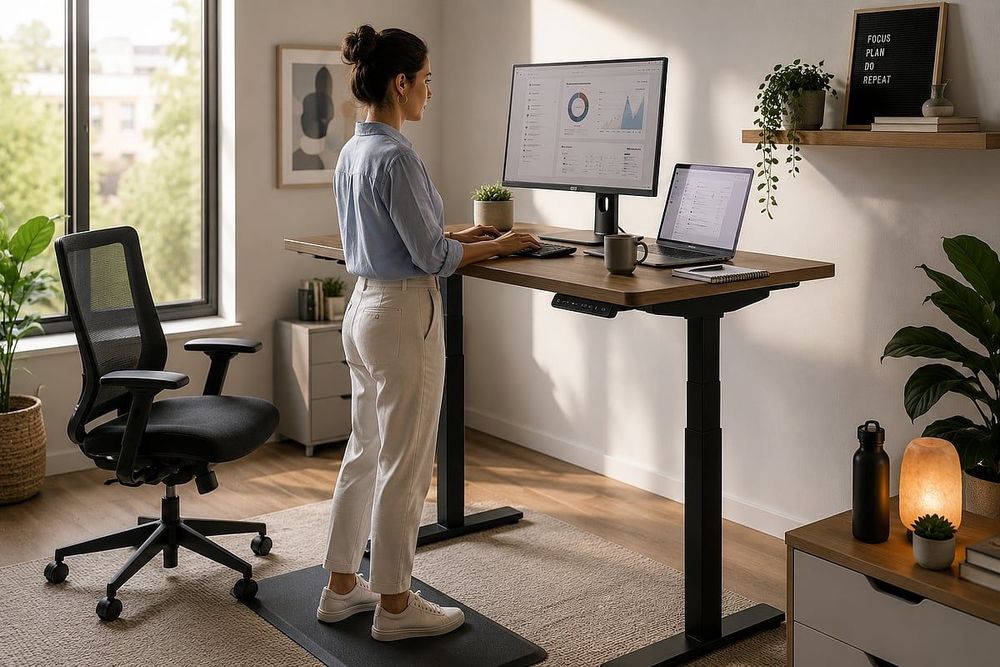
A height-adjustable desk fundamentally changes how often you move during work hours rather than transforming how you complete tasks. The core principle behind sit-stand workstations is facilitating position changes without disrupting workflow. Research published in Annals of Internal Medicine indicates that sitting for more than eight hours daily increases risks for heart disease, diabetes, cancer and premature death, with effects comparable to obesity and smoking. Ergonomics guidance from Mayo Clinic and the US Occupational Safety and Health Administration emphasizes arranging workstations to support comfortable posture throughout the day rather than focusing solely on standing duration.
A 2024 Texas A&M University review analyzing 27 studies with over 2,000 participants found that introducing sit-stand desks reduced lower back pain by an average of 54% within four weeks. Meanwhile, a December 2024 UC Riverside study revealed that prolonged sitting harms even young, active adults, and current exercise guidelines prove insufficient to offset negative effects of excessive sitting time. People who spend more time seated face a 112% higher risk of diabetes according to Harvard T.H. Chan School of Public Health research.
Understanding the health benefits
Studies published through 2024 demonstrate that alternating between sitting and standing every 20 to 30 minutes produces superior metabolic outcomes compared to extended standing periods, including an 11.1% reduction in post-meal glucose spikes. A 2025 BMC Public Health scoping review of 17 studies involving 2,886 university students found that standing desks improved movement patterns in seven studies and enhanced mental health outcomes including anxiety, mood and stress in four studies.
However, a 2024 University of Sydney study provided important balance, noting that standing alone does not substitute for movement and that static standing carries its own risks. The true advantage lies in position variety rather than endurance in either posture.
Who benefits from adjustable workstations
A sit-stand desk suits anyone spending substantial portions of the day working at a computer, whether in dedicated home offices or shared workspaces. The UAE standing desk market is projected to reach USD 65.52 million in 2025 with growth at 5.3% annually, driven by increasing corporate investments in modern office infrastructure and workplace health initiatives. Globally, the standing desk market is expected to expand from USD 7.95 billion in 2025 to USD 12.20 billion by 2033, reflecting rising awareness of sedentary lifestyle health risks.
The primary advantage is flexibility. Users can stand while reading emails, taking video calls or reviewing documents, then return to seated positions for concentrated typing. Ergonomics specialists recommend changing position regularly instead of maintaining either posture for hours. A straightforward rhythm, such as alternating every 30 to 60 minutes, introduces movement into the workday. The objective is variety, not duration.
Essential features and setup
Select a desk with a height range comfortably matching both seated and standing positions. Stability matters equally to lift speed, particularly when using one or two monitors. OSHA guidelines specify that elbows should bend between 90 and 120 degrees during computer work, with monitors positioned at least 20 inches away and directly in front of users to maintain neutral body positioning. Once adjusted properly, elbows should rest close to 90 degrees while typing, and monitor tops should sit at or slightly below eye level. If monitors cannot reach that height, a riser provides a simple solution. An anti-fatigue mat makes longer standing sessions more comfortable by offering a softer surface underfoot.
Product considerations
An electric standing desk eliminates friction from position changes because height adjusts at a button touch. The ErGear model offers an electric lift system with programmable height settings and a work surface suitable for everyday office equipment. For most users, its greatest strength is encouraging frequent transitions rather than leaving the desk fixed in one position.
Standing becomes substantially more practical when the surface beneath feet provides cushioning. The KitchenClouds anti-fatigue mat uses high-density foam construction designed for standing workstations and kitchen use. While not essential for brief standing sessions, it proves worthwhile for users expecting to spend longer periods at their desk throughout the day or preferring to work standing during meetings.
Adjusting desk height alone does not guarantee comfortable workstation ergonomics. The screen also requires proper viewing position. The ikeoat monitor riser lifts displays closer to eye level while creating storage space underneath for accessories. It proves particularly useful if monitor stands have limited height adjustment or when using laptops with external keyboards.
Making the investment work
A standing desk functions best as part of a complete workstation rather than a standalone upgrade. Regularly switching between sitting and standing, placing monitors at eye level and adding supportive mats where needed creates a setup that encourages movement without interrupting concentration. Among available options, the ErGear Electric Standing Desk represents the strongest starting point because it makes changing posture quick and practical throughout the workday.