UAE faces extreme 49°C heat on Sunday before weather shift brings rain
Temperatures approaching the nation's all-time record are forecast for inland areas on Sunday, with humid conditions and fog expected before rain chances increase from Tuesday as September begins.

UAE faces extreme 49°C heat on Sunday before weather shift brings rain
Extreme heat is forecast to grip the UAE on Sunday, with temperatures in inland areas expected to reach 49°C, approaching the nation's all-time record of 52.1°C set in July 2002. The scorching conditions will give way to more unsettled weather from Tuesday, with rainfall possible as the country transitions into September.
The National Centre of Meteorology, the federal agency responsible for weather forecasting and atmospheric research in the UAE, has forecast fair to partly cloudy conditions on Sunday. While inland areas brace for temperatures between 44°C and 49°C, coastal and island regions will see highs of 40°C to 45°C. Mountain areas are expected to be cooler, with temperatures ranging from 30°C to 37°C.
Sunday's forecast represents significantly hotter conditions than typical August maximums, which according to NCM climate data usually range between 40.9°C and 43.2°C. The extreme heat comes despite the traditional sighting of the Suhail star on August 24, which culturally signals that the peak of summer heat is ending, though temperatures remain elevated through September before gradually declining.
Humidity will increase overnight into Monday morning, particularly across western areas where fog or mist could develop. The warm coastal waters of the Arabian Gulf, which average around 33°C in summer, provide high evaporation rates that supply the moisture needed for fog formation when combined with calm winds and nocturnal cooling. Winds will remain light to moderate, blowing from the southeast to northeast at 10 to 25 km/h and reaching up to 35 km/h at times. Seas are expected to stay slight in both the Arabian Gulf and the Oman Sea.
Monday will bring similar conditions, with fair to partly cloudy skies and clouds appearing over eastern areas during the afternoon. Humidity will again build overnight, raising the possibility of fog or mist over some coastal and internal areas by Tuesday morning. Winds could strengthen to 40 km/h and stir up blowing dust in exposed areas.
Rain and cooler conditions from midweek
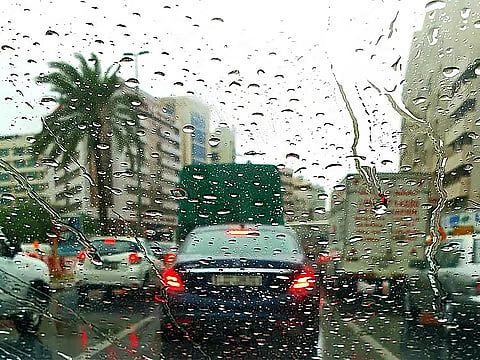
The weather pattern is expected to shift on Tuesday when clouds capable of producing precipitation develop over eastern parts of the country. These vertically oriented convective clouds, which form in unstable atmospheric conditions with significant rising and sinking air motions, can quickly generate rainfall ranging from brief showers to more intense thunderstorms. Temperatures are also forecast to fall, particularly in western areas.
While August fog and rain events are uncommon, they are not unprecedented. NCM historical data shows that August 2018 recorded the highest frequency of fog with 15 occasions, while the highest August rainfall of 100.4mm fell in Hamim in 2013. During August, the UAE can be affected by the Intertropical Convergence Zone, a weather pattern that can enhance the development of rain-bearing clouds.
Humid conditions overnight into Wednesday may again produce fog or mist across some coastal and internal areas. Winds could reach 40 km/h, while the Arabian Gulf is expected to become slight to moderate and rough at times in western waters. The chance of rain will continue on Wednesday, with convective clouds again possible over eastern areas during the afternoon. Fresh winds may cause blowing dust, while rougher conditions could persist in western parts of the Arabian Gulf.
By Thursday, rainfall chances could extend to both eastern and southern areas. Fog or mist may form again overnight across some coastal and internal areas, while winds of up to 40 km/h could continue to raise dust.
The forecast marks a notable shift from Sunday's intense heat towards more changeable conditions as September begins, with lower temperatures in some areas accompanied by recurring fog, stronger winds and increasing chances of rain across the country.