Dubai RTA Launches AI Strategy to Shift Half Its Operations and Services to Agentic AI
Dubai's Roads and Transport Authority is targeting more than AED 300 million in annual added value under an updated AI strategy launched by Mattar Al Tayer. The two-and-a-half-year plan aims to move 50% of the authority's operations and services to an Agentic AI ecosystem.
 Layla Haddad
Scope and performance targets
Al Tayer, RTA's director general and chairman of its Board of Executive Directors, said the strategy would take the authority beyond AI tools that assist existing operations toward systems that analyze information, anticipate outcomes, support decisions and complete services. Its goals cover traffic flow, customer service and the efficiency of transport operations and corporate functions.
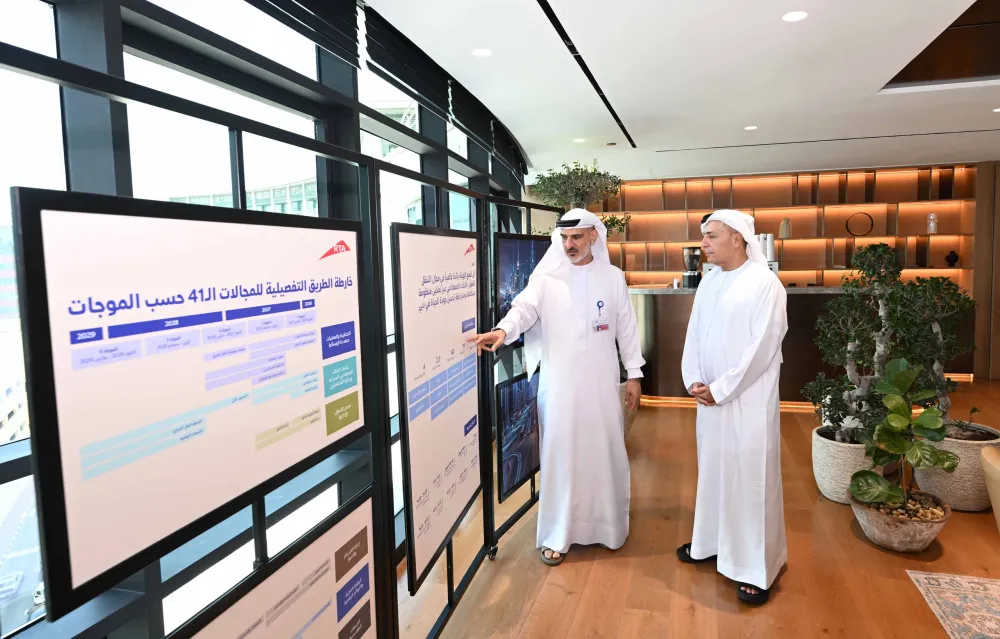
The plan covers 41 areas within RTA. Its first two implementation waves address 11 business areas and call for 40 AI products, of which 11 are complete, plus four foundational projects. Those business areas are Planning and Business Development, Vehicle Licensing, Right-of-Way, Traffic, Contracts and Procurement, Customer Happiness, Bus Operations and Maintenance, Driver Licensing, Roads, Roads and Facilities Maintenance, and Human Resources and Development.
RTA has set a congestion reduction target of 3% to 5%. For Customer Happiness Centres, it aims to cut waits by 14% to 16% and service delivery times by 15% to 20%. Processing cases and complaints is targeted to take 20% to 30% less time.
Other targets include a 10% to 20% reduction in accidents involving newly licensed drivers, procurement cycles that are 10% to 15% shorter, and savings of 10% to 15% in operational and engineering working hours.
The authority's 50% adoption goal mirrors a federal framework announced in April 2026, though the federal timetable is two years. That framework seeks to transform half of UAE Government sectors and services through agentic AI capable of autonomous execution and decision-making. Sheikh Mohammed bin Rashid Al Maktoum, vice president and prime minister of the UAE and ruler of Dubai, reviewed its progress on May 12, 2026.
Customer transactions and project approvals
One customer-facing initiative expands Mahboub from a chatbot that answers questions into a system that can carry out transactions through RTA's app, website and WhatsApp. The upgraded platform supports five vehicle licensing services from start to finish and provides about 100 information services.
Connections to UAE PASS and Dubai Pay allow customers to complete vehicle-related transactions in less than five minutes. RTA aims to double the speed of service delivery through Mahboub and increase the platform's share of services to 10% by the end of 2026 and 50% by the end of 2027.
For works and projects near RTA assets, the electronic No Objection Certificate system uses agentic AI to help applicants, check submitted documents against approved procedures and give reviewing entities engineering insights. The Traffic and Roads Agency developed it with the Corporate Technology Support Services Sector.
The certificate service handles approximately 130,000 certificates annually, while demand is growing by about 11%. RTA's targets for the system are threefold faster reviews, more than 700,000 days saved annually, a customer satisfaction increase of more than 5% and revenue growth of 5% to 10%.
Document audits, contracts and bus planning
The Agentic AI Auditor applies machine learning and optical character recognition to licensing documents. Developed by the Licensing Agency and the AI and Data Science Centre, it detects anomalies, recommends corrections and keeps an audit record. Across seven priority services, RTA wants to replace sample-based auditing with checks of every document within scope, accelerate audits by up to 21 times and eliminate more than 25,000 hours of manual work each year.
Another tool, the Outsourcing Contracts Accountant, checks outsourcing contracts each month before payments are approved. The Finance Department and the AI and Data Science Centre developed it to examine attendance and work outputs, check compliance with contract terms and streamline invoice reviews.
For Dubai's bus network, approximately 20 AI agents will support planners through the Agentic AI-powered Network Planner. The Public Transport Agency and the AI and Data Science Centre are implementing the system, which examines performance, finds service gaps, tests operating alternatives and recommends network changes.
RTA aims to make network analysis and assessment five times faster and shorten the time needed to implement service changes from about 60 days to 48. The planner also has targets to improve on-time performance by up to 10% and increase the cost recovery ratio by 3% to 7%.
Deployment progress and employee readiness
Ahmed Hashem Bahrozyan, CEO of RTA's Corporate Technology Support Services Sector, said planning for the first wave is finished. The work identified more than 180 use cases and quick-win initiatives across 11 business areas, with 12 departments involved in implementation. Of the 11 AI products already launched, five serve Planning and Business Development, five serve Vehicle Licensing and one serves Right-of-Way.
Bahrozyan reported that active use of Microsoft Copilot exceeds 90% among its RTA users, with a 10% saving in working time. He also cited 34 works submitted for intellectual property registration, approval for the "Rail AI Chatbot" work, and RTA's AI World Series 2026 Award. The authority has developed eight strategic initiatives with technology partners including Huawei, Boston Consulting Group and Microsoft.
RTA's workforce plans include wider use of intelligent tools, specialized training and continued learning. Al Tayer said the authority wants to combine technology, data, skilled staff and partnerships to sustain the transport network as Dubai's population and economy expand.
Employee preparation is also part of the federal effort. According to Lucidity Insights, the UAE Cabinet approved a training program for 80,000 government employees, from ministers and senior executives to new hires, describing it as the largest in UAE Government history. It also approved an initial set of agentic AI applications for services used by citizens, residents and businesses.
Lucidity Insights reported that the federal framework requires policies, processes and procedures to be redesigned around AI capabilities. Ministers and directors general are to be assessed on how quickly and effectively they adopt the technology. Federal entities were initially given 90 days to take a selected service through exploration, design and implementation planning.
Dubai's broader AI policy and supplier requirements
The RTA plan sits within a wider Dubai AI agenda. Launched in April 2024, the Dubai Universal Blueprint for Artificial Intelligence, or DUB.AI, seeks an annual AED 100 billion contribution to Dubai's economy and a 50% productivity increase through digital solutions under the Dubai Economic Agenda D33.
The blueprint's first phase included chief AI officer appointments at every government entity, incubators for AI and Web3, an AI commercial license and land allocations for data centers. Its first initiative, the Dubai AI Campus at DIFC, has attracted more than 505 companies, reaching its company target two years early, and created more than 2,020 jobs, according to Lucidity Insights.
A separate two-year Dubai program detailed in June 2026 aims to help 295,000 companies adopt agentic AI. It also calls for developing 100 specialized AI assistants and supporting the establishment of 50 agentic AI companies.
Government purchasing is subject to a certification requirement. Lucidity Insights reported that Dubai Finance instructed government entities in October 2025 to award AI-related service contracts only to holders of the Dubai AI Seal. The certification framework launched in January 2025, and 325 Dubai companies had applied by May that year.
Other deployments and international discussions
Dubai Electricity and Water Authority introduced agentic AI across its digital platforms in July 2026, including its website, smart app, Smart Office employee app, dashboards and internal platforms. HIT 96.7 described DEWA as one of the first utilities worldwide to put agentic AI into production. Its virtual assistant Rammas, introduced in 2017, had answered more than 13 million inquiries by mid-June 2026.
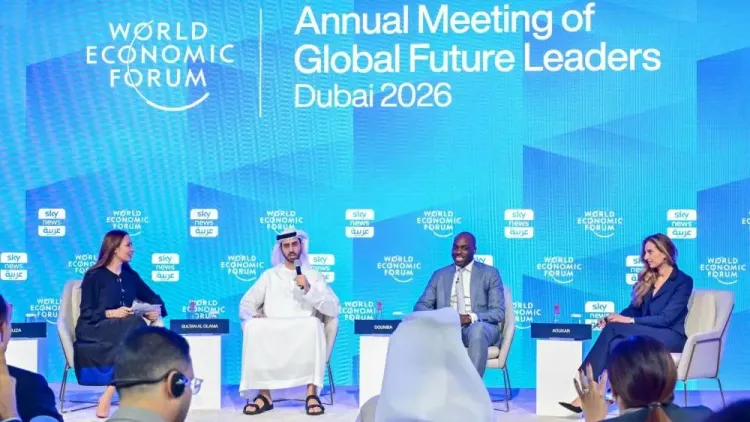
In October 2026, the UAE also began work with the World Economic Forum on global principles for government use of AI in planning and decision-making, with a focus on agentic AI. Dubai Eye 103.8 reported that discussions opened at the Annual Meeting of Global Future Leaders in Dubai. Organizers described the UAE as the first country to lead a global dialogue of this kind.