Musk predicts AI will create 'universal high income' amid jobs debate
Tesla chief tells White House gathering that artificial intelligence and robots could deliver unprecedented prosperity worldwide, while critics warn of concentrated wealth and worker displacement.
 Daniel Pereira
Musk predicts AI will create 'universal high income' amid jobs debate
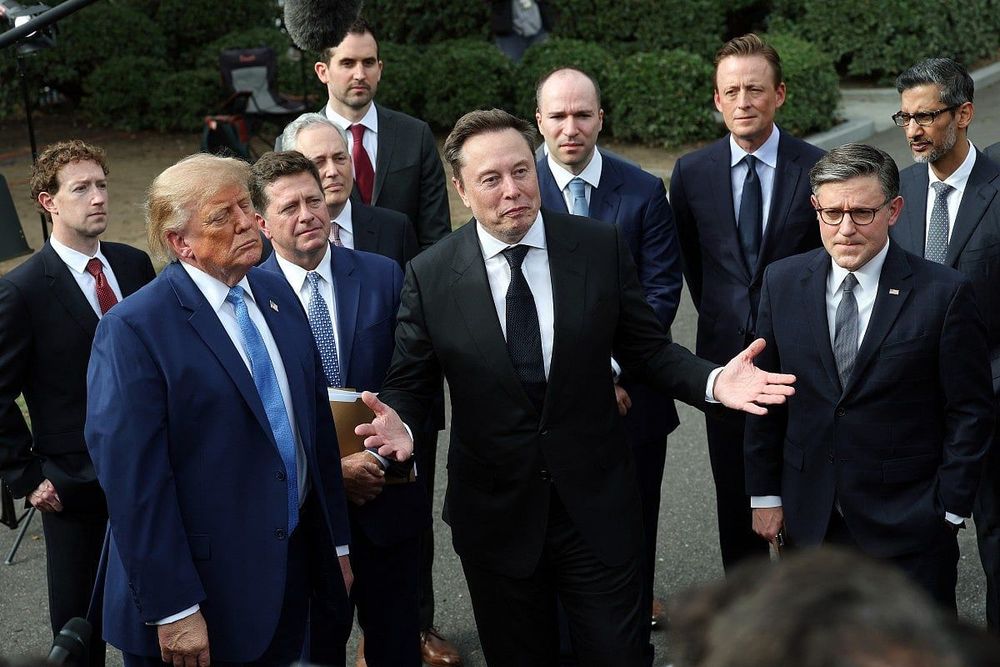
Elon Musk argued at a White House technology summit that artificial intelligence and humanoid robots will ultimately raise global living standards rather than create mass unemployment, predicting what he called "universal high income" for people worldwide.
Speaking alongside President Donald Trump on September 29, the Tesla and SpaceX chief executive told assembled technology leaders that AI-driven automation could produce an "age of abundance" in which everyone receives superior healthcare and higher material prosperity.
"When you have robots and you have superintelligence, it means that everyone in the world can have better medical care than anyone here, including me," Musk said during the event, which brought together CEOs including Jensen Huang of Nvidia, Mark Zuckerberg of Meta, Sundar Pichai of Google, Jeff Bezos of Amazon, Dario Amodei of Anthropic, and Greg Brockman of OpenAI, along with House Speaker Mike Johnson and Cabinet officials.
Jobs will change, not disappear
Musk dismissed concerns about permanent job losses, pointing to historical technological transitions. He cited the example of human computers — workers whose occupation was performing calculations before electronic systems automated that work.
"Jobs are going to change. Jobs have always changed," he said, suggesting that AI and robotics would transform occupations rather than eliminate the need for human labour entirely.
The IMF has upgraded its global growth forecast for 2026 to 3.3%, driven partly by an AI investment surge. Private-sector investment in artificial intelligence is projected to potentially surpass $2 trillion globally this year, with technology investments linked to AI contributing an estimated 0.5 percentage point to U.S. GDP growth in 2025.
An IMF working paper released in September estimated that AI could boost aggregate labour productivity by as much as 3.8% over the long term, with past AI patent activity already lifting output per worker by up to 1.2%.
Healthcare transformation at scale
Musk's vision centres heavily on healthcare. He has previously suggested that humanoid robots such as Tesla's Optimus could eventually perform sophisticated medical tasks, including surgery. Tesla announced in the first quarter of 2026 that it would begin pilot production of the Optimus robot at its Fremont facility, targeting an initial production capacity of 1 million units annually, with long-term plans for 10 million units per year at its Giga Texas plant.
The logic behind Musk's prediction is that AI could provide diagnostic and decision-support capabilities at enormous scale, while robots handle physical tasks without the geographic and labour constraints facing today's healthcare systems. That could potentially make high-quality medical expertise available far beyond wealthy countries — if the technology becomes reliable, affordable and widely deployed.
Universal high income versus basic income
Musk's phrase "universal high income" differs deliberately from universal basic income. While UBI typically refers to providing people with regular cash payments sufficient to establish a basic financial floor, Musk's concept is more expansive: AI and robots would produce such large increases in goods and services that the economy could provide much higher living standards for everyone.
He has used similar language for years. In a 2023 conversation with then-British Prime Minister Rishi Sunak, Musk predicted an "age of abundance" and said there would be "universal high income" rather than universal basic income.
Evidence from universal basic income trials shows mixed results. The Stockton SEED program found that $500 monthly payments increased full-time employment from 28% to 40% over one year and improved mental health outcomes. However, larger studies showed varied employment effects, with some indicating work reductions of 2-5%.
Near-term disruption already visible
While Musk focuses on long-term abundance, near-term job displacement is measurable. Through August 2026, U.S. employers announced 116,175 job cuts attributed to AI, representing 22% of all announced layoffs during the January-August period. AI was cited as the leading cause of layoffs for five consecutive months this year.
Employment data shows disruption falling unevenly across age groups. Workers aged 22-25 in AI-exposed occupations experienced a 19% employment decline relative to less-exposed peers through mid-2026, driven primarily by reduced hiring for entry-level positions rather than increased layoffs of existing workers.
Goldman Sachs estimates from April indicate approximately 16,000 net U.S. jobs were eliminated by AI per month, or 192,000 annually. The World Economic Forum projects 92 million roles displaced globally by 2030 but 170 million created, for a net gain of 78 million jobs.
Policy response and industry divisions
The White House meeting produced a voluntary AI-safety framework covering internal controls, monitoring, external audits and board-level oversight. The agreement is described as "morally binding" rather than legally enforceable regulation.
Following the September 29 gathering, President Trump announced on October 6 the creation of a "Super Intelligence Force" AI task force to be led by Director of National Intelligence Jay Clayton, FTC Chairman Andrew Ferguson, Under Secretary of Defense Emil Michael, and OPM Director Scott Kupor.
Not all technology leaders share Musk's optimism about minimal regulation. Anthropic CEO Dario Amodei and OpenAI CEO Sam Altman have publicly called for a slowdown in AI development amid rising safety concerns, opposing President Trump's position that AI safety fears are a "hoax." The disagreement creates a policy divide within the tech industry over the pace and oversight of AI advancement.
Competing visions of AI's future
The debate between Musk's abundance thesis and critics' concerns about displacement represents fundamentally different views of how AI gains will be distributed. Supporters see AI as a general-purpose technology that can make workers and businesses more productive, similar to electricity or the internet.
Critics do not necessarily deny AI's productive potential. Their concern is that technological gains could concentrate among companies owning advanced models, computing infrastructure and intellectual property, while workers and communities absorb displacement costs.
Even the IMF's research finds that AI can increase wealth inequality even in scenarios where it reduces some wage inequality. One reason: higher-income households are more likely to own capital and can therefore benefit from increased returns generated by AI-driven productivity gains.
Musk's vision depends on several technological breakthroughs occurring together: AI systems becoming substantially more capable, humanoid robots becoming reliable and inexpensive enough for mass deployment, enormous increases in automated manufacturing, plentiful energy and computing capacity, AI-assisted medicine becoming demonstrably superior in many areas, and productivity gains being broadly distributed rather than concentrated.
The final assumption — broad distribution of benefits — is economic and political rather than purely technological. Who owns the machines, who controls computing infrastructure, how companies are taxed, how workers transition between occupations and how societies distribute resulting wealth will determine whether AI produces Musk's age of abundance or a more unequal outcome.