Robotic spacecraft launches on commercial mission to rescue aging satellites
Northrop Grumman's Mission Robotic Vehicle blasted off Tuesday carrying three jetpacks designed to extend the life of fuel-depleted communication satellites orbiting 22,300 miles above Earth, marking a new era in orbital satellite servicing.
Robotic spacecraft launches on commercial mission to rescue aging satellites
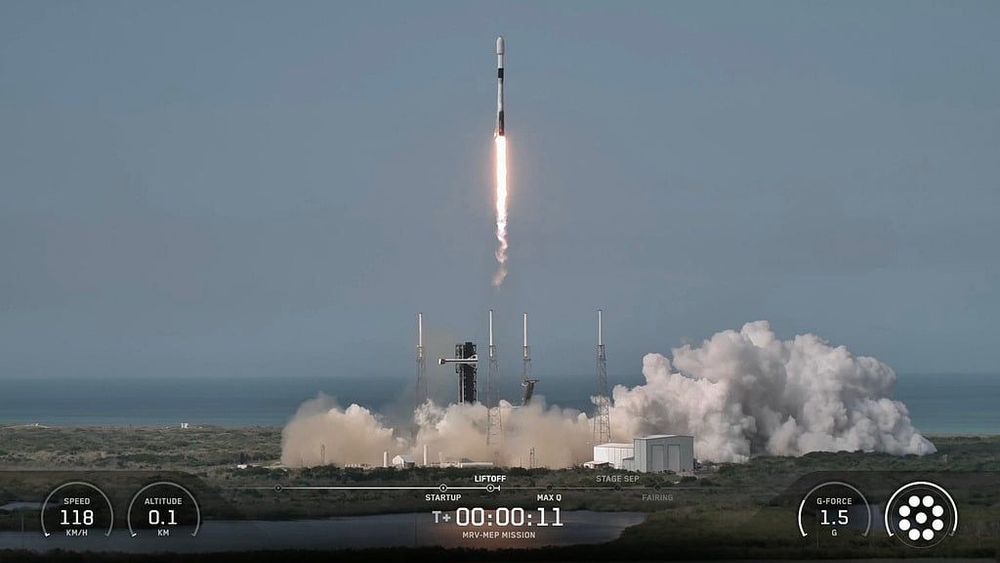
A robotic spacecraft equipped with sophisticated mechanical arms launched Tuesday on a groundbreaking commercial mission to attach life-extending jetpacks to aging satellites running out of fuel in high orbit, demonstrating the growing business case for repairing rather than replacing multi-million-dollar space assets.
The Mission Robotic Vehicle, built by Northrop Grumman and launched aboard a SpaceX Falcon 9 rocket from Cape Canaveral, Florida, carried three Mission Extension Pods designed to dock with communication satellites operating 22,300 miles above Earth. Each pod can extend a satellite's operational life by up to eight years and supports spacecraft weighing up to 4,400 pounds.
The launch represents the second satellite rescue operation this month, following Katalyst Space Technologies' July 3 mission to boost NASA's Swift Observatory. Together, the missions signal an emerging industry focused on maximizing spacecraft longevity and avoiding costly replacements that typically run between $200 million and $400 million for geosynchronous communication satellites.
Year-long journey to operational orbit
The minivan-sized MRV and its three jetpacks will spend approximately one year maneuvering into proper position at geosynchronous Earth orbit, where satellites match Earth's rotation speed and maintain constant coverage of specific regions. The spacecraft features two three-meter robotic arms with seven degrees of freedom and more than 20 situational-awareness cameras to enable safe rendezvous and docking procedures.
Once in position by mid-2027, the robotic vehicle will use its arms to capture each washing-machine-sized jetpack and attach it to a designated satellite. The pods, which separated from the MRV after launch and are navigating independently using xenon gas thrusters, will provide the propulsion necessary to keep fuel-depleted satellites operational.
The mission will service communication satellites operated by SES of Luxembourg and Optus of Australia. The MRV itself is designed to remain operational in orbit for several years and can service up to thirty satellites over its lifetime.
Building on previous successes
This marks Northrop Grumman's third venture into satellite servicing. The company launched two earlier spacecraft in October 2019 and 2020 that latched onto faltering communication satellites to provide steering assistance. The first mission, MEV-1, successfully docked with Intelsat 901 in February 2020, marking the first time two commercial satellites docked in orbit.
The new robotic helpers represent a significant technological advancement. Future versions are envisioned to repair and relocate active satellites and remove defunct spacecraft from congested orbits. The development reflects both DARPA's $420 million investment in the Robotic Servicing of Geosynchronous Satellites program and Northrop Grumman's collaboration with the US Naval Research Laboratory and the Defense Advanced Research Projects Agency.
Urgent rescue mission for Swift telescope
Meanwhile, Katalyst Space Technologies continues testing its Link satellite helper before attempting to rescue NASA's Swift Observatory. The 880-pound spacecraft, standing 5 feet tall with approximately 20 feet of solar panels and three robotic arms, experienced initial communication and pointing difficulties that required software patches uploaded from ground control.
Swift, a gamma ray observatory that has cost $500 million to build, launch and operate since its 2004 deployment, has been descending faster than anticipated. The sun reached the peak of its 11-year cycle in 2024, releasing intense flares and coronal mass ejections that caused Earth's atmosphere to expand, intensifying atmospheric drag on the telescope and accelerating its orbital decay.
A boost by Link in the coming weeks could extend the observatory's mission by many years. Swift monitors approximately one hundred gamma-ray bursts annually and has unique capabilities to rapidly reorient and observe these cosmic explosions before they fade. With no replacement planned, its loss would significantly impact time-domain astrophysics research.
NASA awarded Katalyst the $30 million contract in September 2025, giving the Arizona-based company just nine months to design, build, test and launch a spacecraft capable of raising Swift from its declining altitude back to its original 373-mile orbit. Northrop Grumman provided Link's ride to space using a plane-launched Pegasus rocket.