SpaceX completes successful Starship test flight following record-breaking IPO
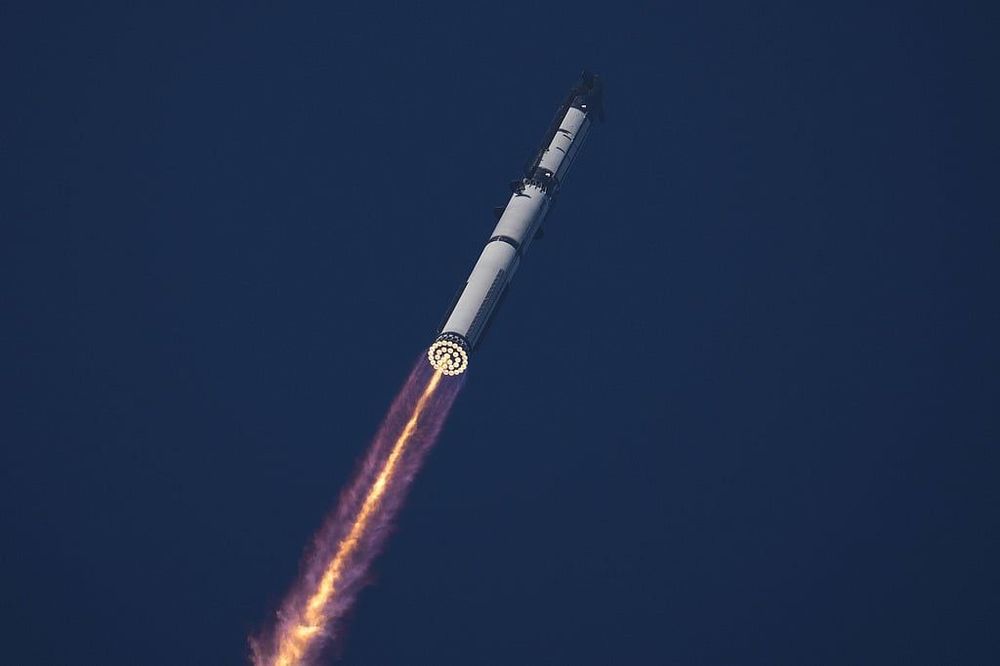
SpaceX's Starship successfully completed its 13th test flight on Friday, deploying 20 next-generation Starlink satellites and demonstrating heat shield upgrades in the company's first launch since its historic $75 billion public offering in June.
SpaceX completes successful Starship test flight following record-breaking IPO
SpaceX's Starship rocket executed a flawless test flight on Friday, marking a milestone achievement as the company's first launch since completing the largest initial public offering in history. The spacecraft splashed down intact in the Indian Ocean after deploying 20 advanced Starlink V3 satellites, drawing enthusiastic cheers from employees at the company's Starbase facility in Texas.
"Starship is intact, floating in the ocean and transmitting telemetry!" SpaceX CEO Elon Musk announced on X following the approximately one-hour mission.
The successful flight represents a significant step forward for SpaceX, which raised approximately $75 billion in June 2026 by pricing shares at $135 each, achieving a valuation approaching $1.8 trillion. The offering surpassed Saudi Aramco's previous record of $29 billion raised in 2019.
Advanced satellite deployment
Friday's mission deployed 20 Starlink V3 satellites, each designed to support 1 terabit per second of downlink capacity and 160 gigabits per second of uplink capacity. These specifications represent approximately a tenfold improvement in downlink and 22-fold increase in uplink capacity compared to previous Starlink V2 satellites.
"This test will provide critical data as we prepare to expand our Starlink constellation," SpaceX stated. The company's satellite internet service has become a major revenue driver alongside its launch operations and, following the February 2026 acquisition of xAI, artificial intelligence operations.
SpaceX spokesperson Dan Huot expressed excitement during the livestream: "I'm losing my mind right now. This is the first time we've put an intact Starship in the water. This is a dream scenario for the team that's trying to get this heat shield data."
Technical challenges overcome
The launch followed an aborted attempt on July 16, 2026, when four Raptor engines failed to ignite properly at T-0, triggering an automatic stoppage. SpaceX engineers subsequently replaced two engines before clearing the vehicle for Friday's successful flight, which was further delayed by weather and visibility concerns.
Flight 13 marked the second test of Starship's third-generation configuration, following a debut flight in May 2026. The mission aimed to demonstrate design improvements and test upgrades to the spacecraft's heat shield system.
While the upper stage performed flawlessly, the booster's landing burn proved more challenging than anticipated. "Just looking at the booster real quick, it didn't look like we lit all 13 engines that we were planning for that initial land and burn," Huot noted. "We were targeting a softer splash on it, and as you saw, it came in with quite a bit of velocity."
NASA partnership advances
The successful test flight carries significant implications for NASA's lunar ambitions. The space agency awarded SpaceX a $2.9 billion contract in April 2021 to develop a modified Starship variant as a lunar landing system for the Artemis program, with an additional $1.15 billion contract modification in November 2022 for a second crewed demonstration mission.
NASA Administrator Jared Isaacman, confirmed to the position in December 2025 following a 67-30 Senate vote, responded enthusiastically to the flight. Sharing an image of the Starship rocket passing the Moon, Isaacman commented: "Pretty clear from this shot that SpaceX knows where we are going!"
"When Starship comes online, its capabilities will be game-changing, not least of which will be ensuring we never give up the Moon again!" added Isaacman, a billionaire entrepreneur who founded payment processing company Shift4 and has flown to space twice as a private astronaut, including commanding the Polaris Dawn mission in 2024.
The successful flight demonstrates continued progress toward SpaceX's ambitious goals of expanding its satellite internet network and advancing capabilities for lunar missions, as the newly public company navigates heightened scrutiny from investors and stakeholders.