SNB, UBS and SIX Launch Study of a Shared Swiss Financial Ledger
The Swiss National Bank and eight financial institutions are exploring whether wholesale central bank money, tokenized bank deposits and tokenized securities could operate on a single distributed ledger. Announced November 24, 2026, the Swiss Financial Ledger initiative does not commit the central bank to issuing a digital franc or putting the proposed system into production.
 Layla Haddad
The scope of the shared ledger
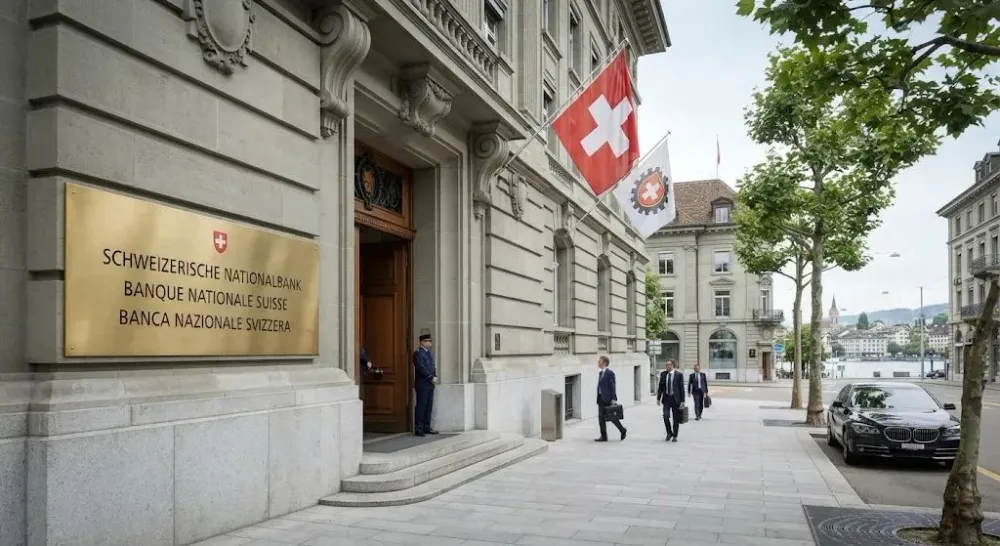
The participants are the SNB, UBS, SIX, Zürcher Kantonalbank, PostFinance, Banque Cantonale Vaudoise, Basler Kantonalbank, Sygnum Bank and settlement platform Seturion. Their work falls under the SNB's Project Helvetia and draws on Project Agorá, the cross-border tokenization collaboration led by the Bank for International Settlements (BIS) and the Institute of International Finance (IIF).
The study will consider a common infrastructure for three types of assets: money that commercial banks hold at the central bank, potentially represented as wholesale central bank digital currency (wCBDC); tokenized commercial bank deposits; and securities issued or represented using distributed ledger technology (DLT). Participants will examine the technical options, benefits and risks, along with the rules and operating arrangements such a system would require.
A shared ledger could coordinate payments with securities transfers and reduce the work needed to reconcile transactions between separate systems. The initiative will assess its possible use for both Swiss transactions and cross-border settlement.
The SNB describes Switzerland's existing financial market infrastructure as highly efficient and is examining possible extensions to it. It cautions that this work signals neither an eventual launch of the Swiss Financial Ledger nor a decision to issue tokenized central bank money permanently for financial institutions.
Governance, access and Seturion's role
A newly established Helvetia Strategic Board will coordinate the initiative. The Swiss Bankers Association will take part as an observer.
Access is among the governance questions still to be resolved. According to Crypto News Flash, participants in the current Helvetia pilot must hold a sight deposit account at the SNB and be admitted to the Swiss Interbank Clearing (SIC) payment system. Those requirements restrict access to wholesale central bank money to regulated banks and securities firms. The Swiss Financial Ledger's governance work must address whether to retain that restriction or allow licensed non-bank platforms such as SeturionX to participate.
Seturion belongs to Germany's Boerse Stuttgart Group, which the group describes as Europe's sixth-largest exchange group. It is developing a pan-European settlement platform for tokenized assets and operates SeturionX in Switzerland. The group describes SeturionX as the first FINMA-licensed DLT trading system for tokenized assets.
The Swiss operation adopted its current branding on September 15, 2026. According to a Boerse Stuttgart Group media release, BX Digital became SeturionX, while the legal entity BX Digital AG was renamed Seturion AG. It continues to operate the licensed Swiss DLT trading system, with all settlement processes taking place within Switzerland.
Helvetia's two settlement approaches
The SNB has extended Project Helvetia until at least June 2028. It is testing two routes for settling tokenized assets in central bank money: issuing wholesale CBDC on the regulated SIX Digital Asset Platform, and linking DLT trading and settlement platforms to SIC.
The first route uses delivery-versus-payment, in which the tokenized securities and cash change hands simultaneously. The second allows securities on DLT platforms to settle against conventional central bank money in Switzerland's existing payment infrastructure.
Crypto News Flash traces Helvetia's development from Phase I in December 2020, which demonstrated two ways to settle digital securities, to Phase II in January 2022, when wholesale CBDC was connected to five banks' systems. Real wholesale digital francs went live on SIX in December 2023. A real-time gross settlement (RTGS) link for traditional central bank money followed in June 2025.
Several participants also have experience with tokenized commercial bank money. In September 2025, UBS, PostFinance and Sygnum completed what the Swiss Bankers Association described as the first legally binding interbank payment using deposit tokens on Ethereum in a permissioned setup, according to Crypto News Flash.
What Agorá has tested across borders
Project Agorá brings together public- and private-sector participants, including seven central banks and the SNB, to investigate whether tokenized bank deposits and wholesale central bank money could improve cross-border payments.
In July 2026, its real-value tests involved 28 financial institutions and central banks, which completed 30 transactions across 17 scenarios. The BIS reported a total value of approximately CHF 800,000, with individual transactions ranging from CHF 9,000 to CHF 125,000.
Payment initiation to settlement took about 80 seconds on average. Those results came from a prototype that was not integrated with existing RTGS or core banking systems.
Five central banks took part in that testing: the Bank of England, the Bank of France on behalf of the Eurosystem, the Bank of Japan, the Bank of Korea and the SNB. SIX facilitated the operations, while Kaleido supplied the technology.
Related work beyond Switzerland
Other central banks are also examining infrastructure that connects tokenized money with securities settlement. The Monetary Authority of Singapore has been expanding experiments involving wholesale CBDC and tokenized securities. The European Central Bank is developing Pontes and Appia to connect tokenized financial markets with central bank money and explore interoperability among digital asset networks.
For the Swiss initiative, the work remains an evaluation of technical architecture, governance and operating requirements. Any decision on a production system would come after that assessment.