Euro edges off 18-month low as US rate expectations support dollar
The euro recovered slightly in European trading on Tuesday, November 24, as investors reassessed the European interest rate outlook after recent economic data. Expectations of further Federal Reserve tightening kept the dollar strong and limited the rebound.
 Layla Haddad
A modest recovery after Monday's decline
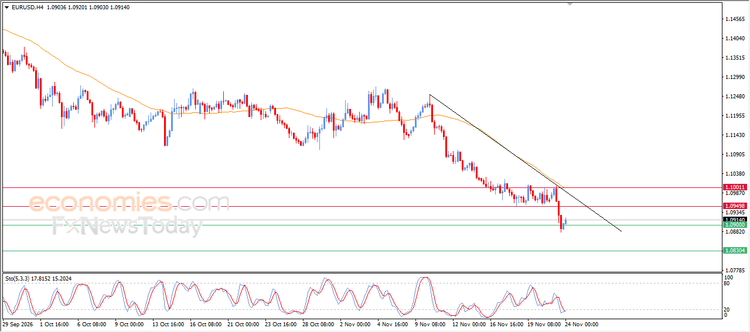
At $1.0914, the euro was up 0.10% from Monday's close of $1.0903. The currency had dropped about 0.63% on Monday, reaching an 18-month low of $1.0881. Its loss over the past month was approximately 2.5%.
Expectations of tighter US monetary policy continued to support the dollar, particularly following Monday's sharp rebound in US technology stocks.
Markets anticipate a December Fed increase
Money markets now fully price in a quarter-point Fed rate increase in December, while assigning a small probability to a half-point move. On November 18, the probability of a quarter-point increase stood at about 98%.
The Fed meets December 8-9, 2026, and will announce its decision on December 9. A 25-basis-point increase would raise its target range from 3.75%-4.00% to 4.00%-4.25%.
Minutes released November 18 from the October 27-28 meeting showed broad support for a December increase: nearly all officials expected a quarter-point move. Some had favored raising rates in October, and two raised the possibility of a half-point increase in December.
ECB debate extends beyond December
European Central Bank policymaker Gediminas Simkus warned that the quarter-point increase widely expected on December 17 might not be enough to contain inflation. Euro area inflation reached 4.0% year over year in October, up from 3.8% in September and the highest reading since September 2023. Energy inflation topped 20%, while core inflation remained between 2.5% and 2.6%.
The ECB's deposit facility rate was 2.50% in mid-November, where it had stood since September. Money markets and all 71 economists surveyed by Reuters expected the December 17, 2026, meeting to deliver a 25-basis-point increase to 2.75%.
The ECB has raised rates twice this year. Reuters described a third increase in December as all but certain, with attention turning to the subsequent rate path as a new president prepares to succeed Christine Lagarde. Markets fully price in another European rate increase by June 2027, amid concerns over persistent energy-driven inflation and expectations of faster wage growth.
Separately, the ECB Governing Council was scheduled to consider doubling banks' minimum reserve requirement from 1% to 2% at its November 25 non-monetary meeting. Reuters estimated annual savings for the ECB of about €4.4 billion at current rates, along with some withdrawal of liquidity. A decision could be delayed until December 17.
Eurozone growth masks a widening national divide
November's eurozone composite purchasing managers' index held at 51.7, marking a fifth straight month of expansion. Beneath that steady headline, services weakened to a five-month low of 51.2, while manufacturing improved to 52.9.
Germany's composite PMI reached 55.0, its strongest reading since March 2022. S&P Global linked the country's manufacturing-led expansion to a surge in investment in defense and AI-related technologies. For the eurozone overall, it said the flash PMI readings were consistent with fourth-quarter GDP growth at a pace near 0.3%.
France's private sector contracted more sharply as domestic demand deteriorated. Business activity declined for a second month, with the composite PMI falling to a six-month low of 46.2. The contraction was the deepest in six months, and the gap between German and French performance was the widest in six years. S&P Global warned that France risked entering a technical recession in the fourth quarter.
Inflation data and ECB minutes next
Investors await Wednesday's US inflation report and Thursday's ECB meeting minutes for clues to how the gap between US and European interest rates may develop.