EUR/USD Edges Up After 1.0900 Test, With Bearish Trend Intact
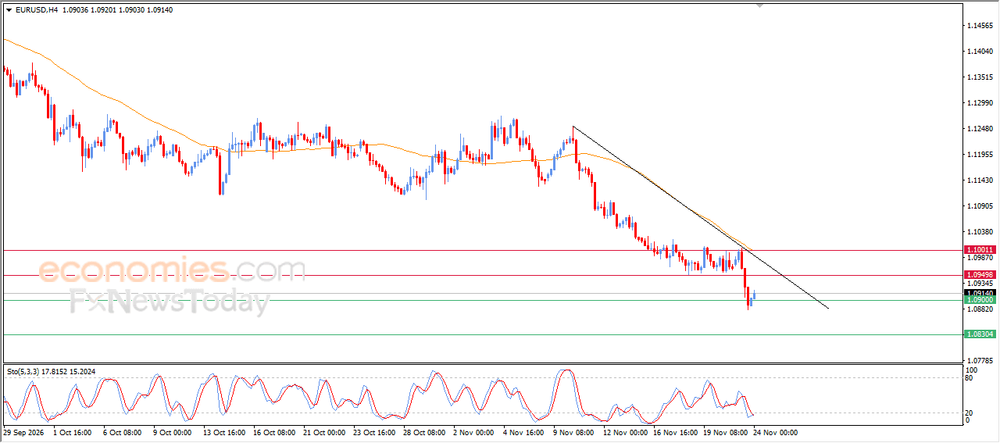
EUR/USD recovered modestly after testing support at 1.0900, reaching the final downside target in Economies.com's earlier analysis. The November 24 assessment still showed a short-term downtrend, with US inflation data and December interest-rate decisions ahead.
 Layla Haddad
Recovery faces technical resistance
The intraday rise retraced some earlier losses as relative strength indicators began to ease out of oversold conditions. A positive crossover was starting to form, according to Economies.com.
The broader technical signals remained bearish. EUR/USD was below its 50-period exponential moving average, or EMA50, which continued to act as dynamic resistance. A minor descending trend line also supported the prevailing short-term decline.
In analysis published around November 19, Admirals identified another closely watched level near 1.0900: the 61.8% Fibonacci retracement at about 1.0904. Measured from the 2025 low of 1.0176 to the 2026 high of 1.2081, that level was then seen as the next major support. Analysts viewed a sustained break beneath it as a signal pointing toward the 2025 low.
Earlier losses and competing forecasts
The latest support test followed a five-session retreat from roughly 1.1250. On November 18, EUR/USD reached 1.0953, its weakest level since April 2025, before ending the session at 1.0975. It had not closed above 1.1000 since November 11.
Forecasts published around November 16-19 differed on the potential extent of further losses. ING said it would be content to see the pair stabilize at 1.10-1.11, while warning of a significant risk of a break lower.
Societe Generale identified a potential support zone at 1.0950-1.0880 and a risk of a deeper retracement toward 1.0650. MUFG considered a move to about 1.0800 plausible if crude oil rebounded sharply and US yields increased.
Rate differentials favor the dollar
Analysts cited the roughly 1.7-percentage-point gap between US and German two-year government yields as the main force behind dollar strength and euro weakness. By mid-to-late November, the Federal Reserve's target range was 3.75%-4.00%, while the European Central Bank's deposit rate was 2.50%. Both had been in place since September 16, leaving a policy-rate gap of about 1.4 percentage points.
Stronger eurozone inflation figures had not prevented the earlier selloff. Final October data put annual headline HICP inflation at 4.0%, compared with 3.8% in September. Core inflation was revised from an initial 2.5% to 2.6%, while energy inflation reached 21.0%.
EUR/USD nevertheless hit its then-19-month low on the day of that release. A December ECB rate increase was already more than 90% priced in.
French fiscal and economic pressure
France's political and fiscal strains added to pressure on the euro during November. With parliament divided over the 2027 budget, the yield premium on French 10-year debt over German Bunds widened to about 1.6 percentage points, the largest gap since the eurozone debt crisis.
French activity figures released on November 23 also disappointed. The flash manufacturing purchasing managers' index registered 47.9 against expectations of 49.8, while the services reading was 46.6 versus a forecast of 47.2. Those results kept the euro under pressure.
Inflation release and policy decisions ahead
The October US personal consumption expenditures report was due on the morning of November 25. Analysts expected monthly increases of 0.3% in both headline and core PCE. CMC Markets said a stronger reading could take EUR/USD below 1.09 and potentially toward 1.075. Separately, it said an extension of the bear flag formed between September and early November suggested a possible move to around 1.07.
Around November 26, EU leaders were expected to choose the next ECB president. Pablo Hernández de Cos was considered the most likely successor to outgoing President Christine Lagarde. StoneX characterized the expected choice as largely priced in and unlikely, by itself, to produce much market movement.
The Fed's next decision was scheduled for December 9, followed by the ECB on December 17. As of around November 20, traders put the probability of a December 17 ECB increase above 90%, implying a rise in the deposit rate from 2.50% to 2.75%. A December Fed rate hike was also widely expected.