Standard Chartered and OCBC Test Cross-Bank Dollar Payments Through StraitsX
Standard Chartered, OCBC and StraitsX completed a proof of concept linking the banks' separate tokenized deposit networks for US dollar payments outside normal banking hours. Conducted under Singapore's BLOOM initiative, the test showed potential for settlement within minutes but has not advanced to commercial deployment.
 Layla Haddad
How the banks connected their systems
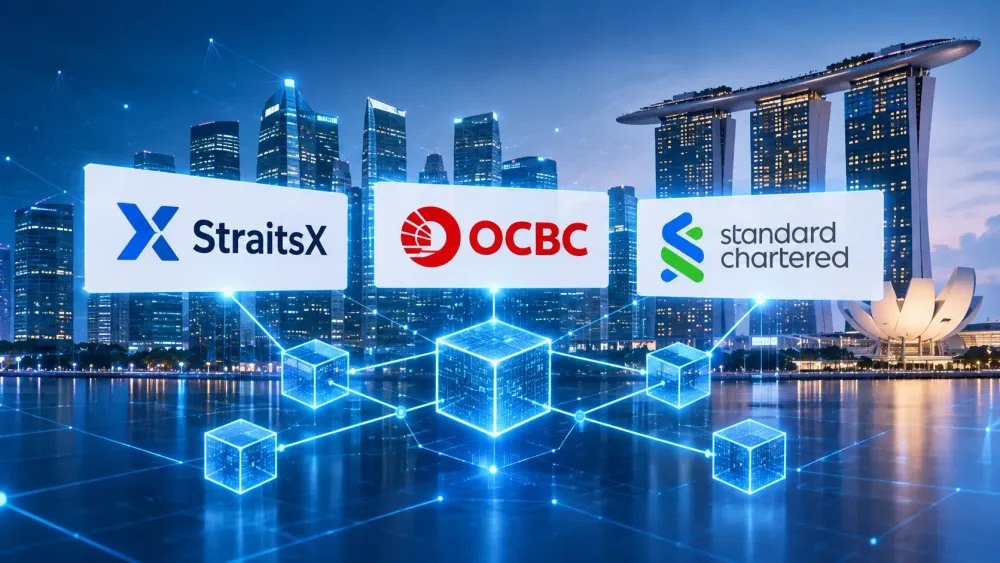
Standard Chartered and OCBC each supplied a tokenized deposit environment, with StraitsX providing the shared settlement infrastructure between them. The test covered the payment process from initiation through compliance screening and liquidity checks to settlement and confirmation.
Connecting these networks requires more than transferring a token. A tokenized deposit is a claim on the bank that issued it, not a freely transferable digital asset. Separate banks may also use different blockchain platforms and standards, making additional infrastructure and settlement arrangements necessary. In this test, StraitsX enabled payment instructions and settlement information to pass between the banks after the required checks.
The participants found that the model could also lessen the need for bilateral prefunding: money banks hold with one another in advance to facilitate payments. For corporate treasury teams and financial institutions, such connections could make liquidity more accessible across markets and allow cross-border settlement to continue beyond conventional banking cutoffs.
Those possibilities remain subject to further work. A commercial rollout would require engagement with regulators, approvals from participants and reviews of settlement finality, liquidity management, legal responsibilities and financial-crime controls.
StraitsX holds a Major Payment Institution license from the Monetary Authority of Singapore (MAS) and issues the XSGD and XUSD stablecoins. The company describes its role as a stablecoin-native settlement layer for payments and cross-border transactions. Stablecoins and tokenized deposits remain distinct: the latter are claims on commercial banks, while stablecoins have separate issuance arrangements and regulatory and contractual frameworks.
Other banks move from tests to live services
The Standard Chartered-OCBC experiment follows other efforts to connect bank-issued digital money across networks. On November 16, DBS and Kinexys by J.P. Morgan launched a commercial service for institutional clients to move US dollars between tokenized deposit accounts in Singapore and the United States around the clock. Ant International was its first client, using it for treasury and liquidity management.
An earlier test used infrastructure from Swift. In September, Citi and DBS made a cross-border tokenized deposit transfer over a weekend through Swift's blockchain-based Digital Ledger. The payment between Singapore and the United States settled in minutes.
Together, these projects illustrate banks' growing focus on linking their tokenized money systems rather than keeping each network isolated. The Standard Chartered-OCBC project is still experimental, unlike the commercially operational DBS-Kinexys service.
BLOOM's regional scope and safeguards
BLOOM stands for Borderless, Liquid, Open, Online and Multi-currency. Cointelegraph reported that MAS launched the initiative in October 2025, building on Project Orchid, which started in 2021 to examine uses for a digital Singapore dollar.
The MAS-led initiative brings banks and other financial institutions together with payment networks, technology companies and policymakers to develop domestic and cross-border payment infrastructure for tokenized commercial bank money and regulated stablecoins. MAS identifies three priorities: cross-jurisdiction acceptance and settlement, interoperability among digital money arrangements, and programmable safeguards, including identity checks, sanctions screening and transaction controls.
Its remit extends beyond cross-border payments. According to Cointelegraph, BLOOM also covers corporate cash management, trade finance and payments carried out by AI agents within predefined limits.
Bank Negara Malaysia and the Bank of Thailand joined the policy collaboration with MAS in October. Malaysia's central bank had separately announced in February 2026 that three initiatives would test ringgit stablecoins and tokenized deposits during 2026 for wholesale payments, both domestically and across borders.
MAS's October 23, 2026, announcement listed Anchorage Digital, Ant International, Circle, Coinbase, DBS, J.P. Morgan, Kasikornbank, OCBC, Partior, Schroders, Standard Chartered, StraitsX, Stripe, Temasek, UOB and Xweave as existing BLOOM participants. It named nine additions: Airwallex, Mastercard, Maybank, Monee, Nium, Ripple, ShopeePay, Visa and the World Bank Group.
New cross-asset pilot and implementation guide
BLOOM also provided the setting for a separate announcement by Ant International on November 19, 2026. Its Whale Orchestration Protocol enables Delivery-versus-Payment transactions between tokenized deposits and tokenized money market funds. Ant International completed pilot transactions with DBS and Franklin Templeton; the parties described them as Singapore's first successful demonstration of cross-asset interoperability between those two types of tokenized instruments.
BLOOM Field Guide 2 was published the same day and announced at the Singapore FinTech Festival. It sets out a common framework for implementing digital money arrangements, intended to reduce the number of separate arrangements institutions need to negotiate with individual counterparties or markets.