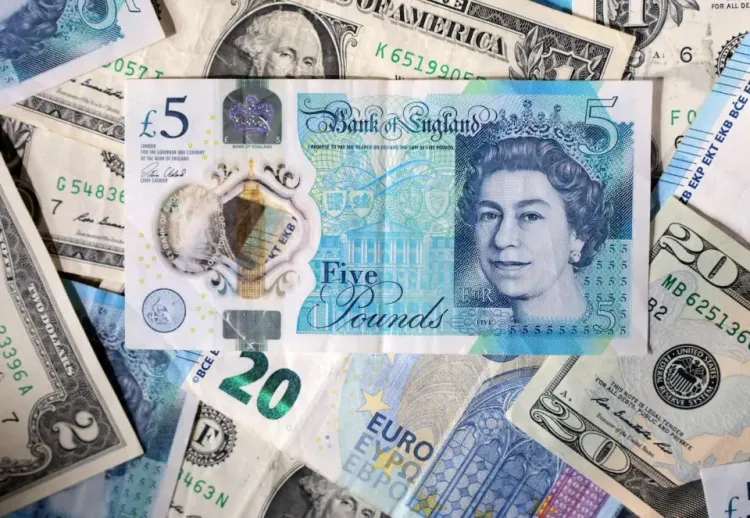
Euro and pound extend gains as lower Treasury yields weigh on dollar
The euro and British pound continued their recovery against the dollar on Friday, October 30, as US government bond yields fell. Expectations of further rate increases in Europe also supported the currencies following this week's central bank decisions.
 Layla Haddad

Currency gains follow retreat in US yields
Economies.com reported that the euro was trading near $1.1192, a gain of 0.10% for the session, while sterling rose 0.11% to $1.3392. Against the euro, the pound remained near a 17-month high, with EUR/GBP around £0.8357.
Renewed selling in US technology shares prompted investors to buy government bonds, pushing Treasury yields lower and weakening support for the dollar.
The Federal Reserve left interest rates unchanged earlier in the week without providing much clarity about its December decision. Its federal funds rate range remains 3.75%-4.00% following a September increase. TradingNEWS reported that late-October futures pricing implied an 89% to 94% probability of another increase in December.
Pound supported by budget reception and rate expectations
Sterling drew support from the subdued market response to Chancellor John Healey's October 28 budget. Despite Britain's strained finances, the package contained no major surprises.
The budget put fiscal headroom at £15 billion, compared with £23.6 billion in March, and increased the banking surcharge from 3% to 6%. Britain's 10-year gilt yield declined 2 basis points that day to 5.323%, according to Reuters via Yahoo Finance.
Attention now turns to the Bank of England's November 5 meeting. TradingNEWS reported that markets in late October assigned a roughly 90% to 95% chance to a quarter-point increase, which would take Bank Rate from 3.75% to 4.00%. Money markets also anticipated additional tightening next year.
At the meeting that ended September 16, the Monetary Policy Committee voted 6-3 to keep Bank Rate at 3.75%. Megan Greene, Catherine Mann and Huw Pill favored raising it to 4.00%.
UK annual consumer price inflation reached 3.5% in September, up from 3.1% in August and the highest reading since October 2025. Services inflation rose to 3.7%, TradingNEWS reported.
ECB pause leaves December increase in view
The European Central Bank's October 29 decision did not eliminate expectations of another rate increase before year-end, helping support the euro. The bank held its deposit rate at 2.50%, its main refinancing rate at 2.65% and its marginal lending rate at 2.90%, after two quarter-point increases earlier in 2026, most recently in September.
The ECB warned that elevated energy costs could keep inflation higher for longer. Eurozone inflation had accelerated from 3.2% in August to 3.8% in September, nearly twice the bank's 2% target, according to Yahoo Finance and Euronews.
Worries about France's public finances nevertheless restrained the euro's advance. French 10-year borrowing costs exceeded 5% in late October for the first time since 2002. On October 29, the yield was around 5%, roughly 155 basis points above the German equivalent. Moody's retained France's Aa3 credit rating with a negative outlook.
The policy outlook also faces uncertainty over ECB President Christine Lagarde's departure. She will leave on February 7, 2027, about nine months before the end of her eight-year term. The ECB offered no explanation. Yahoo Finance and Euronews reported that coverage dating back to February 2026 had linked the timing to France's April 2027 presidential election.
Price levels and the next policy decision
Economies.com identified $1.1215 as resistance for the euro and $1.1170 as support. For sterling, it cited a possible test of $1.3407, with near-term support at $1.3374.
The Bank of England's November 5 decision could shape whether the pound continues to outperform the euro.