Ackman Says SpaceX Could Need $1 Trillion in Borrowing to Meet Musk's Compute Targets
Bill Ackman says Elon Musk's data-center expansion goals could require SpaceX to borrow as much as $1 trillion. Wccftech's analysis suggests a lower financing requirement, even as Musk outlines a much larger ambition: building AI satellites on the Moon and launching them into deep space.
 Layla Haddad
The cost of the 2027 expansion
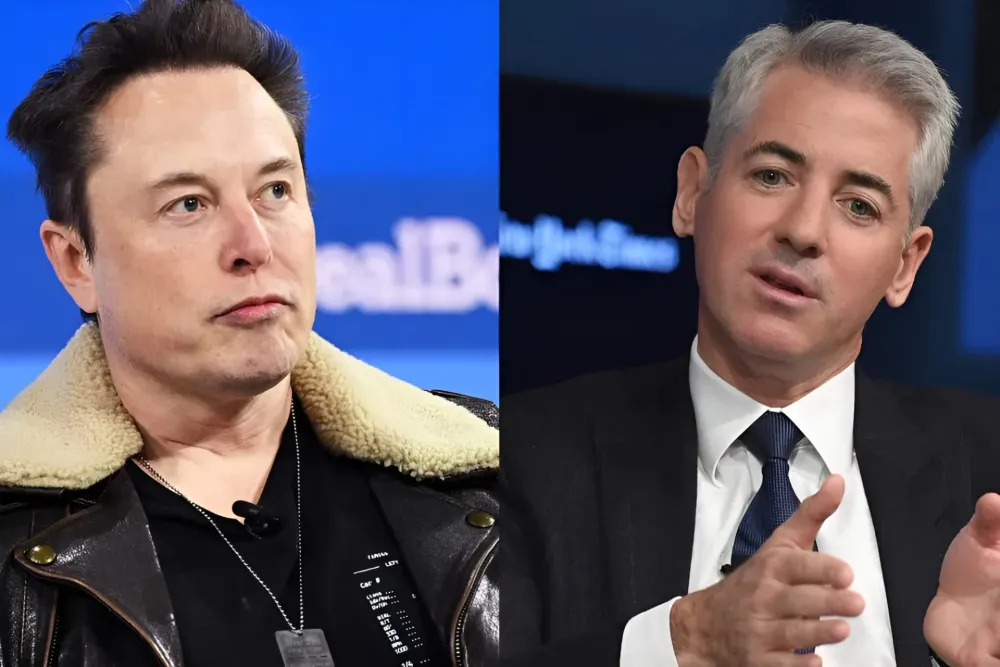
Ackman tied his estimate to the compute projections Musk presented on SpaceX's earnings call. "If he meets his objective, he might have to borrow a trillion dollars of capital," the billionaire hedge fund manager said.
SpaceX is targeting 2.5-3 gigawatts of compute capacity by the end of 2026. Its plans include 1.2 million Nvidia Blackwell GPUs at the Colossus 2 data center alone. For 2027, the company plans to add 13 GW and is targeting total capacity of around 20 GW.
Wccftech interprets Ackman's estimate as an implied cost of about $50 billion per gigawatt across the 20 GW target. It contrasts that with expected compute-related capital spending of $390 billion in 2027, or roughly $30 billion for each of the 13 GW planned for that expansion phase. On that basis, the publication suggests SpaceX's debt needs could be substantially below $1 trillion.
SpaceX has already arranged a major equipment-financing commitment. On October 24, 2026, it signed a binding agreement with an Apollo Global Management-managed entity for roughly $40 billion in GPU and data-center equipment financing. Under the master finance lease, the entity will purchase hardware and lease it to SpaceX for individual terms of about five to five-and-a-quarter years.
The transaction is expected to close before the end of 2026, with equipment deliveries starting in the first half of 2027. It will support deployment of Nvidia's next-generation Vera Rubin chips. Funds associated with BlackRock and KKR have also committed financing.
AI revenue and investment returns
SpaceX's latest earnings release identifies its Super Intelligence segment as its largest business unit. The segment generated $7.56 billion in third-quarter 2026 revenue, a ninefold increase from $813 million a year earlier.
CFO Bret Johnsen said in October that SpaceX was seeing "less than one-year payback periods" on its super-intelligence infrastructure investments while expanding the compute that supports Grok and its cloud services.
Earlier reporting on SpaceX's first earnings call as a public company put total second-quarter 2026 revenue at $7.8 billion, up 92% from a year earlier. Its space segment nevertheless recorded an adjusted loss as it spent on Starship.
Bernstein cited improved prospects for the terrestrial AI expansion when it raised its SpaceX price target from $248 to $267 in late October, retaining an "Outperform" rating. The firm also said a multitrillion-dollar valuation ultimately depends on orbital data centers succeeding.
Ackman's concerns center on neoclouds
Despite the scale of his SpaceX borrowing estimate, Ackman said he believes the broader AI infrastructure expansion is sustainable. He described intelligence as "an enormously valuable asset" and argued that demand for the computing capacity behind it should endure. In his view, hyperscalers have both the financial resources and the creditworthiness to fund their projects.
His concern is greater for pure-play neoclouds, providers of GPU-as-a-Service and AI inference capacity. He compared them to "highly levered real estate developers playing a theme" and said they are "much more sensitive to the cost of capital."
Musk has issued similar warnings. According to CNBC, he predicted in October 2026 that the more than 200 neocloud companies would undergo widespread failures and consolidation, leaving only a small number of survivors.
In a separate X post, Musk said debt markets had almost entirely stopped providing money to companies without substantial revenue outside AI data centers. Daytona.io, which provides isolated virtual sandboxes for AI-generated code and agent workflows, cited that post when reporting that a GPU supplier had sought to renegotiate a signed contract and that banks had halved their lending offers after the post went viral.
Lunar factories and deep-space compute
Musk's longer-term proposal extends far beyond terrestrial data centers. Responding to an X article by Sequoia's Maguire about his economic modeling of SpaceX, Musk wrote: "Launching super intelligence satellites into deep space with a mass driver on the Moon can achieve >>petawatt/year capability, which would far exceed the best case value of Earth's economy."
The concept calls for manufacturing large numbers of AI compute satellites on the Moon, then sending them into deep space, where continuous sunlight would supply power. For comparison, Wccftech puts humanity's current energy use at around 20 terawatts; a petawatt is 50 times that level.
A long electromagnetic launch track, similar to the technology used by maglev trains, would propel the satellites off the lunar surface. Wccftech cites the difference in escape velocity: 2.38 kilometers per second on the Moon, compared with 11.2 kilometers per second on Earth. The publication estimates that realizing the vision would likely require trillions of dollars in additional financing.
SpaceX described elements of the proposal in regulatory filings before its June 2026 IPO. The company plans lunar factories for large-scale AI compute satellites, using aluminum, titanium and silicon mined from lunar regolith while bringing chips and other lightweight components from Earth.
Those filings connect an electromagnetic launcher, described as a "lunar mass driver," to a petawatt-scale constellation of orbital AI compute. SpaceX wants to begin deploying that constellation as early as 2028.