UAE fatal crashes put focus on truck safety, fines and route changes
Eleven people have died in a bus-and-truck collision in Ras Al Khaimah, the UAE Ministry of Interior said, following the November 12 Fujairah crashes that killed 14. Authorities are investigating both incidents as police introduce truck-congestion alerts and prepare to change access to an industrial area in Umm Al Quwain.
 Mariam Al Mansoori
Investigations in Ras Al Khaimah and Fujairah
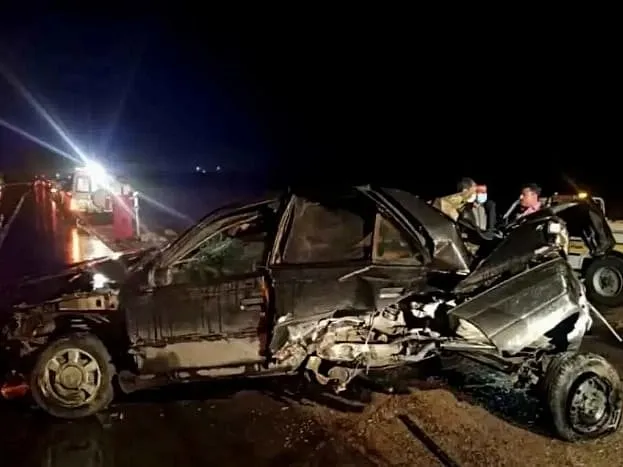
The Ras Al Khaimah collision occurred on Al Watan Street. Emergency responders worked with ambulance crews and Civil Defence to rescue victims, provide medical care and secure the road while traffic was managed around the scene. The Ministry of Interior said investigators were still establishing the cause and would release their findings when the inquiry was complete.
The National reported on November 24 that 14 people were injured. Citing Ras Al Khaimah Police, it said the bus was carrying 41 people when it struck a truck that had stopped on the roadside because of a mechanical failure. The location was Al Watan Street along the Southern Ring Road.
In Fujairah, investigators are examining two successive collisions near maintenance work on Sheikh Khalifa bin Zayed Road on November 12. The right-hand lane was closed. Preliminary findings indicate that a vehicle first struck a stationary truck; a second truck, carrying two shipping containers, then hit several vehicles before overturning. Authorities said 18 vehicles and five trucks were involved.
The 14 people killed in Fujairah were 10 Emiratis and four Indians. Around 30 people were injured, including eight Emiratis, seven Indians, six Omanis, three Egyptians, two Jordanians, two Pakistanis and two Brazilians, according to the Ministry of Interior.
The UAE Public Prosecution ordered the truck driver held in pretrial detention while he receives hospital treatment, and authorities confiscated his passport and driver's license. Investigators are considering possible vehicle defects and road safety violations through technical and on-site inspections, brake checks, tracking and speed-recording data, and witness accounts.
Congestion warnings and a new truck route
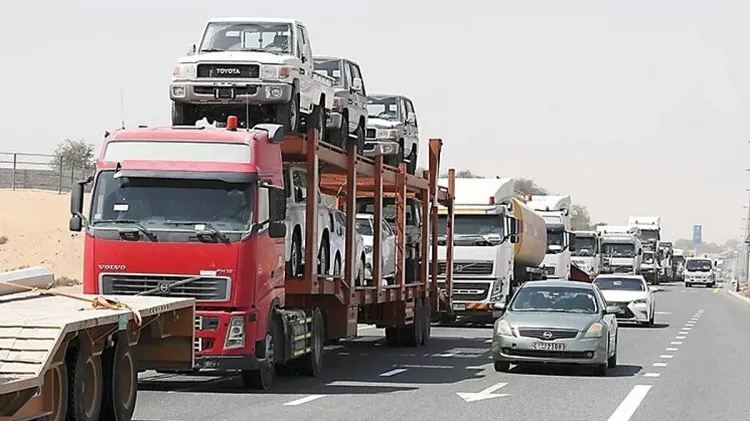
Drivers approaching truck congestion in Fujairah now receive automatic mobile notifications in Arabic, English and Urdu. Fujairah Police's system displays the heading "Warning Alert" and the message: "Warning … Truck congestion ahead. Slow down and keep a safe distance for your safety."
Police have also deployed more patrols on internal and external roads that carry heavy vehicles. Officers will monitor traffic, locate congestion hotspots and regulate truck movements as needed. Motorists have been urged to stay attentive, avoid distractions and slow down before reaching stationary or slow-moving traffic.
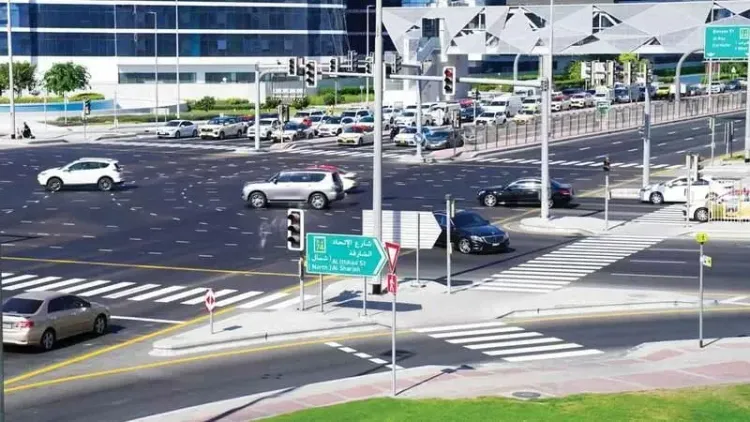
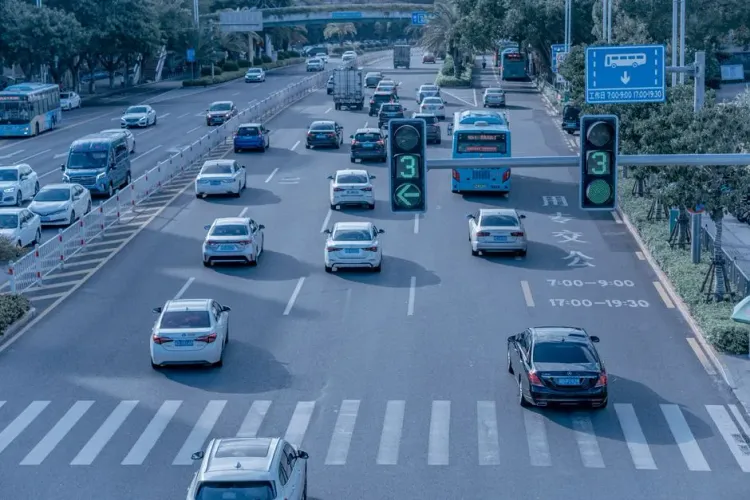
A separate access change takes effect in Umm Al Quwain on December 1, 2026. Trucks bound for Umm Al Thuoob Industrial Area must bypass the entrance opposite Exit 103 on Highway 311, continue to Exit 110 and take the return route toward Umm Al Quwain. They must then use the designated Free Trade Zone entrance to reach the industrial area.
Umm Al Quwain Police have placed a "No Trucks" sign and a surveillance camera at the entrance being closed to heavy vehicles. The change is intended to regulate truck movements and improve traffic flow. Police said drivers who disregard the restriction face a Dh1,000 fine and four black traffic points.
Existing penalties cover routes, loads and vehicle condition
After the Fujairah crashes, the Ministry of Interior drew attention to 11 heavy-vehicle offenses covered by Ministerial Resolution No. 178 of 2017. These are existing penalties, not findings about what caused the crashes.
Causing a crash in which a truck or another vehicle overturns carries a Dh3,000 fine and a one-year license suspension. The same penalties apply to overtaking where it is prohibited. Cargo that falls or spills from a truck brings a Dh3,000 fine and 12 black points; leaving a truck's load uncovered also carries a Dh3,000 fine.
Drivers who depart from designated heavy-vehicle routes or lanes face a Dh1,500 fine and 12 black points. Entering a road or area closed to heavy vehicles carries Dh1,000 and four black points. A load that endangers others or damages roads brings a Dh2,000 fine and six black points, while failure to follow loading and unloading procedures carries Dh1,000 and four black points.
Unroadworthy tires can result in a Dh500 fine, four black points and seven days of vehicle impoundment. Missing rear reflective stickers carries a Dh500 fine. Operating certain industrial or construction vehicles without the required permit brings a Dh1,500 fine.
Truck crash figures and Dubai's safety measures
Ministry of Interior statistics record 1,136 UAE traffic accidents involving heavy trucks from 2022 through 2025. The annual total rose from 208 in 2022 to 271 in 2023, reached a four-year high of 332 in 2024 and fell to 325 in 2025.
Dubai's Roads and Transport Authority separately reported a 20% decline in truck-related traffic incidents in the emirate in 2025. It credited measures that included more than 30 awareness campaigns, rear safety barriers installed on trucks, a rapid-response framework for removing broken-down trucks from main roads, and 14 truck rest areas across six locations. The authority also reported an 8% increase in technical inspections through joint night patrols that year.
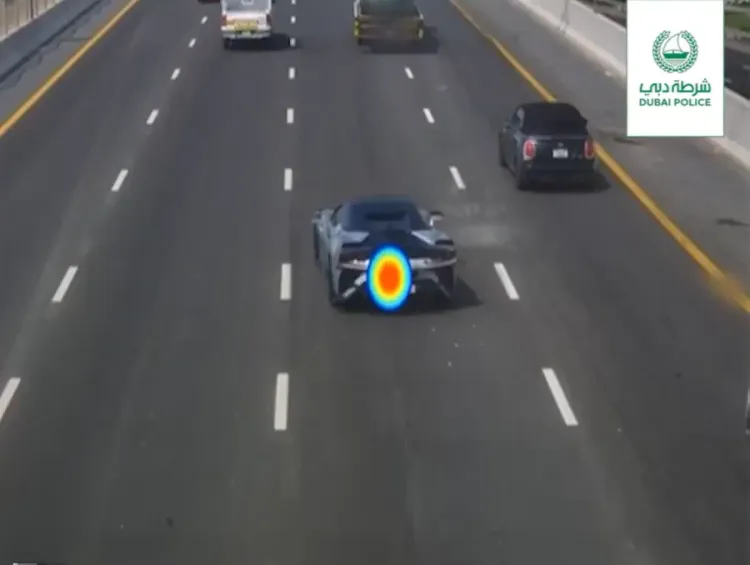
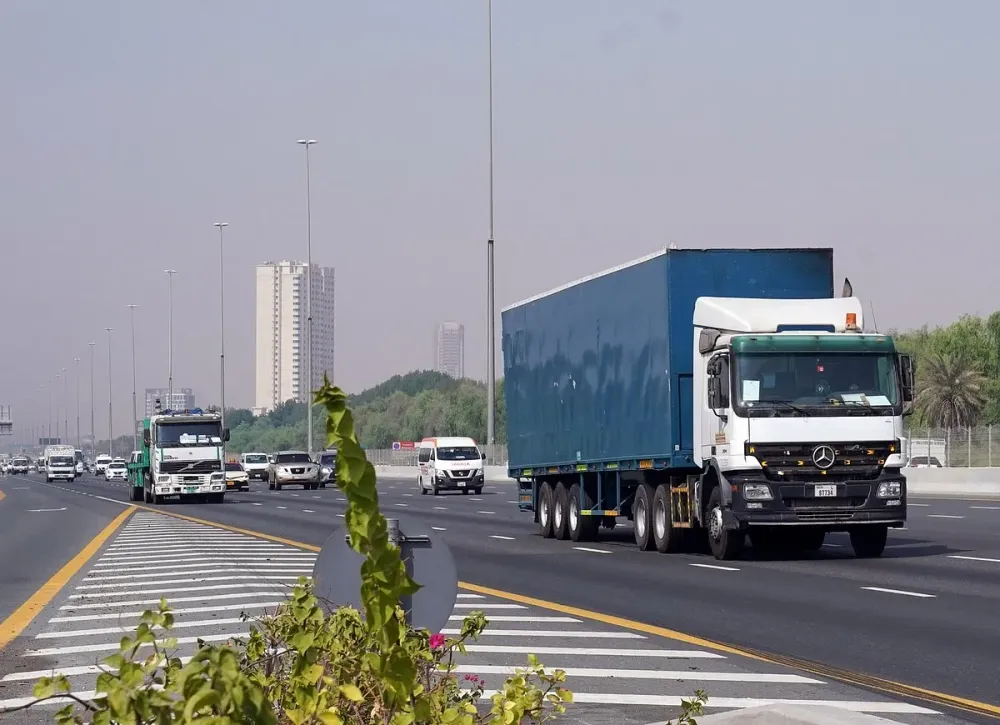
Through its Aman Roads initiative, Dubai Police have warned both drivers and motorcyclists about the space heavy vehicles need. Compared with smaller vehicles, trucks and buses have larger blind spots, need more distance to stop and have less room to maneuver.
Police identified six behaviors to avoid: passing on the right, remaining in blind spots, tailgating, squeezing alongside a turning truck, taking risks at roundabouts or roadworks, and changing lanes abruptly. Drivers should pass on the left only when safe and avoid lingering beside a truck. If its side mirrors are not visible, its driver may be unable to see them.
The advice also calls for extra following distance, enough turning space at intersections and narrow construction zones, and early signals before lane changes. Drivers should not weave between trucks or cut in immediately after passing. Authorities have also urged truck drivers to check their vehicles, secure cargo and comply with designated routes and traffic rules.
Further rules take effect January 1
Cabinet Decision No. 174 of 2026 introduces additional requirements from January 1, 2027. Heavy-vehicle and bus drivers will be allowed no more than nine hours of driving in any 24-hour period, unless the Federal Traffic Council changes that limit.
The decision also raises the empty-weight threshold for classification as a heavy goods vehicle from more than 2.5 metric tons to more than 3.5 metric tons. Buses carrying 9 to 26 passengers will be classified as light buses, while those carrying more than 26 will be heavy buses. Loads will no longer be permitted to extend beyond a heavy vehicle's dimensions.