Italy Faces $30,000-a-Day Bill for Seized Sailing Yacht A as Legal Dispute Continues
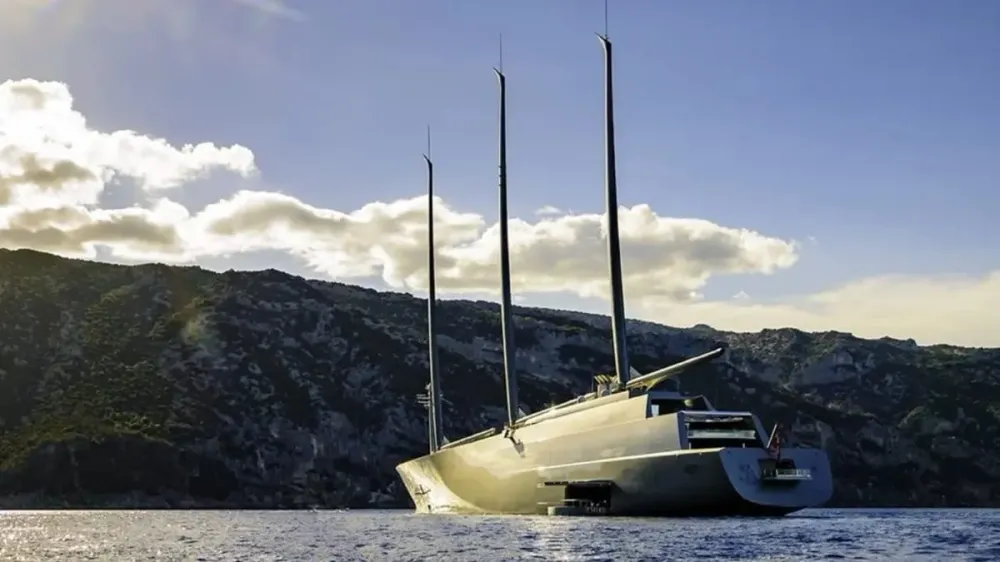
Italian taxpayers are covering roughly $30,000 a day to maintain Sailing Yacht A, the $600 million vessel seized in Trieste in March 2022 after sanctions against Russian billionaire Andrey Melnichenko. The yacht remains in port, with generators powering climate control to protect artworks, including paintings by Claude Monet, while a court dispute over the seizure remains unresolved.
 Mariam Al Mansoori
The cost of keeping the yacht in port
Sailing Yacht A has stayed in Trieste for nearly five years, but its systems still need fuel and staff. Le Parisien puts maintenance expenses at approximately $30,000 a day, or $11 million a year, including insurance, generator fuel and climate control. A 20-person cleaning staff also helps keep the onboard systems operating.
The vessel reportedly uses 400 gallons of diesel each hour, costing around $2,500. Its air conditioning cannot simply be switched off without damaging the valuable paintings aboard.
Annual operating expenses for superyachts are generally estimated at about 10 percent of their purchase price, though such estimates usually concern vessels in use rather than those held in port.
Designed by Philippe Starck, the 468-foot Sailing Yacht A has three rotating carbon masts, each as tall as an eight-story building. It has also drawn criticism for its appearance, once being labeled the "world's ugliest yacht." CNN estimates the fortune of Melnichenko, a Russian banker and industrialist, at around $20 billion.
Trieste Mayor Roberto Dipiazza called the public expense a "disgrace" and threatened to sell the yacht or sail it away. "It will eventually cost him less to buy a new yacht than to pay back all we have spent," he told CNN. "And where does that leave us? We could be paying for this monstrosity for years."
A trust-ownership dispute keeps the case open
Melnichenko contested the seizure in the summer of 2022, arguing that he did not own the yacht directly. His position was that it belonged to Valla Sails through a trust established by his wife. The challenge went before a Rome court that year and later reached the Court of Justice of the European Union.
On May 21, 2026, the EU court set out how sanctions should apply to trust-held assets in a group of joined cases. Under its ruling, a sanctioned person's "legal or de facto ability to use, benefit from, dispose of, or influence" an asset is sufficient to meet the sanctions-law test of "belonging to" or "control." Courts must consider all the facts, not just the documents establishing a trust.
That decision did not resolve Melnichenko's challenge. The Lazio Regional Administrative Court in Rome must now apply the broader test to his trust arrangement. Sailing Yacht A remains seized pending that assessment.
According to reporting cited by MariTrace, Italy had spent around $47 million maintaining the yacht by mid-2026. That reporting also indicates that, if the Lazio court finds the freeze was improperly imposed, Melnichenko could recover the vessel without repaying Italy's maintenance expenses.
Other yachts are adding to Italy's bill
Italy is also paying to maintain other Russian-linked vessels. Local press reports cited by CNN put the expense for the 465-foot Scheherazade at more than $15 million for Tuscan taxpayers since its sequestration in Marina di Carrara.
In Imperia, the bill for the 210-foot Lady M has reached around $2 million, according to Matteo Bonjean, vice director of the port of Marina di Imperia, speaking to Forbes. Its owner, Alexei Mordashov, is a Putin associate and the majority shareholder in steel and mining company Severstal.
The distinction between freezing an asset and finally confiscating it extends well beyond Italy. Forbes reporting cited by MariTrace says only four of roughly 20 Russian-linked superyachts frozen or detained by Western governments in 2022 have reached final, formal confiscation. Those yachts were collectively valued at $4.3 billion at the time. Across blocked Russian oligarch assets totaling $58 billion, about $3 billion, or 5 percent, has been formally seized anywhere.
Sales elsewhere have had mixed outcomes
Some jurisdictions have sold detained vessels. Reuters reported that Gibraltar auctioned the 236-foot Axioma, linked to Russian steel magnate Dmitry Pumpyansky, for about $37.5 million. The United States has sold several yachts, among them Amadea, owned by Russian politician Suleiman Kerimov, who has been sanctioned twice.
A sale has not been possible for every vessel. In Montenegro, the 353-foot Luminosity, belonging to sanctioned Russian Andrey Guryev, has been left to deteriorate. An attempt to sell it for €135 million in 2024 was blocked.
A technical survey could bring another expense
For Sailing Yacht A, a mandatory class renewal survey could be due before January 2027. The review would establish whether the vessel still complies with technical and safety requirements. Reported cost estimates range from about €2 million to €10 million ($2.78 million to $11.39 million), depending on any problems inspectors identify in the hull, propulsion, electrical infrastructure, safety equipment or complex sailing rig.
Italian outlet Il Piccolo has suggested that shipyards in Trieste and Genoa could compete for the work. The Italian Treasury is reportedly expected to cover the upfront expense.