Board of Peace faults Israel and Hamas as new Gaza offensive begins
A new report from the US-led Board of Peace says Israeli strikes, Hamas armed activity and unresolved political decisions are holding up Gaza's ceasefire arrangements, leaving its planned civilian administration and international security force unable to deploy. The findings emerged Wednesday as Israel began one of its largest ground operations in Gaza since the October 2025 truce.
 Sara Khan
Transition remains stalled
The report, seen by The National, is the board's second to the UN Security Council. The council is expected to consider it this month. It faults both Israel and Hamas for failing to fulfill key ceasefire commitments and warns that continued delays threaten reconstruction and a political transition toward Palestinian self-determination and statehood.
Neither of the two bodies intended to oversee that transition is operating inside Gaza: the National Committee for the Administration of Gaza (NCAG) has not entered the territory, and the International Stabilization Force (ISF) has not deployed. Hamas and other Palestinian factions accepted a 15-point road map in July that calls for giving up their weapons and handing over civilian and security authority, but implementation has made little headway.
The board said Israel still had not taken the decisions necessary to train and deploy a Palestinian civilian police force to replace Hamas. It called for those decisions, and approval for the NCAG and ISF to enter Gaza, "without delay."
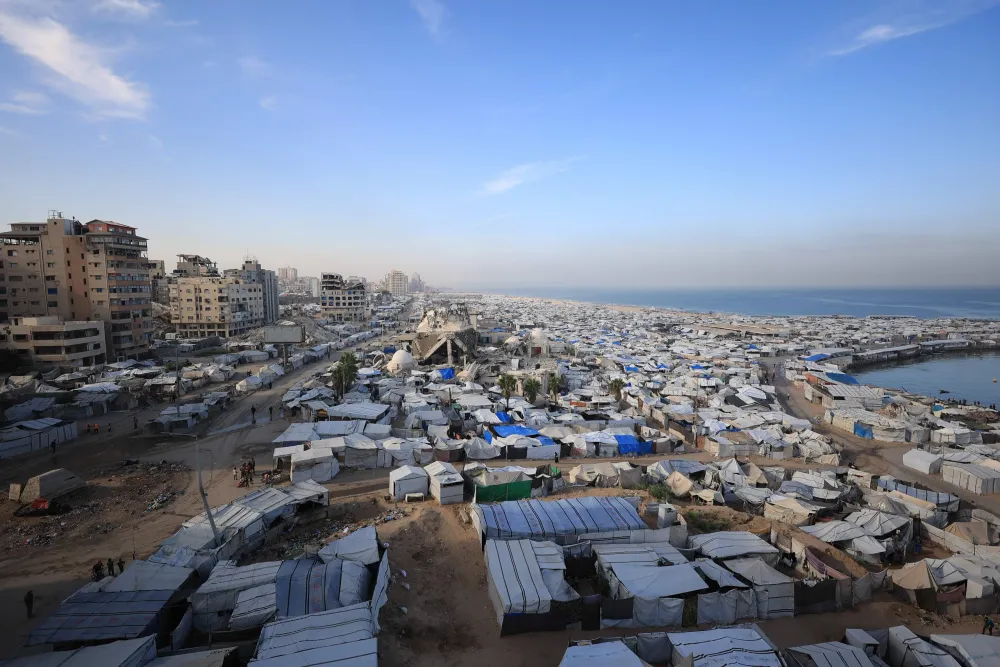
"Every day that Israel continues strikes against Hamas targets, it delays putting Hamas's agreement to the road map to the test," the report said. "Meanwhile, Hamas militant activity continues … and the population faces another winter in tents and rubble."
The report also accused Hamas of continuing armed operations, including attacks on Israeli troops, and taxing incoming goods in ways that affect supplies of basic commodities. It urged the group to fulfill its July 30 commitments by ending military activity, weapons possession, tunnel construction and interference with aid.
"A ceasefire that delivers nothing visible cannot be sustained indefinitely," the board warned.
Troops advance near central Gaza camps
Residents fled areas of central Gaza on Wednesday as Israeli forces moved near the Bureij and Nuseirat refugee camps. Residents reported tanks and bulldozers near the camps, while sections of the territory's main north-south road were closed and people were ordered to keep away.
Artillery fire and sustained gunfire were reported near the "yellow line," which delineates Israeli-occupied territory in Gaza. Israel's military described the operation's target as "terrorist infrastructure."
The offensive was Israel's first publicly announced ground offensive since the ceasefire began. Hamas called it a breach of the truce and said the advance and displacement of people northeast of Nuseirat amounted to dangerous escalations.
Israeli Defense Minister Israel Katz said Wednesday that Israel would remain in Gaza until Hamas was dismantled and the territory demilitarized.
Who would govern and provide security
The board's May 2026 report described the road map as a joint effort by the ceasefire guarantors—Egypt, Qatar, Türkiye and the United States—and the High Representative for Gaza. It names the NCAG as the only legitimate transitional authority and requires Hamas to permanently end its military, policing and administrative activities.
Dr. Ali Sha'ath heads the NCAG, while Nickolay Mladenov serves as High Representative for Gaza. Major General Jasper Jeffers commands the ISF under unified US command. Indonesia has offered personnel for the force: at the board's inaugural meeting in Washington on February 19, 2026, President Prabowo Subianto said his country was ready to contribute at least 8,000 peacekeepers and potentially more.
President Donald Trump established the Board of Peace in November 2025. According to its May report, he signed its founding charter as chairman on January 16, 2026, before a launch ceremony in Davos, Switzerland, on January 22. The board has 28 member states.
Security Council Resolution 2803 endorsed the US-backed Comprehensive Plan to End the Gaza Conflict and welcomed the board's creation. Adopted on November 17, 2025, with 13 votes in favor, none opposed and abstentions by China and Russia, it requires written progress reports every six months. The board and temporary ISF are authorized through December 31, 2027, unless the council takes further action.
Winter shelter shortages persist
Flooding in November destroyed more than 6,000 family shelters and damaged another 17,400, according to the latest report. Meanwhile, more than 150,000 tents are waiting outside Gaza for delivery. The board urged Israel to remove restrictions blocking shelter materials and winter supplies.
Aid deliveries still fall short of the requirements in Resolution 2803, the board said. That resolution called for immediate deliveries at least matching the levels agreed to in January 2025.
The board had reported improvements in its May assessment: aid distributed during the ceasefire by UN agencies and humanitarian partners was up more than 70% from pre-ceasefire levels, with nearly 300,000 metric tons delivered. It also estimated that diversion of UN-facilitated in-kind aid had dropped to about 1% since November 2025, compared with a peak of roughly 90% during hostilities.
Recovery pledges and reconstruction needs
Donors have pledged about $17 billion for Gaza's recovery, the board said, with $280 million already "deployed for the preparation phase." The European Union and its member states have committed $1 billion to early recovery through Team Gaza, an initiative launched in July.
The report put the UAE's direct humanitarian assistance over the past three years at $4.33 billion, covering health care, food, water, shelter and logistics. Other countries have offered support to the transitional administration: Morocco for disarmament and reintegration, Egypt for police training, Kazakhstan for university scholarships for Gaza students, and Romania for medical evacuations.
A Rapid Damage and Needs Assessment by the World Bank, UN and EU estimated that Gaza would need $71.4 billion for recovery and reconstruction over the next decade. The board's May report cited that assessment and separately projected reconstruction investments of more than $30 billion.
That report described damage or destruction affecting about 85% of buildings and infrastructure. It estimated that 70 million tons of rubble must be cleared and roughly 350 kilometers of tunnels neutralized.
Hostage returns and the continuing death toll
The board's May report also documented hostage returns and prisoner releases. Of the 251 Israelis and foreign nationals taken captive on October 7, 2023, 168 returned home alive. The last living hostage was returned to Israel on October 13, 2025, and the last deceased hostage was recovered on January 26, 2026. Israel released 250 prisoners serving life sentences and about 1,700 Gazans detained after October 7, 2023.
The Hamas-led attacks on Israel in October 2023 killed about 1,200 people. Israel's subsequent military campaign has killed more than 74,700 Palestinians in Gaza.
Since the US-brokered ceasefire was reached in October 2025, more than 1,600 Palestinians, many of them civilians, and five Israeli soldiers have been killed in Gaza.