WHO declares historic opportunity to eradicate polio in Pakistan as cases plummet to three in 2026
Pakistan has recorded only three polio cases in 2026, down from 74 in 2024, prompting WHO to identify the next six to twelve months as critical for permanently eliminating the disease that once paralyzed thousands annually.
WHO sees 'historic opportunity' to end polio in Pakistan
Pakistan stands at a pivotal moment in its decades-long battle against polio, with the World Health Organisation declaring a "historic opportunity" to interrupt wild poliovirus transmission after the country recorded just three cases in 2026—a dramatic decline from 74 cases in 2024.
A high-level international delegation led by WHO Regional Director for the Eastern Mediterranean Dr Hanan Balkhy visited Pakistan to assess progress and reaffirm support for the government's eradication campaign. The delegation described the next six to twelve months as a critical window for eliminating the disease, urging Pakistan to sustain and intensify vaccination campaigns and surveillance efforts.
Remarkable turnaround after 2024 spike
The progress represents a remarkable turnaround. Pakistan reported 74 wild poliovirus cases in 2024, representing a more than twelve-fold increase from only six cases in 2023. Environmental surveillance detected 628 sewage samples positive for wild poliovirus in 2024, compared to 126 positive samples in 2023, indicating widespread virus transmission during that period.
However, the country achieved significant improvement in 2025 with 31 cases, demonstrating sustained progress before reaching only three cases by July 2026. Virus transmission is now largely restricted to southern Khyber Pakhtunkhwa. Over the past three decades, Pakistan has achieved a 99.8 percent reduction in polio cases, bringing it closer than ever to ending a disease that once paralyzed thousands of children every year.
"Discussions with national authorities and experts, together with the available evidence, show that Pakistan has a genuine opportunity to interrupt poliovirus transmission," Dr Balkhy said. "We have the tools: proven vaccines, the best available science, and the extraordinary commitment of hundreds of thousands of frontline health workers, backed by steadfast Government leadership. But this opportunity will only be realised if we intensify our efforts over the next six to twelve months – a period that will be critical."
Afghanistan faces steeper challenge
Pakistan and Afghanistan remain the only two countries in the world where wild poliovirus is still endemic. Afghanistan reported eleven wild poliovirus cases by mid-July 2026, nearly four times higher than Pakistan's three cases during the same period, highlighting the cross-border challenge.
Nigeria was removed from the list of polio-endemic countries in 2016 after successfully interrupting wild poliovirus transmission. When the Global Polio Eradication Initiative was launched in 1988, polio paralyzed an estimated 350,000 people annually across more than 125 endemic countries. Wild poliovirus type 2 was declared eradicated globally in September 2015, and wild poliovirus type 3 was eradicated in October 2019, leaving only type 1 still circulating in Afghanistan and Pakistan.
Strong political commitment
Dr Balkhy praised Pakistan Prime Minister Shehbaz Sharif and the Pakistani government for adopting a whole-of-government approach to the eradication campaign. "I commend Prime Minister Sharif and the Government of Pakistan for their strong leadership and the whole-of-government commitment to protecting every child from polio – not only in Pakistan, but also across the Region and the world," she said.
The WHO chief was part of a delegation that also included Mike McGovern, Chair of the Polio Oversight Board and Rotary International PolioPlus Committee, UNICEF Asia Pacific Regional Director Sanjay Wijesekera, KSrelief Senior Adviser Dr Ziad Memish, Gavi CEO Dr Sania Nishtar, Gates Foundation Global Development President Dr Chris Elias, and US Centers for Disease Control and Prevention Polio Team Lead Dr Omotayo Bolu.
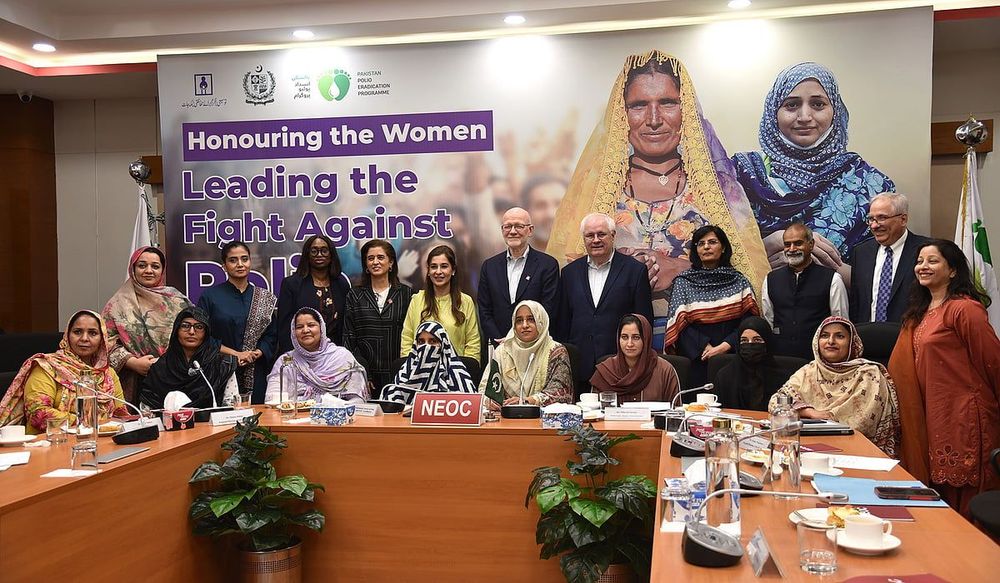
The delegation met Prime Minister Sharif, Federal Health Minister Syed Mustafa Kamal, Deputy Prime Minister and Foreign Minister Ishaq Dar, Prime Minister's Focal Person for Polio Eradication Senator Ayesha Raza Farooq, and Pakistan Army's Engineer-in-Chief Lieutenant General Kashif Nazir. They also met female frontline vaccinators, who make up around 60 percent of Pakistan's more than 400,000 polio workers.
Cross-border coordination essential
Before arriving in Pakistan, the delegation visited Afghanistan, which has reported seven polio cases this year. Dr Balkhy emphasised that both countries form a single epidemiological block and must work closely to stop virus transmission. "As a single epidemiological block, Pakistan and Afghanistan cooperation is vital to interrupt transmission together," she said.
She called for stronger links between routine immunisation programmes and emergency polio campaigns to ensure the virus does not return once transmission is interrupted. "No child in the Region – or the world – will be safe until every child is safe," she said.
World-class surveillance infrastructure
Pakistan's eradication programme is supported by one of the world's largest disease surveillance systems. The country operates more than 12,500 acute flaccid paralysis reporting sites and 127 environmental surveillance sites, backed by the WHO-accredited Regional Reference Polio Laboratory. Environmental surveillance involves testing wastewater samples to detect poliovirus circulation, which can identify asymptomatic carriers and virus presence before paralytic cases appear.
The Global Polio Eradication Initiative's 2022-2029 strategy requires $6.9 billion in total funding, with approximately $2.4 billion still urgently needed as of late 2024. The Polio Oversight Board, the highest decision-making body of the Global Polio Eradication Initiative, said the progress made in Pakistan demonstrates that eradication is achievable, provided momentum is maintained during the coming months.