Living Legacies opens at Louvre Abu Dhabi with a focus on heritage's caretakers
The people and techniques behind cultural preservation take center stage in Living Legacies: Protecting Heritage, Building Hope, opening November 25 at Louvre Abu Dhabi. On view through April 25, the exhibition gathers about 50 works from eight countries and examines efforts to protect heritage from conflict, disasters and climate change.
 Mariam Al Mansoori
The work behind the objects
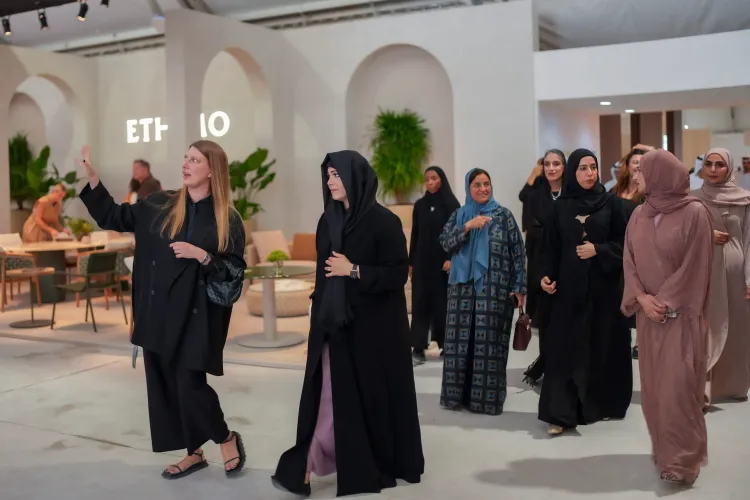
Conservation tools, photographs and video accounts from heritage professionals appear alongside ancient artifacts, manuscripts, ceremonial costumes and contemporary art. Across seven sections, curators Sandra Bialystok, Magdalena Ruiz Marmolejo and Bastien Varoutsikos direct attention to work that visitors rarely see in a finished museum display.
"Generally, we consider this to be behind the scenes. That's what we call it, but this time it's on the stage," Guilhem Andre, Louvre Abu Dhabi's director of scientific, curatorial and collections management, told The National.
Some of that work happened at the museum shortly before the opening. Maria Luisa Russo restored manuscripts from Djenne, Mali, in its laboratories. She founded Amalia, an Italian organization that partners with the International Alliance for the Protection of Heritage, known as Aliph.
Aliph organized the exhibition with Louvre Abu Dhabi to mark a decade of its work. The Swiss-based foundation has supported more than 650 projects in 65 countries. Founded in Geneva in 2017 at the initiative of France and the United Arab Emirates, it followed the December 2016 Abu Dhabi conference on endangered cultural heritage.
The fund supports the protection and rehabilitation of heritage endangered by war, climate change and natural disasters. According to Bulgari Hotels & Resorts' account of the exhibition, Aliph reported cumulative investment of about $138 million as it approached its tenth anniversary.
What Beirut's broken glass reveals
Glass vessels lent by the Archaeological Museum of the American University of Beirut show how much restoration can achieve, but also where it stops. Intact pieces stand alongside reassembled vessels and fragments recovered after the August 4, 2020, Beirut port explosion.
The university museum says the blast hurled a display case containing 74 ancient vessels to the floor. Just two small goblets remained intact; the other 72 vessels shattered. Roughly 15 items were considered restorable.
Aliph funded restoration undertaken with France's Institut National du Patrimoine and, for eight vessels, the British Museum. The display preserves evidence of the damage rather than presenting only successfully repaired objects.
For Bialystok, who is also Aliph's director of communications and partnerships, the grouping conveys both the scale of the task and its limits. "Sometimes it's possible, and sometimes, unfortunately, it is not," she said.
Aliph's work after the Beirut explosion forms part of a broader emergency response portfolio. Its first projects, launched in 2018, involved rehabilitating Iraq's Mosul Museum and Mar Behnam Monastery. It later expanded into protecting Ukrainian museum collections and supporting African heritage threatened by climate change, according to Bulgari Hotels & Resorts.
Reconstructing Mosul's Lamassu without guessing
Mosul receives a section of its own. Near ancient Nineveh, the Iraqi city developed a shared culture through centuries of interaction among religious and ethnic communities. From 2014 to 2017, its museums suffered looting, archaeological sites were damaged and historic monuments were deliberately destroyed. Iraqi authorities have since pursued restoration with partners including UNESCO and Aliph.
Beneath Louvre Abu Dhabi's dome, visitors can use their phones to view digital reconstructions of the monumental Lamassu sculptures destroyed at Mosul's museum in 2015. Snap developed the augmented reality experience with Aliph, drawing on scans of surviving stone fragments to present the sculptures at their original scale.
"You can make the unseen visible," said Antoine Gilbert, head of AR Studio Paris at Snap.
The reconstruction also reflects the limits of the available evidence. Pigment traces establish that the sculptures were painted, but researchers do not know precisely how the paint was applied. Rather than invent a complete color scheme, the developers included only selected areas of color.
Visitors can inspect the reconstructed details, take photographs of themselves beside the sculptures and share those images outside the museum.
Buildings, ecosystems and living traditions
Other displays address damage that accumulates over time. Intense rain can erode historic earthen buildings, heat can hasten manuscript deterioration, and rising seas can carry harmful salt into coastal structures. Shibam's mud-brick towers in Yemen and Al Jahili Fort in Al Ain represent longstanding earth-building traditions, while a fortress model from Afghanistan introduces conservation work at a specific site.
Andre emphasized that communities often initiate preservation efforts, with international organizations supplying money and technical expertise. "They are committed to preserving their heritage because they know its value," he said. "We are not there to replace them, but to give them a voice."
The connection between heritage and its surroundings also runs through ceremonial traditions from Cameroon's Grassfields. In certain rituals, masked dancers come out of sacred forests believed to house ancestral spirits. The objects they use gain meaning through music, movement and shared beliefs; wood, raffia and feathers have symbolic roles. Sustaining those traditions also requires protecting the ecosystems that provide their materials and settings.
Traditional craft takes a contemporary form in Malian artist Abdoulaye Konaté's monumental textile, "Tuareg Pattern on a Blue Background from the Sahel and the Sahara" (2024). Recently acquired by Louvre Abu Dhabi, according to Exhibo, the work explores how artisanal knowledge continues to shape artistic creation.
Learning to look beyond the finished work
A guide for children and young adults asks readers to take on the roles of historians, archaeologists and conservators. Amaryllis Maria Georges, the museum's senior curatorial assistant, said it introduces professions whose work is often absent from public view. She linked heritage to collective memory and identity, explaining "why we think the way we think and act the way we act and create the way we create".
Bialystok hopes encounters with other cultures, from a Cameroonian elephant costume to the influences informing Konaté's textile, will encourage curiosity and empathy.
"When we listen to other people's stories and when we can start to engage with other people's cultures and where they come from, that gives us the foundations to start real, nuanced dialogue," she said. "I think we go forward into the world with more empathy."
Exhibo lists accompanying curator talks, a symposium, film screenings, performances and learning programs for adults and families. Louvre Abu Dhabi admission includes the exhibition and costs AED 70, according to Bulgari Hotels & Resorts.