Childhood Memories Become Interactive Art in Abu Dhabi's 'What We Left in the Sandbox'
Visitors can move a heavy puzzle, touch sand and step inside an oversized childhood home in Reem Al Mubarak's new exhibition at Rizq Art Initiative. Curated by Emirati architect Azza Aboualam, "What We Left in the Sandbox" opens in Abu Dhabi on November 6, 2026, and continues through January 10, 2027.
 Mariam Al Mansoori
A gallery without a fixed route
Al Mubarak, an Emirati artist and author who grew up in Abu Dhabi, uses familiar objects to examine how memories change as people revisit them. Plastic chairs, bubble wrap and childhood games become artworks that invite visitors to bring their own recollections into the room.
Aboualam designed the exhibition without a prescribed path. Sand houses hang from thick white ropes, suggesting swings, while torn panels hold unfinished poems. A bicycle's passage survives as a single line of popped bubbles in bubble wrap. Rather than keeping visitors at a distance, the installation asks them to enter, touch and play.
"The viewer is a player in Reem's playground. Everyone has a memory of bubble wrap as a child," Aboualam said.
Her approach draws on her work across architecture and research. An assistant professor at Zayed University, Aboualam studies the relationship between memory, architecture and society in the Middle East and North Africa. In 2025, she became the first Emirati woman to curate the National Pavilion UAE at the Venice Architecture Biennale, presenting "Pressure Cooker," an exhibition about architecture and food production in the UAE.
For this show, she wanted to set aside the usual expectation that art should remain untouched. "There's always a sense where artwork is so sacred. It's on the walls, you don't touch it. But here, we are invited to go into the spaces, to touch the sand, to play with the artwork."
Building a remembered home from sand
At the center of the exhibition stands a golden, walk-in sand castle based on Al Mubarak's childhood home. Its towering walls, oversized doorway and high windows reproduce her sense of the building as a small child, not its actual dimensions. Her parents remember a much smaller door.
"Everything you see is not the actual house. It's a distortion of my own interpretation," Al Mubarak said.
Sand became both her material and a way to explore that instability. She devoted a year to researching it, gathering samples across the UAE and examining them under a microscope to understand their formation, oxidation and binding. Those differences also shaped the colors on display: Saadiyat supplied pale, bright tones, Al Ain iron-rich reds, and Abu Dhabi softer yellows.
Her interest reaches back to childhood, when she collected a stone wherever she traveled, a habit she still cannot explain. She keeps the stones in a cabinet and broke some apart to investigate how rocks form. "I realized they're all based on sand. A single grain is tiny in size, but mighty."
Before this exhibition, Al Mubarak participated in the six-month Cultural Foundation Art Residency in Abu Dhabi. The National reported on its open studio in April 2026. During the residency, she compared coastal and desert sand from around the UAE, made rocks by hand and explored bubble wrap as a central material. Her wider practice also uses sand gathered from islands around Abu Dhabi, according to FABUK Magazine.
Objects that refuse to stay ordinary
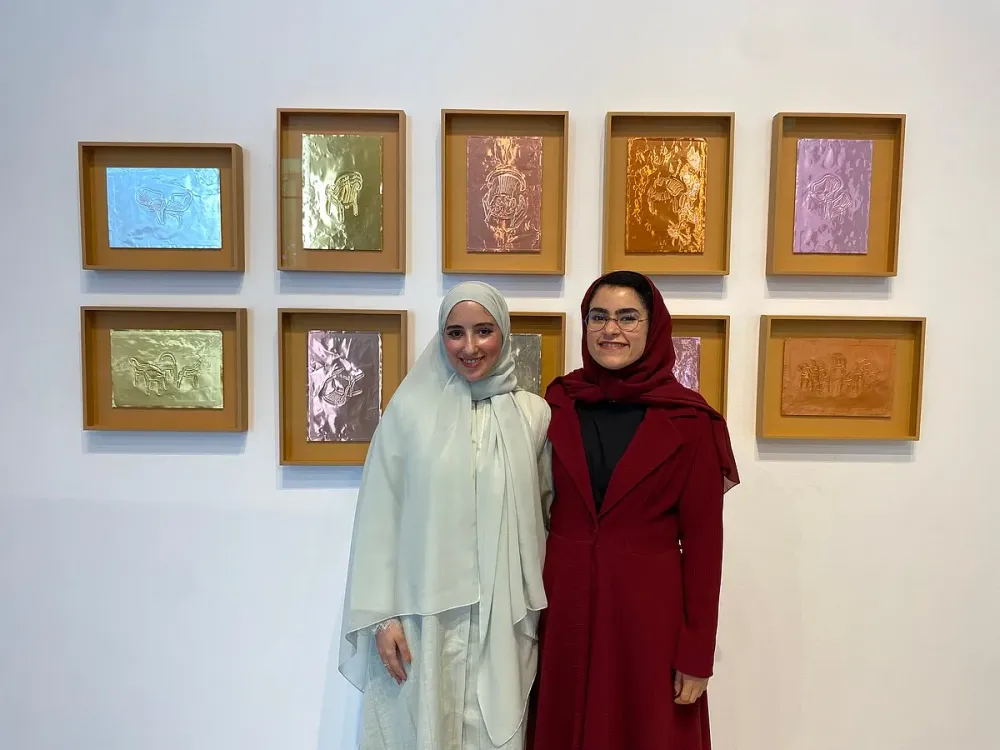
The chair works recall an object children often treated as anything but seating. Al Mubarak has cast plastic chairs in aluminum and mounted them on the wall; elsewhere, foil bears impressions of chairs. Their reflective surfaces bring the viewer into the work.
"When you're closer, your reflection becomes part of the work," she said. "When people interact, they see themselves in it, quite literally."
The series also shows how she uses language to leave room for interpretation. Its English title is "We Never Used Them Properly," while the Arabic means roughly that the chair was a toy. Her bilingual titles are not literal translations.
"The show is a little bit of a mind game," Al Mubarak said. "I give you enough but never truly reveal."
Another work turns a childhood moment with her grandfather into a metal puzzle. Visitors need some strength to shift the heavy pieces, but they cannot complete the picture. The missing resolution reflects the exhibition's treatment of memory as something that cannot be recovered whole. Seeing the puzzle assembled in the gallery moved Al Mubarak: "I made a toy that's an artwork. I did not know that it was possible."
Aboualam described the uncertainty behind such reconstructions: "Memory is always subjective. You can never really reconstruct it in full, and even once you do, how do you know that was the reality?"
Learning to lose
Two sand boards record different experiences of tic-tac-toe. One shows opponents blocking each other until the game ends without a winner. The other preserves a game Al Mubarak played with her nine-year-old niece, when winning no longer felt like the point.
"The second we started playing, I knew I wanted her to win. There is that sensitivity of a child. You never want to break their heart," she said.
The work reads "I used to play to win" in English; its Arabic text says it is now her turn to lose. Al Mubarak connects that change to her own happy childhood and the adults who once let her win, giving her the excitement she now wants her niece to experience.
That exchange between personal and shared experience also explains the exhibition's title. The sandbox represents a place of play where toys were left behind, while "we" includes anyone who recognizes something of their own life in the work.
"The we is every single person who comes in and relates to the space. As much as it's mine, it is equally or even more for the audience," Al Mubarak said.
An Abu Dhabi artist and venue
The exhibition is Al Mubarak's second solo show and her largest so far. She studied visual arts and started her art career in 2017. This project grew from a conversation in December 2024 and took a year to develop. Her description of it brings its interests together: "Collective memory, play, a little bit of nostalgia."
Rizq Art Initiative represents Al Mubarak and included her among the Emirati artists it showed at the Abu Dhabi Art fair in November 2025. Founded by entrepreneur and art historian Shafeena Yusuff Ali, the initiative opened its 700-square-meter venue on Al Reem Island on November 23, 2023.
Registered as a Ma'an social enterprise, it directs more than 80% of its profits back into residencies, fellowships and publications. Its year-round exhibitions, residencies, talks and research programs focus on artists from the Global South, which it calls the "majority world."
For Aboualam, the collaboration is also a source of pride: "It's two Emirati women representing the art scene at the moment. It makes me feel proud, and hopeful for the future." Al Mubarak likewise hopes the work makes her country proud.
Although the exhibition draws on Abu Dhabi's beaches, farms and family homes, Al Mubarak's invitation is to reconnect with a curiosity that adult responsibilities can crowd out. "As adults, we're always forced to be a specific way. You go to work, you go to the gym, you have the role of a parent, a sibling. But it's important to remember that curious, childlike nature we should not lose touch with."