Volkswagen to eliminate 100,000 positions in historic restructuring by 2030
German automaker approves unprecedented workforce reduction affecting 15% of global employees amid China market collapse and electric vehicle transition challenges. Four German factories face uncertain future as unions and management reach agreement.
Volkswagen to eliminate 100,000 positions in historic restructuring by 2030
Volkswagen has confirmed plans to eliminate 100,000 positions worldwide by the end of the decade, marking the automotive industry's largest-ever workforce restructuring. The cuts will reduce the carmaker's global headcount of approximately 664,000 employees by roughly 15 percent.
Management and union representatives jointly approved the reduction plan on Thursday, which combines 50,000 newly announced cuts with another 50,000 previously agreed eliminations. The 10-brand conglomerate, whose portfolio extends from its namesake brand to Audi and Porsche, cited the need to align staffing levels with current economic conditions.
The restructuring surpasses General Motors' 50,000 job cuts following its 2009 bankruptcy filing, establishing a new benchmark for automotive industry downsizing.
German plants under threat
Four production facilities in Germany face uncertain futures under the approved plan. The Hannover, Emden, Zwickau and Neckarsulm plants may be closed or repurposed, representing the first time Volkswagen would shutter full-scale manufacturing operations in its home country. The Zwickau facility, which employs more than 11,000 workers as part of Volkswagen Sachsen GmbH, holds particular significance as the group's first factory converted entirely to electric vehicle production.
Martin Lehmann, a Zwickau employee since 2012, expressed concern about the broader regional impact.
"If this plant really were shut down, you could put a big black spot on the map. The plant and the jobs outside it, our suppliers, they're the motor of the entire region."
Germany has borne the brunt of European automotive sector contraction, with more than 70,000 net job losses announced in 2024 and over 40,000 additional positions eliminated in 2025. These figures represent more than three-quarters of all European automotive employment reductions during this period.
Financial pressures mount
The restructuring responds to multiple pressures battering Europe's largest automaker. US tariffs, inconsistent electric vehicle demand and intensifying competition from Chinese manufacturers have severely impacted the company's performance. Volkswagen's operating profit plummeted from approximately 19 billion euros in 2024 to 8.9 billion euros in 2025, a 53.5 percent decline that pushed the operating margin down to just 2.8 percent.
China market performance has deteriorated dramatically, with sales declining 25.9 percent during the first half of 2026. Deliveries fell 14.8 percent in the first quarter before plunging 36.6 percent in the second quarter.
The crisis extends beyond Volkswagen. The European automotive supplier industry announced 104,000 job cuts between 2024 and 2025 according to industry association CLEPA, exceeding pandemic-era losses and signaling widespread sector distress.
Governance reforms approved
Thursday's supervisory board approval included significant changes to the company's decision-making structure. CEO Oliver Blume called the unanimous vote
"a strong signal for the future of the Volkswagen Group."
The board requested modifications to approval thresholds and group structure, potentially reducing the supervisory board's traditional authority. Under Germany's co-determination law, companies with more than 2,000 employees must allocate half of supervisory board seats to labor representatives, giving Volkswagen's 10 worker representatives on the 20-seat board substantial influence over plant decisions.
Additionally, the 1960 Volkswagen Law grants the state of Lower Saxony blocking power over major corporate decisions. The state holds 11.8 percent of share capital but controls 20 percent of voting rights, and under the law's provisions, resolutions require more than 80 percent shareholder approval. Lower Saxony also operates five of Volkswagen's six western German assembly plants, amplifying its stake in the outcome.
Union tensions defused
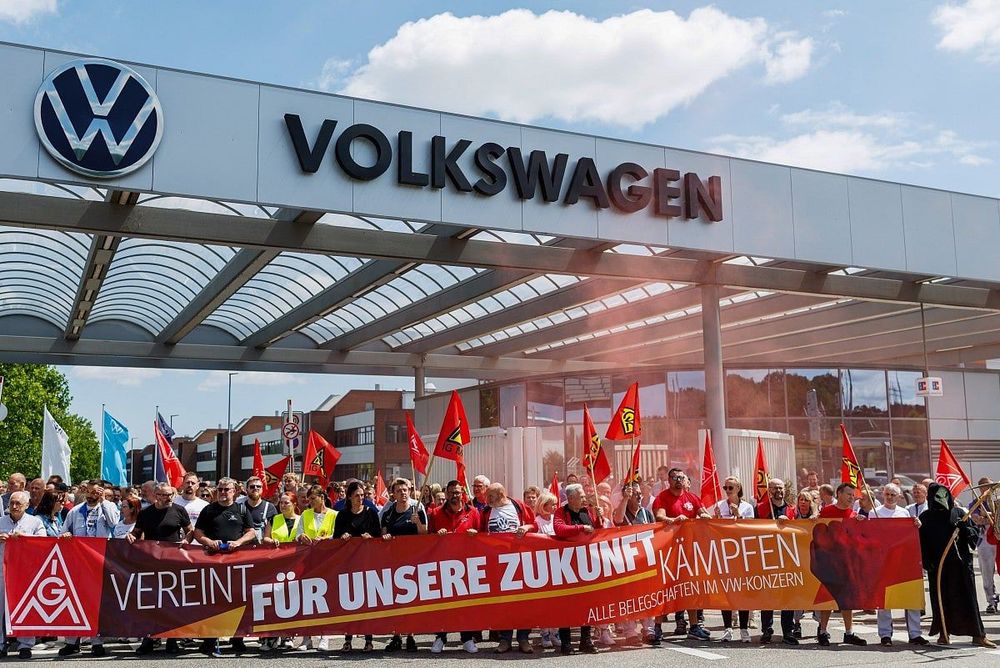
Negotiations between management and unions grew contentious before Thursday's agreement. The IG Metall union accused executives of failing to communicate directly with workers after the 100,000 job cut figure surfaced in media reports before internal notification.
A Tuesday report in WirtschaftsWoche suggesting management sought ways to circumvent the supervisory board sparked further confrontation. IG Metall dismissed the idea as
"nonsense, rubbish, hogwash."
In a joint statement following the vote, IG Metall union representatives Christiane Benner and Daniela Cavallo, along with supervisory board members, emphasized their role alongside Lower Saxony in reaching compromise.
"Workers' representatives, together with the state of Lower Saxony, have once again taken responsibility and prevented a dangerous escalation of the conflict. We've given up on no plant and, contrary to media reports, no plant closure has been approved."
The statement suggested that while the four facilities face uncertain prospects, final decisions on closures remain unresolved, with alternative uses under consideration for affected sites.