Mass protests across Spain demand government action on Ceuta border crisis
Tens of thousands demonstrate in Madrid and other Spanish cities against Prime Minister Sánchez's handling of the humanitarian crisis in Ceuta, where around 5,000 migrants remain after July's mass border breach.
Mass protests across Spain demand government action on Ceuta border crisis
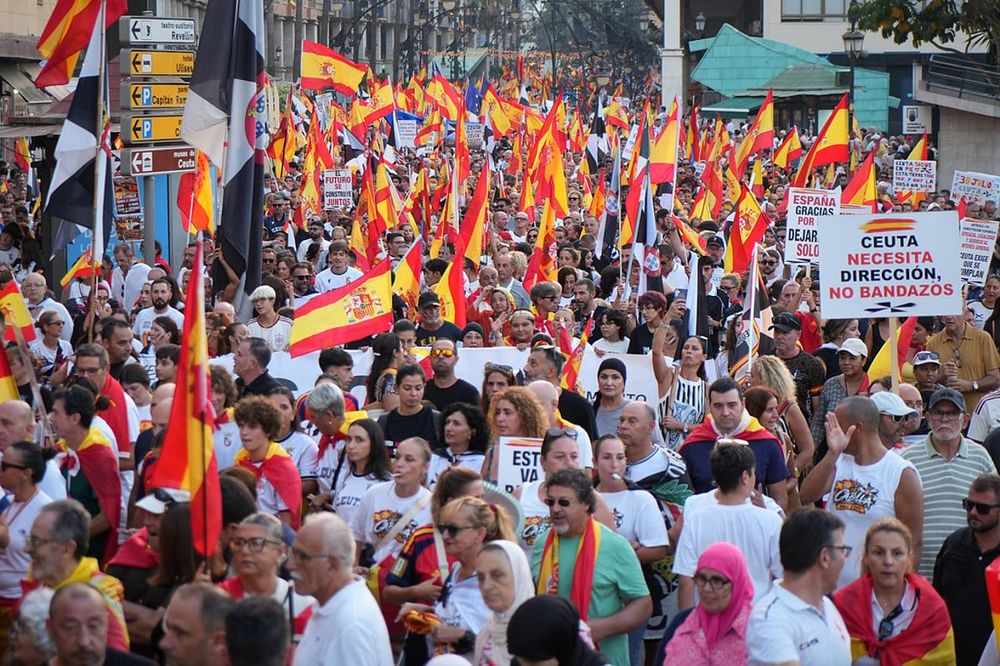
Tens of thousands of protesters filled streets across Spain on Wednesday, demanding solutions to the ongoing humanitarian crisis in Ceuta and criticizing Prime Minister Pedro Sánchez's government for its response to the border emergency.
The demonstrations marked a dramatic shift for Ceuta, a Spanish autonomous city on the North African coast that typically celebrates its Sept. 2 official holiday with little attention from mainland Spain. This year, the anniversary became a rallying point for nationwide anger over the border crisis that has engulfed the territory.
In Madrid alone, authorities estimated that 50,000 people participated in the protests. After the main demonstration concluded, police fired rubber bullets and tear gas to disperse crowds, according to witnesses and Spanish newspaper El País. Significant turnouts were also reported in Barcelona, Valencia and Seville.
Demonstrators waved Spanish flags and chanted slogans including "A united Ceuta will never be defeated," "Sánchez to prison," and "Invaders — go home," referring to the thousands of migrants still in the city.
Crisis stemming from mass border breach
The protests follow late July's unprecedented border emergency, when approximately 72,000 people swam, scrambled or rushed into the small Spanish territory neighboring Morocco. At least 90 people died attempting to reach Europe during the crossing.
While most migrants quickly returned or were escorted back across the border, around 5,000 remain in Ceuta weeks later, according to the national government. Local authorities cite higher figures. The city, which has a population of approximately 84,000, saw its resources severely strained by the sudden influx.
As the European Union's only land border with Africa — a status it shares with nearby Melilla — Ceuta has long been a recurring flashpoint for migration and diplomatic tensions between Madrid and Rabat. Morocco does not officially recognize Spanish sovereignty over these territories, treating them as occupied lands and citing historical claims dating to the 8th century Islamic conquests.
The current crisis stands in stark contrast to Spain's broader migration trends. Interior Ministry statistics show irregular arrivals across the rest of Spain fell from 17,990 in the first six months of 2025 to 12,138 in the same period this year, making the Ceuta surge an anomaly.
Political firestorm and accusations
Juan Jesús Vivas, Ceuta's regional leader and member of Spain's conservative Popular Party, used Wednesday's institutional ceremony to deliver a pointed message.
"What happened to us was not a migratory crisis. What happened was the violation of Spain's territorial integrity."
Vivas and other local authorities have accused the central government of ignoring warning signs before the border was breached. The Popular Party and far-right Vox party have seized on the crisis as a focal point in their campaign to oust the left-wing government in Madrid.
The official organizer of Wednesday's protests was the nonpartisan Spanish Federation of Municipalities and Provinces, though the demonstrations were heavily promoted by opposition parties strongly opposed to irregular migration.
Spain's minister of territorial policy, Ángel Víctor Torres, dismissed the protests as politically motivated.
"This is not to show support for the city of Ceuta or its residents; it is to attack the government of Spain,"Torres told Spanish National Radio.
Government response and international allegations
The Sánchez administration has defended its handling of the crisis, highlighting its allocation of 309 million euros ($357 million) to aid Ceuta's social services, housing, economy and security this week. The government also installed a 500-meter containment barrier on the sea border with Morocco after migrants bypassed existing land fences by swimming or walking around breakwaters at low tide.
Prime Minister Sánchez has repeatedly praised Moroccan authorities for their cooperation in returning most migrants. On Monday, however, he made unsubstantiated allegations that other countries amplified disinformation related to the crisis, specifically accusing social media accounts linked to Russia and Israel, along with right-wing groups, of exploiting the situation.
"There is no information from any of our intelligence services that points to the participation of Moroccan authorities,"Sánchez told Cadena Ser radio. The prime minister attributed the border rush to misinterpretation of a Supreme Court ruling and social media disinformation, though his government did not provide specific evidence for the foreign interference claims.
Russia's Foreign Ministry rejected the accusations outright.
"Without facts, without materials backed up by numbers, dates, names, there is simply nothing to talk about,"spokesperson Maria Zakharova told reporters.
The allegations appear particularly surprising given that Spain and Morocco signed 14 cooperation agreements at a high-level meeting in December 2025, covering digitalization, cybersecurity, climate change and energy transition, with both sides describing the relationship as excellent.
Ongoing humanitarian situation
Despite government efforts to shelter, register and deport eligible migrants, many remain sleeping on streets and beaches. Among them are 1,200 unaccompanied minors, creating additional strain on the city's social services.
"We're suffering and we want to get to Europe or find a solution right now. Here, we're all sleeping on the beach and having a really hard time. We've been waiting for a month, waiting for a solution here, but there isn't one,"Moroccan migrant Nebil Tazi told reporters.
Vivas urged the central government to reinforce and strengthen border infrastructure rather than depending on cooperation with Morocco.
"If we don't do this, there will always be someone tempted to use migration as a tool for political ends,"he warned.
In a recorded video message published Wednesday, Sánchez said his government was deploying all available resources to restore tranquility to Ceuta's residents. The city, which became a Spanish autonomous community in 1995, typically celebrates Sept. 2 with an official ceremony, musical performances and cultural programs — festivities that were overshadowed this year by the continuing crisis and nationwide demonstrations.