Lebanese army increases Beirut security operations amid rising Hezbollah tensions
Lebanese Armed Forces expand patrols and checkpoints in Beirut following explosives seizure from Hezbollah and confrontations in southern suburbs, as Prime Minister orders expanded investigation into the incident.
 Mariam Al Mansoori
Lebanese army bolsters Beirut patrols after tensions surge
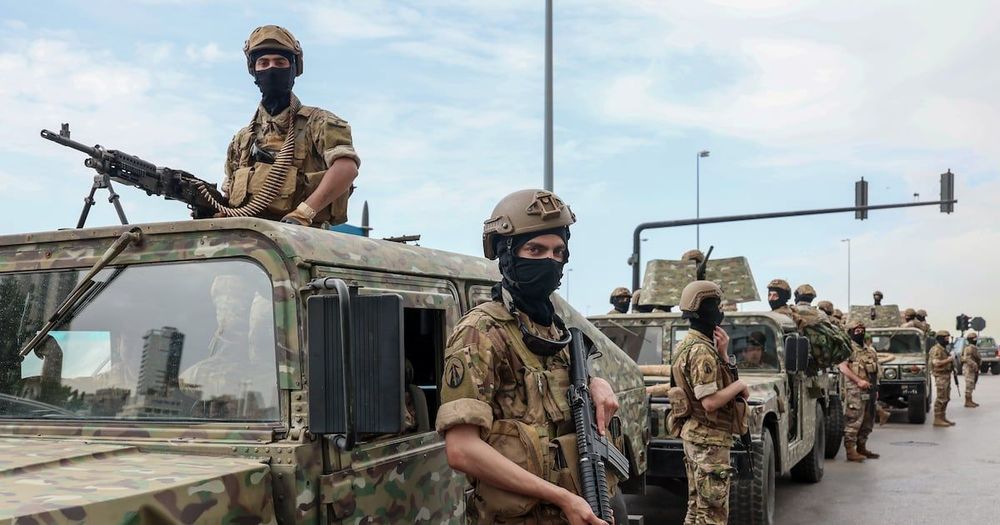
Lebanese Armed Forces have significantly expanded security operations across Beirut and its southern suburbs following escalating tensions with Hezbollah supporters over the government's seizure of explosives and broader disarmament efforts.
The military deployed heavily armed convoys throughout the capital and established temporary checkpoints aimed at pursuing wanted individuals and maintaining public order, according to images published by the armed forces.
Explosives seizure triggers standoff
The heightened security measures come after authorities intercepted half a tonne of explosives at the Dahr Al Baidar checkpoint in the Bekaa Valley before Hezbollah could transport the materials to the capital's southern suburbs, where the group maintains a strong presence. Prime Minister Nawaf Salam, who assumed office in February 2025 after serving as President of the International Court of Justice, has ordered authorities to expand their investigation into the seizure.
The confiscated materials included 250 kilograms of TNT-type explosives and 250 kilograms of C4. Hezbollah has claimed ownership of the explosives, asserting they were intended for operations against Israeli military forces currently occupying portions of southern Lebanon. The group has demanded the release of two detained drivers along with the seized materials.
United States Secretary of State Marco Rubio contacted President Joseph Aoun last week, urging Lebanon's leadership to ensure the explosives remain out of Hezbollah's hands. Aoun, who was elected president on January 9, 2025, ending a two-year leadership vacuum, previously commanded the Lebanese Armed Forces from 2017 to 2025.
Government pursues phased disarmament strategy
The explosives seizure represents a flashpoint in the Lebanese government's broader disarmament strategy. Authorities adopted a five-phase plan on September 5, 2025, beginning with areas south of the Litani River and proceeding northward and eastward. The Lebanese Armed Forces completed the first phase by January 2026, deploying more than 9,000 soldiers and gaining operational control south of the Litani River. Officials announced in February 2026 that the second phase would require at least four months to complete.
Warehouse incident deepens friction
Tensions escalated further following an incident in the Gallerie Semaan neighborhood on the edge of Beirut's southern suburbs. Internal Security Forces attempted to raid a warehouse containing spoiled medicines under prosecutor orders but were confronted by a group of young men on motorcycles who blocked their access. The army was eventually deployed to defuse the situation.
Mohammed Qassem, son of Hezbollah Secretary-General Naim Qassem, issued a statement on Sunday denying any connection to the warehouse after social media speculation linked him to the property. Naim Qassem assumed leadership of Hezbollah on October 29, 2024, following the assassination of Hassan Nasrallah in September 2024.
Hezbollah stated the warehouse incident occurred because Internal Security Forces entered without following agreed procedures between the organization and security authorities.
Political divisions complicate security efforts
The current tensions reflect deeper political rifts. Salam's appointment as prime minister was widely regarded as a setback for Hezbollah, which had backed caretaker Prime Minister Najib Mikati for another term. Salam secured 84 of 128 parliamentary votes, while Hezbollah and its ally, the Amal Movement, abstained from voting.
Senior Hezbollah official Mahmoud Qmati warned in January 2026 that extending disarmament efforts beyond southern Lebanon could trigger chaos or civil war, insisting the ceasefire agreement applies only to the southernmost region bordering Israel.
Israeli occupation continues amid disarmament push
The disarmament push unfolds against the backdrop of ongoing Israeli military presence in Lebanon. Israel launched a ground invasion on March 16, 2026, and currently occupies between 570 and 600 square kilometers of Lebanese territory, primarily south of the Litani River, despite a temporary ceasefire agreement reached in April 2026.
As part of broader government efforts to assert control over strategic locations, Lebanese authorities secured authority over Beirut airport in late 2025, which had previously been described as a key smuggling hub controlled by Hezbollah.