Tesla begins FSD v15 rollout with Reality View, leaves intervention rates undisclosed
Some Tesla drivers are getting a photorealistic, game-style road display as Full Self-Driving (Supervised) v15 begins rolling out. The update also changes how the system handles road hazards and speed, but Tesla has not released the underlying rates for its claimed 25-fold improvement in critical interventions.
 Layla Haddad
An initial rollout, with wider access expected in December
The first wave began Saturday, November 21, 2026. Musk said that day that a wide release would follow in December, according to TeslaNorth. Tesla has neither identified the vehicles receiving v15 first nor given a date for availability to all users. It previously told investors that its AI4 (HW4) computer could run the software.
Availability in Saudi Arabia and the United Arab Emirates also remains unspecified. Tesla has introduced Grok in eligible cars in both countries, but the supplied reporting does not establish whether either market will receive v15 or Reality View, or whether Tesla sells FSD there.
Reality View shows planned turns and parking spots
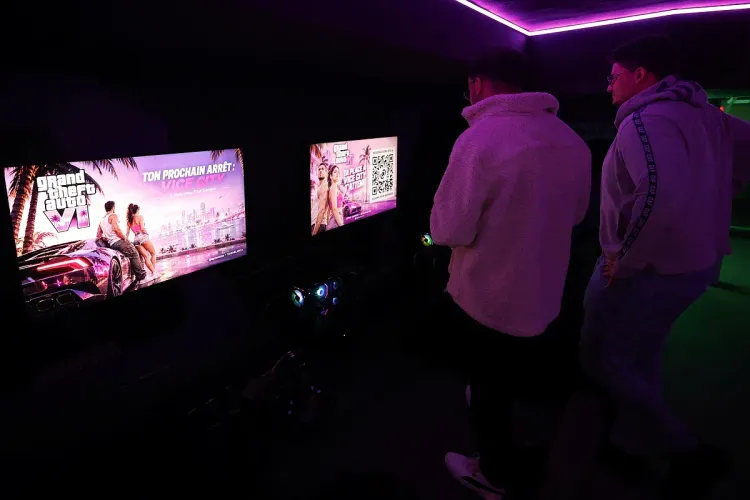
Reality View replaces the largely colorless visualization with a photorealistic scene viewed through a movable virtual camera above and behind the vehicle. In an X announcement cited by Gizmodo's Mike Pearl, Tesla said drivers could use it to see and control FSD's planned actions. Musk's description on X was: "It's like GTA."
The release notes name the feature Tesla Augmented Reality. Rather than showing separate signals, it brings them together in a live scene. Tesla AI software chief Ashok Elluswamy said the same model renders that scene, including arrows marking planned turns and pins identifying intended parking spots. He also said it requires less computing power than the previous display.
TeslaNorth reports that drivers can select a full-screen visualization, a map, a split view or quiet mode. Navigation turns appear within the driving view. Tesla has also softened the turn-signal sound and made it fade after the first few clicks.
Road hazards, speed controls and destination learning
Tesla says v15 improves recognition of potholes, signs, small animals, debris, chains and other road details, along with avoidance of deep standing water. The company also reports better speed handling across driver profiles, in school zones, around speed limits and during bad weather.
The new Speed Camera Slowdown can be canceled by pressing the accelerator or selecting a higher speed profile. After two cancellations at the same camera, the car remembers not to slow there. Drivers can erase saved camera locations through Controls > Service > Manage Saved Locations.
Bike Rack Mode allows FSD use with a bike rack or similar hitch-mounted accessory. With the mode active, the car stops near the destination without reversing; Autopark, Summon, backup chimes and backup warnings are disabled.
The attention monitor more often accommodates hats and sunglasses, while higher-speed profiles impose less strict monitoring. For parking, v15 draws on the driver's parking history to choose a spot and shows several destination parking options on the map. Route learning remains limited to trip beginnings and endings; Tesla says subsequent v15 updates will expand it to the entire route.
The evidence behind the intervention claim
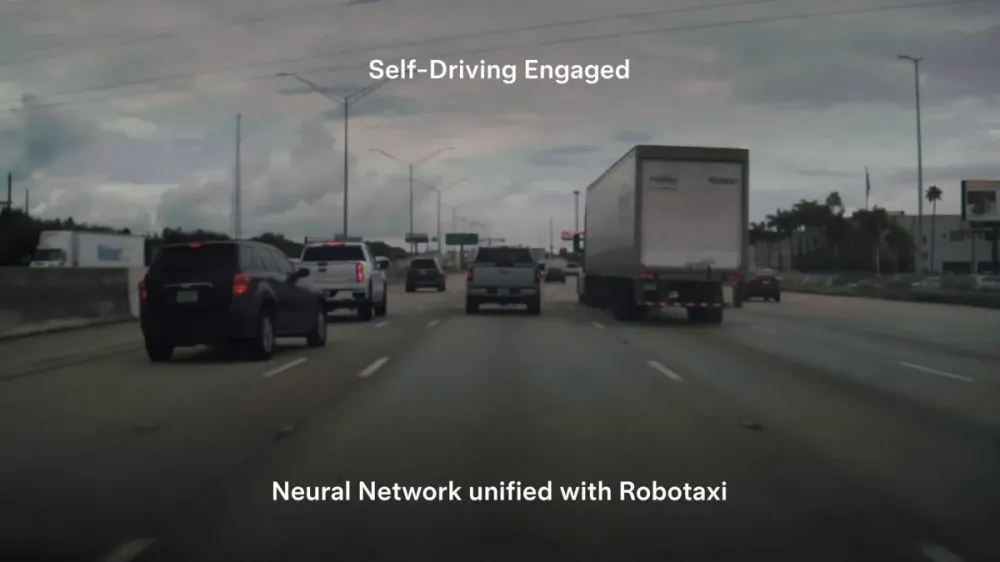
Tesla attributes its claimed 25-fold improvement in the critical intervention rate to a new vision encoder trained on millions of internet videos and shared with Robotaxi and Optimus. It has not disclosed the actual rates. The company had told JPMorgan in August that v15 represented a "step-change" based on seven "core technologies," about 40% of which were already operating in its Austin Robotaxi fleet.
Electrek's Fred Lambert offered a conditional estimate: if the claimed improvement holds, v15 could travel roughly 50,000 miles between critical interventions, compared with the couple thousand miles he attributed to v14 earlier in 2026. That would exceed the roughly 10,000-mile threshold Electrek has proposed for a limited unsupervised service. Those figures are Lambert's extrapolation, not published v15 results from Tesla.
Musk wrote in April that v15 "will far exceed human levels of safety, even in completely unsupervised and complex situations". Separately, Electrek reported that a September test by Brussels nonprofit Johanna.be recorded FSD speeding in 55% of the 30 km/h zones it traversed, with an average speed of 44 km/h.
The National Highway Traffic Safety Administration is reviewing a petition alleging that Tesla Robotaxis speed through active school zones. It also has an investigation, opened in October 2025, into FSD traffic-law violations, including running red lights.
Lambert cautioned that major releases have delivered both improvements and new problems, while smaller updates have regularly regressed: "FSD has never improved in a straight line." Without the underlying intervention rates, Tesla's multiplier does not establish how frequently v15 drivers will need to take over.