Solar ambulance and military medical network showcased in the UAE
A student-built solar ambulance displayed in Dubai and a medical communications network unveiled in Abu Dhabi offer two approaches to reaching patients in remote areas and combat zones: bringing care to communities without reliable infrastructure and connecting front-line medics with distant specialists.
 Mariam Al Mansoori
Bringing medical equipment off the grid
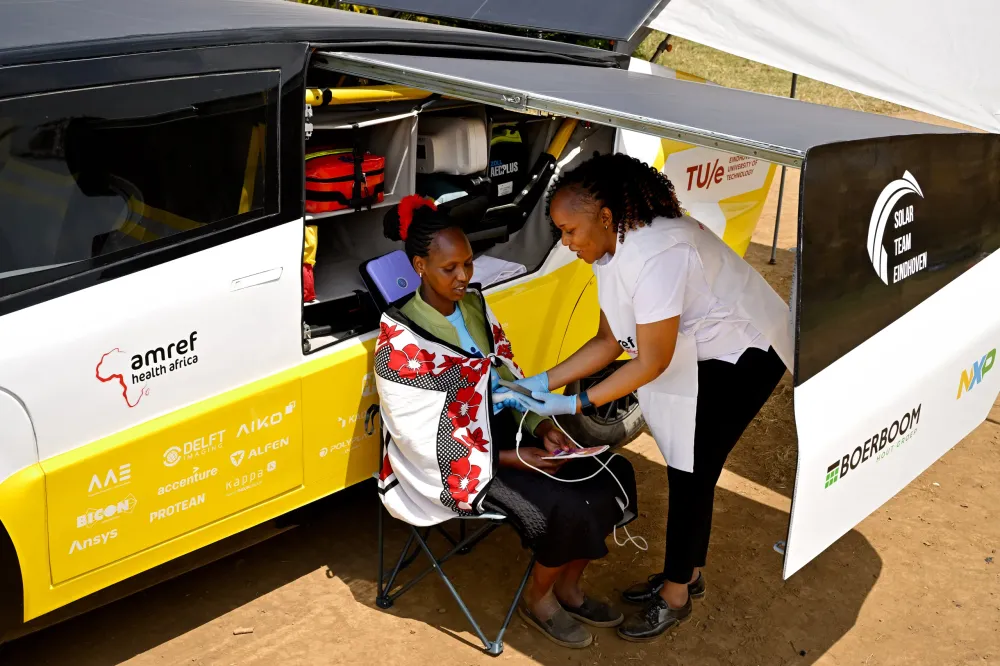
Stella Juva, billed as the world's first solar-powered ambulance, was developed by 23 students from Eindhoven University of Technology in the Netherlands. The Solar Team Eindhoven members took a self-funded year away from their studies to build and test the off-road vehicle, which was displayed at Dubai Future Week.
"With this vehicle we don't bring people to the hospital, but we bring health care to the people themselves," Thomas Derks, 22, the team's structural engineer, told The National.
Designed for preventive care and first aid, Stella Juva carries X-ray equipment, an ultrasound scanner and refrigerated storage for medicines or vaccines. It does not offer the sterile conditions needed for surgery.
According to Geographical, a 50 kWh battery supplies both propulsion and medical equipment. It receives electricity from 326 roof-mounted solar cells and another 216 cells on panels that extend from the vehicle. The team expects up to 715 km of range on paved roads on a sunny day. Off-road range averages about 360 km, depending on the terrain, while speed is capped at 120 km/h.
Team manager Mathijs van Gerven said the United Nations Sustainable Development Goals helped shape the project. Amref Health Africa, which has worked to improve health care in Africa for almost 70 years, contributed to its development.
Kenya testing and the path to deployment
Testing with Amref took Stella Juva through rural Kenya in August 2026. The vehicle covered more than 800 km, including rough-road travel to a clinic without electricity. When parked, its solar panels produced more power than the onboard medical equipment consumed.
The trials indicated capacity to provide care to roughly 200 people over two days, but that estimate came from throughput simulations. The equipment was not used to treat actual patients.
Geoffrey Sadera, Amref Health Africa's project lead for maternal and child health, described the vehicle's potential in conditional terms. "If we could deploy Stella Juva in these areas, the potential impact could be enormous: we could identify risks earlier, intervene sooner, and ultimately save lives," he said.
The student team has built several earlier solar vehicles. Successive teams won Australia's World Solar Challenge Cruiser Class four times in a row. In 2021, the team drove its Stella Vita solar camper to Europe's southernmost tip; in 2023, its Stella Terra off-road car covered more than 1,000 km between northern Morocco and the Sahara.
Turning the Stella Juva prototype into a working fleet would require addressing cost, local maintenance, ease of repair, staff training and medical regulation. No timetable for wider deployment has been announced.
Connecting battlefield medics with specialists
US medical technology company LifeBot is addressing the distance between patients and doctors through its Medical Command Network. The system lets personnel in combat zones and isolated locations send vital signs and other patient information to remote medical command centers. It could allow medics treating wounded soldiers to consult specialists in real time from hundreds of kilometers away.
LifeBot launched the network at the 46th ICMM World Congress of Military Medicine, held November 10-13, 2026, at Adnec in Abu Dhabi. During a demonstration, the company connected its Link, Command and Matrix stations over a closed local network, then deliberately interrupted and restored the connection.
"The goal is to increase the quality of service offered, and to save lives. Usually the problem is that the medic is in one place and the physician is in a different place," LifeBot President and CEO Sherif Mohallal told The National.
Four types of stations share a single clinical workflow. At the patient's side, LifeBot Link uses a rugged 12-inch tablet and the Interceptor monitoring module. LifeBot Core serves as a mobile critical-care hub for locations ranging from aid stations to field hospitals. Doctors and specialists consult through LifeBot Command, while medical headquarters coordinate care through LifeBot Matrix.
The linked stations give doctors access to patient records, live vital signs and video feeds while they communicate with nurses and other personnel on the ground. LifeBot says the network is intended to maintain continuity of care from Role 1 through Role 4, including MEDEVAC, CASEVAC, aeromedical, naval and special operations medicine.
Maintaining connections and clinical oversight
Each station includes an Intelligent Communications Management layer that selects among available connections. Supported options include Ethernet, Wi-Fi, 4G and 5G cellular service, FirstNet Band 14, satellite and data radio. If the active connection fails, the system automatically moves supported traffic to an available alternative.
Mohallal said the stations also continue recording data when connectivity is lost and transmit the stored information once service returns. The network is designed to support care during evacuation, when communications may be unreliable.
Artificial intelligence analyzes medical information and suggests treatments, but LifeBot says physicians retain decision-making authority. "AI can offer them a lot of support, but at the end the physician has to take the decision of what needs to be done," Mohallal said.
Security provisions include controls governing users and their roles, configured authentication and application auditing. Link and Core have full-disk encryption. Depending on the deployment configuration, communications can be encrypted through a VPN or network encryption, and sessions can be hosted on on-premises or private-cloud infrastructure. Mohallal said encryption and operation through closed military networks make enemy cyberattacks difficult.
Mohallal described the region as a natural place to launch the network because the current war has demanded rapid medical responses. LifeBot has deployed systems in the region for more than a decade, he said.