West Bank olive farmers face deadly violence as harvest season begins
Palestinian growers endure extreme settler attacks even before the official harvest starts, with two killed since late September and families injured in areas previously under Palestinian Authority control.
 Mariam Al Mansoori
'He irrigated the tree with his blood': West Bank olive farmers set for another deadly harvest
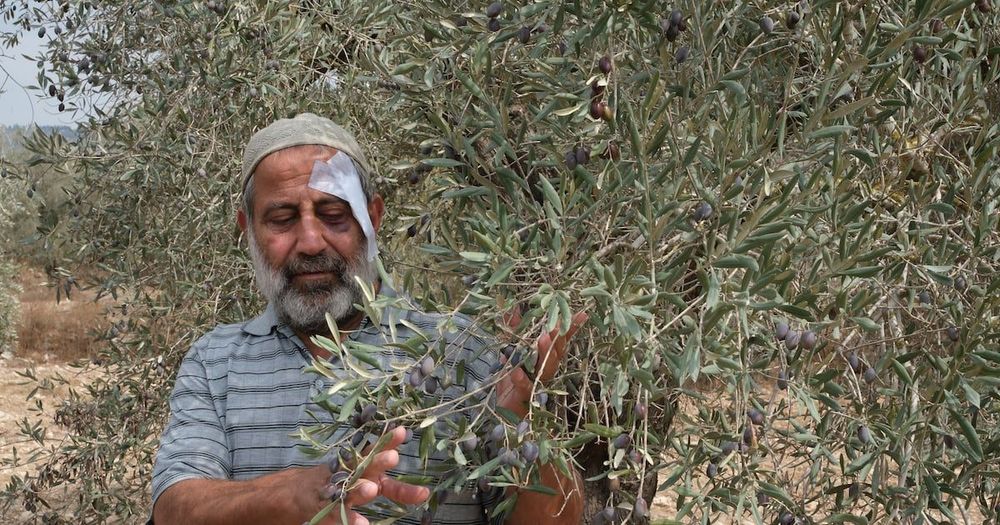
Abdul Latif Al Bazzari, 59, moved deliberately through the pain as he described his cousin's final moments at an olive grove in the dusty hills near Nablus. His face bore fresh bruises beneath a white dressing, remnants of an attack that claimed Ali Al Bazzari's life on October 7.
"He irrigated the tree with his blood," Mr Al Bazzari said, standing near the trunk where his 44-year-old cousin, a father of four, bled to death. "It will forever be the real estate of this attack by Jewish terrorist settlers."
The serene grove, accessible only by a rough dirt track, had seen its first settler attack in 60 years last week. Mr Al Bazzari recounted how settlers shot at the family, beat them with metal and wooden objects, and hurled stones. Eight people were injured, two by gunfire. One cousin remains hospitalised.
"They don't want us to stay on any land, or take any of our crops," he said. "They are telling us to stay in our villages and cities, and not to go down to our trees."
A harvest season marked by violence
Palestinian olive farmers across the Israeli-occupied West Bank are facing another harvest season marked by settler violence. Though the official season begins Thursday, farmers have worked their groves for weeks, fearing thefts by Israeli settlers who have launched social media campaigns encouraging people to take their olives.
Two Palestinians have already been killed by settlers since late September, with many more injured. The violence threatens the entire harvest, dealing a severe blow to the Palestinian economy. Between 80,000 and 100,000 Palestinian families depend on the olive harvest as their main source of income, according to UN estimates. The olive oil sector contributes about 8 per cent of the West Bank's GDP and supports more than 60,000 jobs.
Olive trees account for nearly 45 per cent of cultivated land in Palestine, according to World Bank estimates. More than 45,000 trees, including over 26,000 olive trees, were cut down or damaged across the West Bank during the first half of 2026. The Palestinian Ministry of Agriculture documented losses worth $1.75 million between September 25 and October 1 alone, affecting farmers across seven West Bank governorates.
The harvest carries deep symbolic meaning beyond its economic importance. "The olive groves and the harvest are the soil of the Palestinian people. This is a strategic crop," Mr Al Bazzari said. "It's not like wheat or barley; it's the identity of the Palestinian people. Some of the trees are more than 500 years old, hundreds of years before Israel was established."
Attacks spread to new areas
In the village of Usarin, Warda Adeli, 63, nursed wounds from a settler attack, her arm in a sling and stitches across her bruised right cheek. She was beaten as she rushed towards family members ambushed by settlers in the small grove outside their house 10 days ago.
"I was screaming. I was scared for my son. Then they threw me to the ground and I couldn't feel anything," she said.
Her entire body is covered in bruising. One son remains in intensive care in Nablus with a severe brain injury after being beaten with a metal bar. Another son, Ghassan Ahmed Adeli, seated beside her with a broken shoulder and back injury, spoke on her behalf during the interview.
The family's home offers spectacular views but reveals a bleak situation: vast groves in the valley that farmers have been unable to access for years because of Israeli violence. New settler outposts are also visible, established amid accelerated settlement construction since the Gaza war began. By the end of April 2026, Israeli settlers had established 363 outposts in the occupied West Bank, with 212 created under the current government compared to 151 between 1996 and 2022, according to Peace Now.
This year has brought a worrying development. The attacks on the Al Bazzari and Adeli families occurred in Areas A and B, where the Palestinian Authority is supposed to have either full or partial control. Area A comprises approximately 18 per cent of the West Bank under Palestinian Authority civil and security control, while Area B comprises about 22 per cent under Palestinian civil control and Israeli security control. Area C, representing about 60 per cent of the territory, remains under full Israeli control.
In previous harvests, attacks focused on Area C. Ms Adeli's attack actually happened inside her village, in the narrow groves and streets between homes of the close community.
A broader pattern of violence
The violence forms part of a broader pattern. According to the Colonization and Wall Resistance Commission, 14,742 settler attacks have occurred in the occupied West Bank over the three years since October 7, 2023, with 67 Palestinians killed by settlers and 31 killed in 2026 alone. The Palestinian Authority reports that Israeli settlers have killed at least 30 Palestinians in the West Bank this year.
Some in Israel speak of a loss of control in the occupied West Bank, which has accelerated during Prime Minister Benjamin Netanyahu's far-right government tenure. Palestinian olive farmers who have been attacked, along with some Israeli-Jewish activists who support them during harvest, disagree.
Israeli military and civilian power in the territory has never been greater. Military vehicles move constantly, opening and closing various checkpoints and gates installed in recent years, while settlers travel and build at will.
With Israel's general election weeks away, campaign posters are visible throughout the territory. Opposition candidates like Gadi Eisenkot appear shortly after passing the separation wall between East Jerusalem and the rest of the West Bank. Deep inside Palestinian territory, only posters of Prime Minister Netanyahu and far-right government members, including National Security Minister Itamar Ben-Gvir and Finance Minister Bezalel Smotrich, are visible. Many of them and their supporters praise the "revolution" this government has achieved.
For them, the unpicked Palestinian olive trees represent progress. The violence inflicted on Mr Al Bazzari, Ms Adeli and many others is not something to apologise for, but to celebrate. The stakes are high: in a good year, olive oil exports from the West Bank can bring almost $200 million into the Palestinian economy, with the sector contributing up to $100 million in yearly income to some of the poorest communities.