Philippine lawmaker calls for Marcos accountability after Supreme Court budget ruling
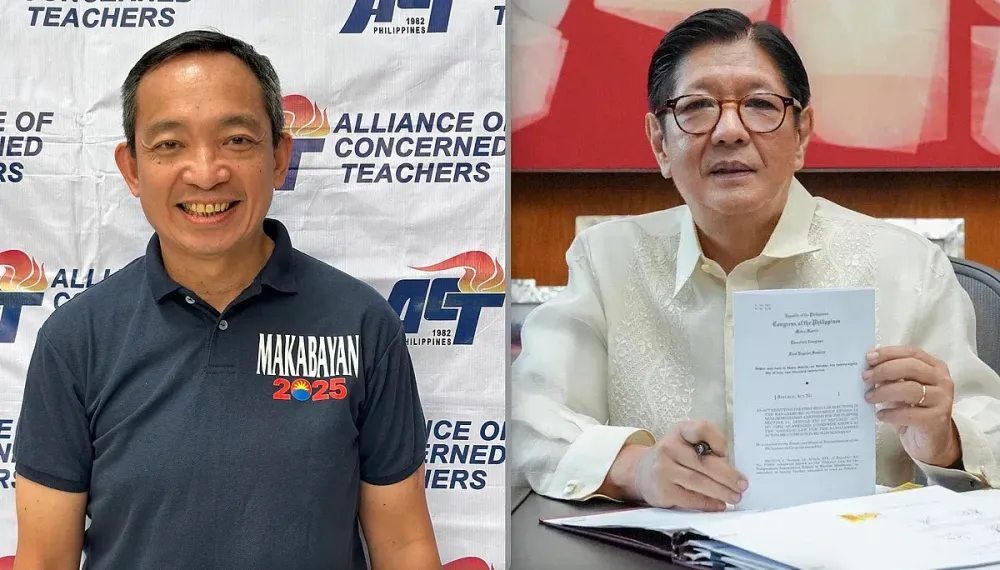
ACT Teachers Rep. Antonio Tinio says President Ferdinand Marcos Jr. should be held accountable for signing three Philippine budgets with provisions the Supreme Court has declared unconstitutional. The administration plans to seek reconsideration of the ruling, which is not yet final and executory.
 Mariam Al Mansoori
Questions of liability
Tinio said responsibility for the unlawful appropriations extends beyond the legislators who proposed and approved them to the officials who carried them out.
"There were many authors and proponents of the unconstitutional budgets in both the House of Representatives and the Senate, but there is no debate on who their implementers were: Marcos and his Cabinet," he said.
According to Tinio, the decision identifies Marcos as the official who approved flood control projects financed through unprogrammed appropriations. He blamed the flood control corruption scandal on cooperation and the sharing of spoils between Congress and Malacañang, describing that arrangement as central to the pork barrel system.
The Court said those who authored, proposed or implemented the unconstitutional appropriations could face civil, criminal or administrative charges if they acted in bad faith. It also applied the doctrine of operative fact to the 2024 and 2025 budgets, preserving irreversible programs whose beneficiaries acted in good faith. That protection does not automatically shield the officials responsible for the appropriations from liability, Inquirer.net reported.
The justices separately found that Marcos did not commit grave abuse of discretion by certifying House Bill No. 8980 as urgent. The measure became Republic Act 11975, the 2024 budget law with a P4.7512-trillion outlay.
The spending provisions struck down
The Supreme Court on Tuesday declared parts of the 2024, 2025 and 2026 national budgets unconstitutional. It found that Congress had unlawfully increased infrastructure allocations, some of which were later believed to have been stolen.
For 2024, lawmakers expanded unprogrammed appropriations from the P281.9 billion proposed in the National Expenditure Program to P731.4 billion in the General Appropriations Act. The Court said the P449.5 billion (Dh26.4 billion) increase took total appropriations above the amount the President had recommended.
The 1987 Constitution allows Congress to cut individual allocations or the overall budget, but it cannot raise the combined total of programmed and unprogrammed appropriations above the President's proposal.
The ruling also struck down P17.99 billion (Dh1.05 billion) added for so-called special roads in the 2025 budget. For 2026, the justices invalidated several special provisions, including a P12.75 billion (Dh750 million) increase in "special accounts," calling it an "unconstitutional lump-sum appropriation with post-enactment executive discretion."
Infrastructure allocations inserted by representatives and senators for their districts have been implicated in kickback schemes, with many projects subsequently found to be substandard or nonexistent.
Palace seeks reconsideration
The 121-page decision, written by Senior Associate Justice Marvic Leonen and dated October 7, 2026, was decided by a 13-2 vote. As of October 21-22, it was not yet final and executory. The Office of the Solicitor General has 15 days from notice to request reconsideration, according to Philstar.com.
Palace press officer Claire Castro said the Solicitor General's office had been instructed to file that request. The administration argues that the Court's conditions for releasing unprogrammed appropriations make the mechanism "useless" for government programs.
Vice President Sara Duterte also called for Marcos and Congress to answer for approving the three budget laws containing unconstitutional provisions. She argued that Marcos was liable for approving a budget that violated the National Expenditure Program and accused the bicameral conference committee of serving as a "stamping pad" for Malacañang.
Challenges to the budgets and the drafting process
The decision addressed several legal challenges. On the 2024 budget, the justices granted the petition brought by the late former Albay Rep. Edcel Lagman and others, while partly granting a separate petition led by former Senate Minority Leader Aquilino "Koko" Pimentel III.
They also granted the Filipinos for Peace, Justice and Progress Movement's petition against the 2025 General Appropriations Act. Challenges by Caloocan Rep. Edgar Erice and Mamamayang Liberal Rep. Leila de Lima to provisions in the 2026 budget were partly granted.
Beyond the allocations themselves, the Court criticized the Bicameral Conference Committee's inadequate records and explanations of budget changes. Its task is to reconcile differences between the versions passed by the House and Senate, the Court emphasized, according to the Daily Tribune.
Associate Justice Samuel Gaerlan proposed safeguards that would require written documentation of major changes, public proceedings and enough time for review, while barring amendments unrelated to the measures being reconciled.
Opposition lawmakers warn about the 2027 budget
The ruling supported objections raised during earlier budget debates by three Makabayan Coalition lawmakers: France Castro of ACT Teachers, Tinio's predecessor; Arlene Brosas of Gabriela Women's Party; and Raoul Manuel of Kabataan Youth Party. All three voted against the 2024 and 2025 budgets and declined pork barrel funds from the President.
Their objections to the 2024 budget included large unprogrammed appropriations and confidential and intelligence funds, alongside inadequate allocations for social services and public utilities. In 2025, they challenged the sharp rise in unprogrammed funding, opaque additions during bicameral deliberations, and cuts to education and health.
The three parties also opposed the proposed 2027 budget, pointing to questionable insertions while corruption investigations continued.
Tinio warned that the 2027 General Appropriations Bill could face a similar constitutional challenge unless the Senate changes its provisions governing unprogrammed appropriations. He singled out a P42.55-billion lump sum for foreign-assisted projects and a P130.7-billion cut to foreign-assisted projects. The House passed the bill on third and final reading on October 12, 2026.