Former US Army soldier charged with arson after fiery attack on Manhattan federal immigration building
Andrew Arrabaca, 43, a homeless veteran, faces federal arson charges and a minimum seven-year sentence after allegedly setting fire to 26 Federal Plaza, one of the nation's busiest federal buildings housing immigration courts and ICE offices.
Former US Army soldier charged with arson after fiery attack on Manhattan federal immigration building
A former US Army soldier has been charged with arson and ordered held without bail after confessing to a months-long plan that culminated in a fiery attack on 26 Federal Plaza in Manhattan, one of the busiest federal office buildings in the United States.
Andrew Arrabaca, 43, dumped gasoline outside an employee entrance, ignited a fire on the sidewalk, launched fireworks and fired a pellet gun at the building Monday morning, according to federal prosecutors. Three people sustained minor injuries in the attack, including an individual with an immigration court hearing scheduled at the building.
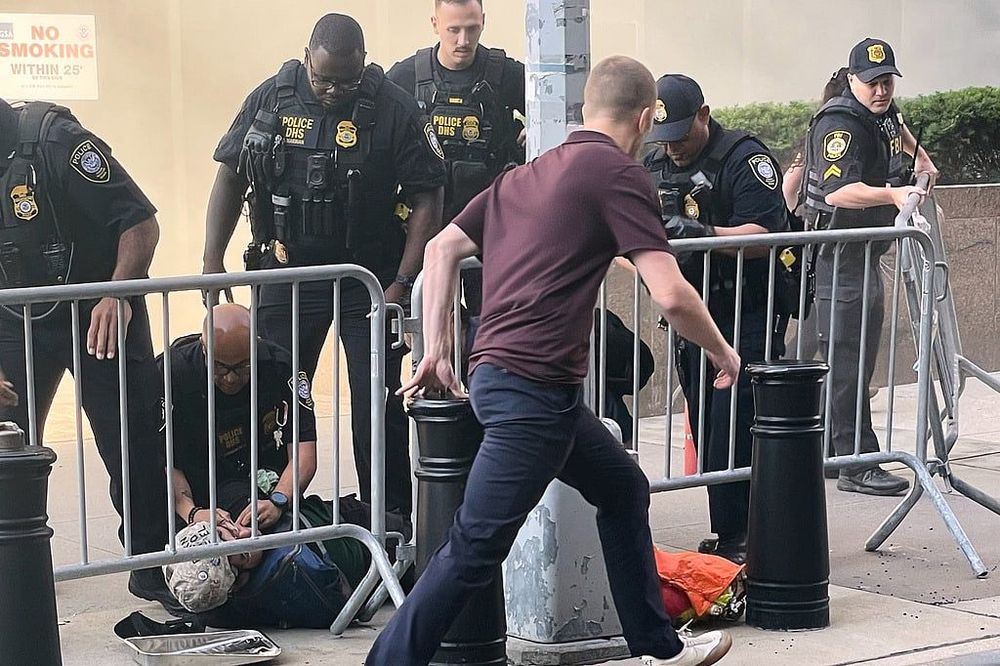
The 12-storey federal complex serves thousands of visitors daily and houses the New York Immigration Court on its 12th floor, ICE field offices on the 9th floor, FBI offices, and a daycare center. The building has become a focal point for protests during the Trump administration's immigration enforcement operations, which have removed more than 350,000 individuals in fiscal year 2026.
Months of planning
Assistant US Attorney Samantha Fry told Manhattan federal court that Arrabaca began plotting the attack in January, traveling to upstate New York to purchase weapons and to Pennsylvania to acquire fireworks. She described his actions as
calculated, targeted and unacceptably dangerous.
When arrested, Arrabaca told investigators he understood people could have been hurt or killed and was willing to accept his own death in the process. He made anti-government statements and derogatory remarks about ICE while being taken into custody, according to James Barnacle, head of the FBI's New York field office.
At the time of the attack, Arrabaca was living in his car and had slept in a park the night before. He wore a military-style helmet with words suggesting suicidal intent and carried two axes, three fixed-blade knives, a hammer, a machete and a wagon affixed with a sign reading "ICE Off Our Streets."
Military service and mental health struggles
Arrabaca served in the US Army from 2001 to 2004 as a Patriot System Repairer, a highly technical role involving field maintenance on the Patriot missile system's electronic assemblies and components using diagnostic software and test equipment. He also served one year in the New York Army National Guard before leaving as a specialist, with no deployments during his service.
In 2020, prosecutors said, Arrabaca was prescribed medication for a mental health condition but stopped taking it approximately a year later. Defence lawyer Jennifer Brown noted that Arrabaca has no criminal history and, until recently, maintained steady employment throughout his life as a lifelong New York resident.
Arrabaca's case reflects broader challenges facing veterans, with approximately 32,495 veterans experiencing homelessness nationwide in January 2025, according to the Department of Veterans Affairs. Research shows veterans exhibit higher rates of severe mental illness, schizophrenia, trauma-related disorders, bipolar disorder, depression and anxiety compared to non-veterans.
Legal proceedings and sentencing
The federal arson charge carries a mandatory minimum sentence of seven years in prison because injuries occurred during the incident. Under federal law, courts cannot sentence below this statutory minimum regardless of mitigating circumstances. Federal arson prosecutions have increased significantly since January 6, 2021, with the Department of Justice prioritizing cases involving federal property and seeking maximum penalties for incidents with political context or anti-government sentiment.
US Magistrate Judge Robyn F. Tarnofsky rejected the defence's request to send Arrabaca to a locked ward at a Veterans Health Administration facility, instead ordering him held at a federal lockup in Brooklyn with a mental health evaluation to be conducted as soon as possible.
This is an individual who, notwithstanding what he appears to have done, has served our country and is quite clearly ill,Tarnofsky said, adding that the planned nature of the crime and its timing when the building was occupied made it particularly troubling.
Brown conceded the dangerous nature of the offence but argued that Arrabaca's expressed intention was to damage property rather than harm people. Prosecutors countered with what Fry called "overwhelming evidence of his guilt," including his detailed confession.
The attack targeted a building that has become increasingly controversial during the Trump administration's immigration crackdown. Since 2025, masked federal agents have arrested immigrants directly after court hearings at 26 Federal Plaza, a practice that has drawn protests and legal challenges. The building's 10th floor contains ICE holding cells that became the subject of a federal lawsuit in 2026 over detention conditions.
Arrabaca, wearing glasses and a black sweatshirt, sat quietly between his lawyers during Tuesday's court appearance, nodding occasionally as they explained the proceedings. He was not required to enter a plea.