EUR/USD Remains Under Pressure as Oversold Signals Emerge
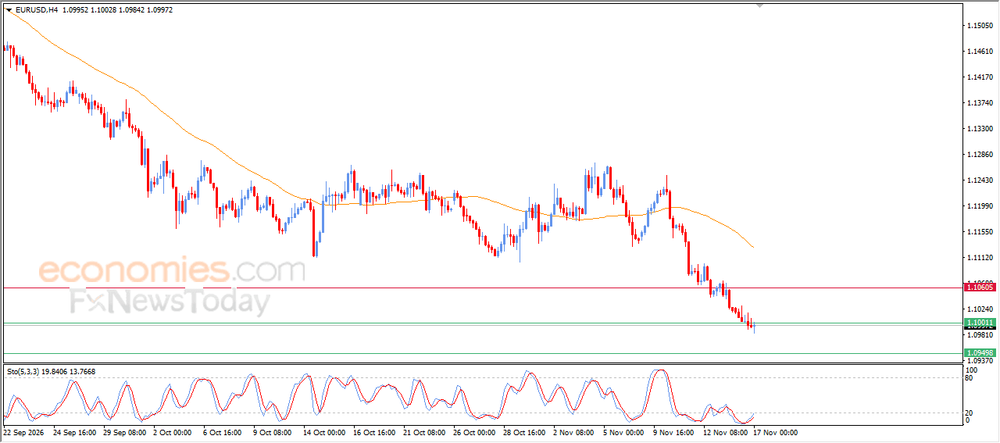
EUR/USD continued to decline in choppy intraday trading on November 17, 2026, even as relative strength indicators began showing positive signals. Economies.com said the pair was trying to ease deeply oversold conditions, but its short-term downtrend remained intact.
 Layla Haddad
Technical pressure follows a 19-month low
The pair remained below its 50-period exponential moving average, which Economies.com identified as dynamic resistance. Its November 17 analysis said that position continued to support the bearish trend and left EUR/USD exposed to further near-term losses despite the emerging positive momentum signals.
The latest weakness followed a fifth straight daily decline on November 16, when EUR/USD touched 1.1002. That was a fresh 19-month low and the weakest level since April 2025, according to FXStreet analysis published by TMGM.
US inflation fuels expectations for more Fed hikes
FXStreet attributed the dollar's advance to stronger-than-expected US inflation and hawkish comments from Federal Reserve officials. Consumer prices rose 0.4% month over month in October 2026, compared with a consensus forecast of 0.3%. As of November 16, traders expected a 25-basis-point Fed rate increase in December and were pricing in additional hikes during the first quarter of 2027.
Producer prices added to those expectations. US producer price inflation reached an annual rate of 6.5% in October, its highest since November 2022, according to Pound Sterling Live, which said the reading reinforced expectations of further Fed tightening.
The gap between US and euro-area two-year swap rates widened by about 35 basis points from November 10 to November 16, reaching its widest since September 2025, according to ING analysis cited by Investing.com and Pound Sterling Live. After adjustment for inflation expectations, the gap was the widest since December 2022.
ECB outlook and French budget risks
Markets also anticipated tighter policy in the euro area. October 2026 headline inflation was 4.0% year over year, twice the European Central Bank's 2% target. By mid-November, a 25-basis-point increase in the ECB deposit rate at its December 17 meeting was almost fully priced in, according to Investing.com.
French fiscal concerns weighed on the euro ahead of the November 17 parliamentary vote on the government's 2027 budget, Investing.com reported. Public debt had reached 121.7% of GDP, annual interest costs were nearing €91 billion, and the French Treasury planned a record €340 billion in borrowing for 2027.
The ECB's leadership succession was another issue facing markets. As of mid-November, the EU Council was set to select a successor to President Christine Lagarde. Pound Sterling Live identified Spain's Pablo Hernández de Cos, viewed as a centrist with dovish leanings, and the Netherlands' Klaas Knot, viewed as more hawkish, as the leading candidates. Société Générale said choosing De Cos could send EUR/USD back below 1.10.
Crowded bearish bets carry short-squeeze risk
Speculative positioning remained heavily tilted against the euro. Large speculators held a net short position of 157,791 EUR/USD futures contracts as of November 3, 2026, according to CFTC data cited by Investing.com.
MUFG described the euro's short positioning as the most stretched of any currency relative to its own two-year range. That concentration of bearish bets created a risk of a short squeeze.