Adnoc Gas raises 2026 profit forecast to at least $4 billion
Adnoc Gas lifted its annual earnings outlook after third-quarter net income roughly doubled from the previous quarter, despite continuing export restrictions linked to the Iran war. The company still expects to restore full capacity at its damaged Habshan gas processing complex by the second quarter of 2027.
 Omar Al Nuaimi
Quarterly earnings recover
The new 2026 net income forecast replaces a range of $3.5 billion to $4 billion issued the previous quarter. Adnoc Gas cautioned that the outlook depends on how regional maritime conditions develop.
In a filing with the Abu Dhabi Securities Exchange, the company reported third-quarter net income of $1.33 billion, little changed from a year earlier but roughly twice the second quarter's $664.6 million. Revenue declined nearly 10% year over year to $4.38 billion.
EBITDA, or earnings before interest, taxes, depreciation and amortization, reached $2.03 billion, a 70% increase from the second quarter. The company attributed that improvement to its operating performance and commercial execution across the business.
Chief Executive Fatema Al Nuaimi said: "Our operational strength and commercial agility enabled us to safely and reliably meet domestic and international demand and drive strong financial results despite continued challenging external conditions."
Shipping improves, but export constraints persist
A recovery in cargo movements helped the quarterly results: by September, shipping had returned to 88% of its 2025 level, according to the company's results presentation. Export and traded-liquid sales volumes rose 69% from the second quarter, mainly because of improved shipping activity, though they remained 28% below a year earlier.
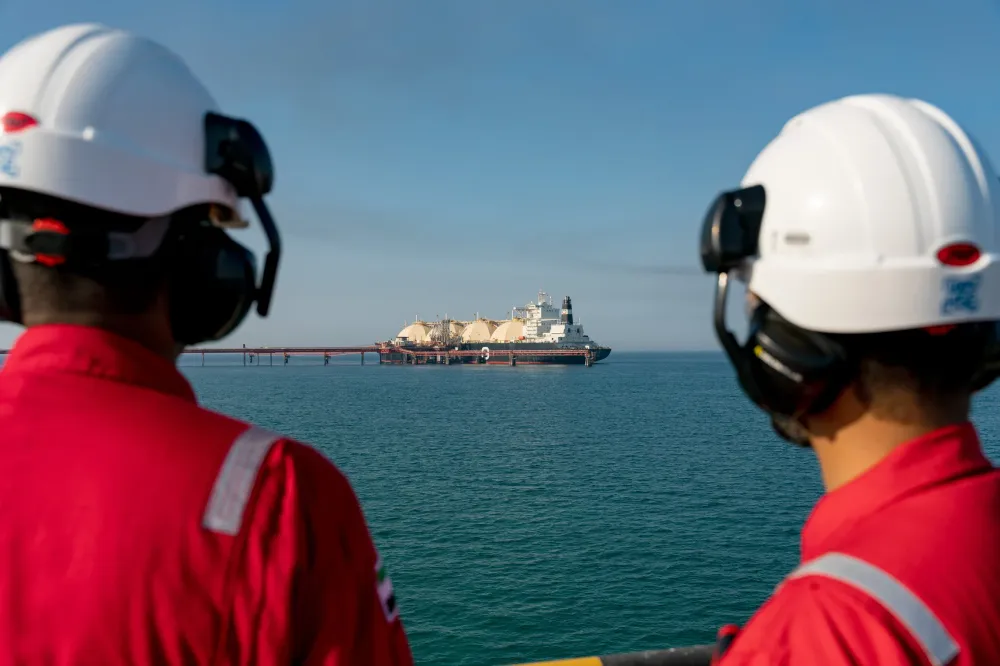
Disruption in the Strait of Hormuz nevertheless continued to restrict shipments of liquefied petroleum gas, naphtha and liquefied natural gas. Adnoc Gas said those limits prevented it from fully benefiting from higher gas and naphtha prices because it could not load and export all its liquids and LNG cargoes.
Global oil and gas prices surged after the Iran war began on February 28 and the strait was effectively closed. Before the conflict, the waterway carried about 20% of global oil and gas flows.
The domestic business also recovered from the previous quarter. UAE gas sales increased 20%, while domestic gas EBITDA rose 28%. International product sales EBITDA increased 106%, and sulfur EBITDA rose 249% over the same period.
The annual comparison was weaker: domestic gas sales volumes fell 19% to 513 trillion British thermal units, reflecting lower reinjection gas and ethane offtake. Sales gas volumes were broadly unchanged from a year earlier. Adnoc Gas meets about 60% of the UAE's sales gas requirements and serves customers in more than 20 countries.
Habshan's full recovery remains scheduled for 2027
Habshan, an Adnoc Gas-operated complex in Abu Dhabi and one of the world's largest gas processing sites, suspended operations in early April after sustaining damage. On April 3, debris from intercepted Iranian strikes started two fires, killing one person and injuring four. Adnoc Gas described the damage at the time as "significant." A further incident occurred at the site on April 8.
The company's results presentation highlighted the speed of the initial recovery: roughly 85% of supply was restored within 43 days of the April 8 emergency shutdown, earlier than originally planned.
For the third quarter, Adnoc Gas said repairs were proceeding according to plan. Its target for restoring full capacity remains the second quarter of 2027.
Dividend approved as investment continues
The board authorized a $940 million quarterly dividend for payment in December 2026, 5% higher than a year earlier. Adnoc Gas targets annual dividend increases of 5% through 2030.
For all of 2026, its dividend commitment is 18 fils per share. That represents a 5.34% yield using the November 9 closing share price. The company said it remains the Abu Dhabi Securities Exchange's largest dividend payer.
Operating cash flow totaled $3.82 billion in the first nine months, providing 1.3 times coverage of the $2.82 billion in dividend commitments for that period. At the end of September, Adnoc Gas held $1.2 billion in net cash and had $6 billion in committed credit facilities.
Capital spending reached $3.672 billion over the first nine months, against guidance of approximately $5 billion for the full year. The company said the annual spending outlook remains subject to progress on Habshan's restoration.
Expansion projects advance
Despite the operating constraints, Adnoc Gas continued its expansion program. In August, it awarded engineering, procurement and construction contracts worth $8.2 billion for phases two and three of Rich Gas Development. The awards followed the June 2025 announcement of Phase 1.
The $13.2 billion, multiphase development will expand gas processing and liquids recovery infrastructure across the UAE. Construction began during the third quarter on Phase 3, which includes a natural gas liquids fractionation train at Ruwais designed to produce more than 8 million metric tons a year for export once completed.
At Ruwais LNG, the company installed its first two 75 MW refrigeration compressor trains, advancing plans for the Middle East and North Africa region's first all-electric LNG facility. The Maximizing ethane recovery and monetisation project, known as MERAM, completed its first connection to existing facilities and received its first gas. Estidama's first sales gas compression train also started up.
Ruwais LNG, MERAM and Estidama are expected to generate a combined $13.4 billion in In-Country Value. Adnoc Gas plans about $28 billion of investment from 2026 through 2030, with its expansion program targeting a 60% increase in EBITDA by 2030 from the 2023 level.
The company is also expanding its use of artificial intelligence and robotics. Its initiatives include AI-powered control rooms at Bu Hasa and Taweelah and autonomous inspection robots, with a goal of delivering significant cost savings and more than $900 million in business value by 2030.
Last week, Adnoc Gas announced an agreement with Etihad Water and Electricity to explore future natural gas supplies for new power generation capacity in the Northern Emirates. It also signed a five-year deal to supply France's TotalEnergies with up to 1.6 million metric tons of LNG.