White House correspondents' dinner returns with tighter security after April shooting
The rescheduled White House Correspondents' Association dinner took place Friday at the Waldorf Astoria with reduced attendance and heightened security, three months after a shooting disrupted the original event.
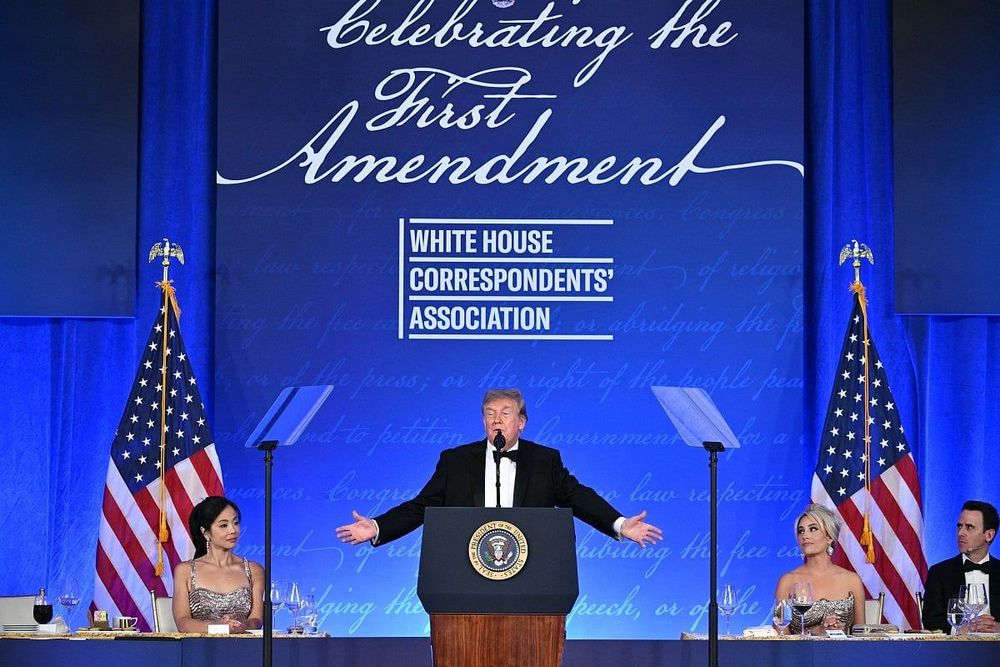
Trump says 'the show must go on' as White House correspondents' dinner returns after shooting
The White House Correspondents' Association dinner returned on Friday evening with President Donald Trump addressing journalists at the Waldorf Astoria hotel, three months after a shooting forced the cancellation of the original April event.
"Let's try this again," WHCA President Weijia Jiang of CBS News told attendees as she opened the rescheduled gathering. "We are back. We will not be intimidated. We refuse to let an act of violence have the final word."
The dinner marked a return to a tradition dating back more than a century. The White House Correspondents' Association was founded in 1914 after President Woodrow Wilson threatened to end presidential news conferences, and the first dinner was held in 1921 with 50 attendees at the Arlington Hotel. President Calvin Coolidge became the first sitting president to attend in 1924, establishing a custom that has continued with most presidents since.
Scaled-down event with enhanced security
Attendance was reduced from approximately 2,600 guests planned for April to about 700 on Friday. The event moved from the Washington Hilton, which had hosted the dinner for nearly six decades in its 30,000-square-foot ballroom, to the smaller 13,200-square-foot Presidential Ballroom at the Waldorf Astoria, formerly known as the Trump International Hotel.
Security measures were significantly tightened. Attendees passed through identity checks, detection dogs, armed officers and additional screening before entering the venue.
President moderates tone in address
Trump had hinted before the event that he might deliver sharp criticism of the media, saying he was unsure whether he would repeat "rather nasty statements" he had prepared before the April disruption. However, his Friday remarks were more measured.
"This is really the largest group of 'Trump Derangement Syndrome' people put together at one time," Trump said, referring to his critics in the room. The president entered to polite applause and sat through more than an hour of award presentations, including honours for journalists whose work had been critical of his administration.
Awards honour shooting response
The rescheduled dinner included two special awards related to the April incident. Secret Service agent Victor Gonzales, who joined the service in 2022 after serving five years in the Marine Corps, received recognition for his actions during the attack. Gonzales was shot in the chest while working at a security checkpoint but was protected by his ballistic vest.
"Officer Gonzales ran toward danger so that thousands of others could make it home safely," Jiang said, praising his courage.
The Washington Hilton staff also received an award for their response to the disruption. After the event was abruptly cancelled, kitchen staff preserved more than 2,000 unserved meals and donated them to local shelters in Washington.
Shooting details emerge
Cole Tomas Allen, 31, of Torrance, California, was charged with attempting to assassinate the president after he checked into the Washington Hilton on April 24. According to federal charges, Allen travelled through an interior stairwell with firearms and shot Gonzales at approximately 8:40 p.m. on April 25.
The Washington Hilton has a previous connection to presidential security incidents. On March 30, 1981, President Ronald Reagan was shot by John Hinckley Jr. as he emerged from the hotel. Reagan survived and returned to the venue less than six months later.
Press freedom debate continues
The return of the dinner comes amid ongoing tensions between Trump and news organisations. Critics have accused the administration of pressuring media outlets through lawsuits, regulatory actions and measures targeting members of the White House press corps.
Jiang described the dinner as a celebration of "a free press and the vital role of journalism in our democracy." However, critics argued that such gatherings risk blurring the line between journalists and the politicians they cover. Kelly McBride, an ethics expert at the Poynter Institute, said these events could weaken public trust by making journalists appear too close to their sources.
The dinner has been disrupted only a few times in its history: in 1930 due to the death of former President William Howard Taft, in 1942 following US entry into World War II, and in 1951 over President Harry S. Truman's concerns about the "uncertainty of the world situation."
Press freedom groups and former journalists had urged the WHCA to use the rescheduled dinner as a platform to challenge what they described as attacks on the First Amendment. Despite the controversy, organisers said the return of the event was meant to reaffirm the importance of journalism and the role of a free press in American democracy.