Uluwatu Temple: Where Bali's ancient fire dance captivates thousands of visitors daily
At Uluwatu Temple, perched 70 meters above the Indian Ocean, the traditional Kecak fire dance draws an average of 3,500 visitors daily to experience Bali's cultural heritage through rhythmic chanting and dramatic storytelling.
 Daniel Pereira
Beyond Bali's beaches: Why tourists flock to Uluwatu for a traditional fire dance
While Bali's pristine beaches and luxurious resorts draw millions of visitors annually, an increasing number of travellers are discovering that the island's cultural treasures offer experiences equally compelling as its natural attractions. At Uluwatu Temple, one of six directional temples considered Bali's spiritual pillars, thousands gather each day to witness the Kecak fire dance, a performance that has become synonymous with Balinese cultural identity.
The temple itself stands approximately 70 meters above the crashing waves of the Indian Ocean, its clifftop position offering dramatic views that enhance the atmosphere of the evening performances. Dating back to at least the 11th century, when it was either built or expanded by Javanese sage Empu Kuturan, the site holds deep religious significance for Balinese Hindus while simultaneously serving as one of the island's premier cultural attractions.
In 2026, Uluwatu Temple has been averaging 3,500 visitors per day, reflecting the growing interest in cultural tourism across Bali. This surge builds on strong tourism growth, with the island welcoming 6.95 million foreign arrivals in 2025, nearly 10 percent more than the 6.33 million international tourists who visited in 2024.
A performance born from collaboration
The Kecak dance that visitors witness today emerged from an unusual collaboration in the 1930s between Balinese dancer I Wayan Limbak and German painter and musician Walter Spies. Together, they adapted the sacred Sanghyang Dedari trance ritual into a theatrical performance incorporating stories from the Hindu epic Ramayana.
The traditional Sanghyang ritual involves two young girls who enter a trance state and dance with their eyes closed, accompanied by chanting from a male and female chorus, with a priest breaking the trance at the end through prayers and holy water. Spies and Limbak transformed this spiritual practice into a dramatic performance accessible to international audiences while preserving its essential rhythmic and chanting elements.
I Wayan Limbak, who passed away in 2003 at the age of 106, helped popularize the dance through international touring performances with Balinese groups, establishing what has become a tourist icon not just for Bali but for Indonesia as a whole.
The human vocal orchestra
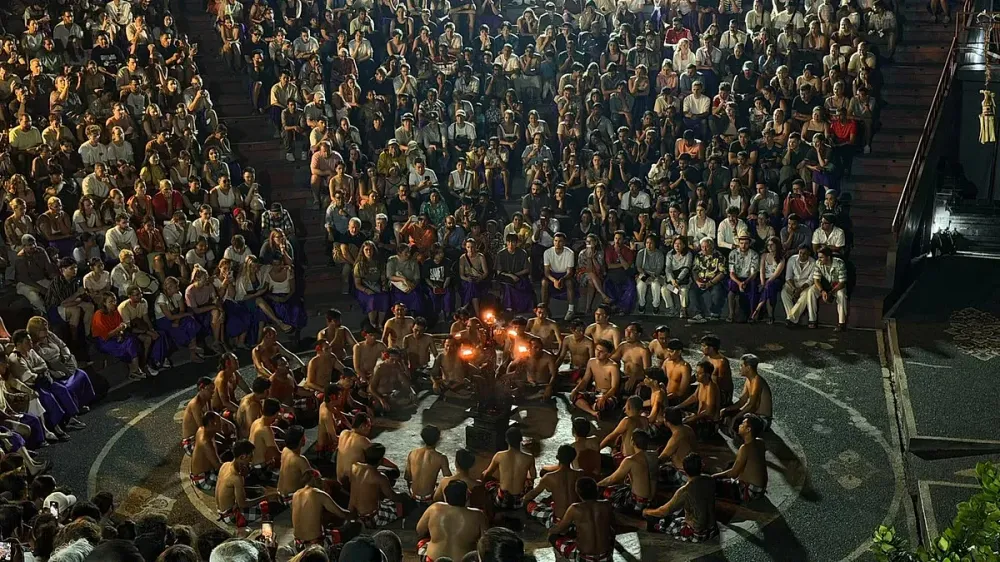
What distinguishes Kecak from other traditional dances is its complete absence of musical instruments. Instead, 50 to 70 bare-chested male performers sit in tight concentric circles, creating what is known locally as Gamelan Suara, a human vocal orchestra. Their voices rise and fall in coordinated patterns as they repeatedly chant "cak, cak, cak," their arms raised and moving in unison.
The performance tells the story of Prince Rama's quest to rescue his wife Sita after her abduction by the demon king Ravana. As the narrative unfolds, performers in traditional costumes portray various characters from the epic, with the continuous chanting providing both rhythm and atmosphere. Among the most memorable figures is Hanuman, the white monkey warrior who aids Rama in his search, particularly during the dramatic fire sequence that has made the performance famous.
Since its creation, Kecak has been performed primarily by men, though the art form has evolved to include female performers, with the first women's Kecak group starting in 2006. The scale of performances has also expanded dramatically since the dance's inception. In 1979, a historic Kecak performance featured 500 dancers staging a massive adaptation of the Mahabharata epic, demonstrating how the form has grown beyond its original conception.
More than entertainment
For Balinese communities, performances such as Kecak serve purposes beyond tourism. The dance preserves and transmits cultural knowledge, maintains connections to religious traditions, and provides a platform for local performers to practice traditional art forms. The theatrical adaptation of the Ramayana introduces audiences to stories and characters that have shaped Balinese artistic traditions for generations.
The open-air amphitheatre near Uluwatu Temple offers particularly striking conditions for the performance. Shows are typically scheduled around sunset, when the ocean backdrop and fading light create a memorable atmosphere. During peak tourist seasons, the venue fills quickly, with large crowds gathering to experience this fusion of religious tradition, theatrical storytelling and natural setting.
Practical considerations
Visitors planning to attend should arrive early, particularly during busy travel periods, as the popularity of the performance means seating can be limited. Performance times are generally timed with sunset, though exact schedules may vary. The temple maintains dress codes and guidelines that reflect its continuing role as an active place of worship, and visitors are expected to respect these requirements.
The experience offers travellers an opportunity to engage with Balinese heritage beyond the island's well-known beaches and hospitality sector. Through the combination of vocal performance, traditional costumes, dramatic fire sequences and the spectacular clifftop setting, the Kecak dance at Uluwatu presents a window into cultural practices that remain vital to Balinese identity while adapting to serve contemporary tourism.
As Bali continues to attract record numbers of international visitors, cultural attractions such as the Kecak fire dance demonstrate how traditional art forms can maintain their significance while reaching global audiences, creating experiences that introduce travellers to the heritage that distinguishes the island beyond its natural beauty.