Dubai Airports CEO predicts passport-free travel within five years
Travelers could leave their passports at home within five years if governments, airlines and airports agree on shared digital identity standards, Dubai Airports CEO Paul Griffiths said Monday. His LinkedIn post offered a forecast conditional on international cooperation, not a launch date for passport-free travel.
 Omar Al Nuaimi
From fewer checks to leaving the passport behind
"Passports could be redundant within five years," Griffiths wrote. He argued that the necessary technology already exists and that carrying a physical passport to fly is technologically outdated. The remaining task, he said, is connecting systems so the same digital identity is recognized across borders.
Griffiths had outlined the same five-year outlook in October 2026 at the 26th World Travel & Tourism Council (WTTC) Global Summit in Malta, according to Euronews. During a panel on digital identity and border procedures, participants discussed using digital credentials not only at borders but also to collect rental cars and check into hotels.
The prediction builds on his ambition to reduce repeated identity checks at airports. In an interview with Gulf News a year ago, Griffiths said: "I just want to eliminate queues. I want to make the entire process frictionless." He described a system that would capture facial biometrics once, then use cameras embedded in airport infrastructure to recognize passengers as they continued through the terminal.
What passengers can use in Dubai now
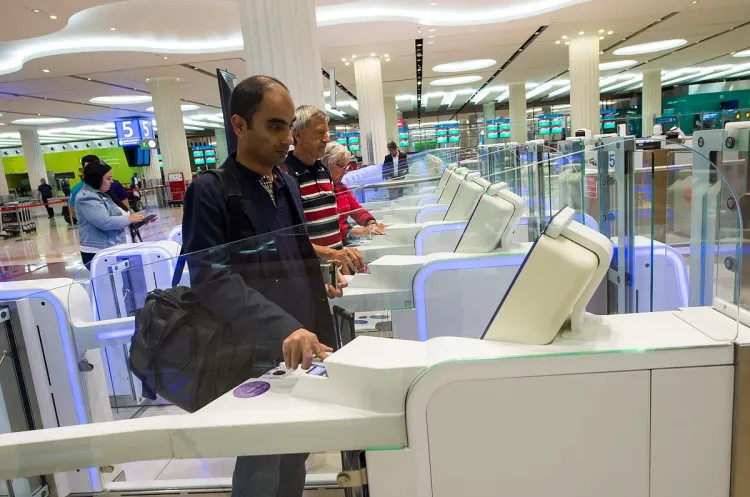
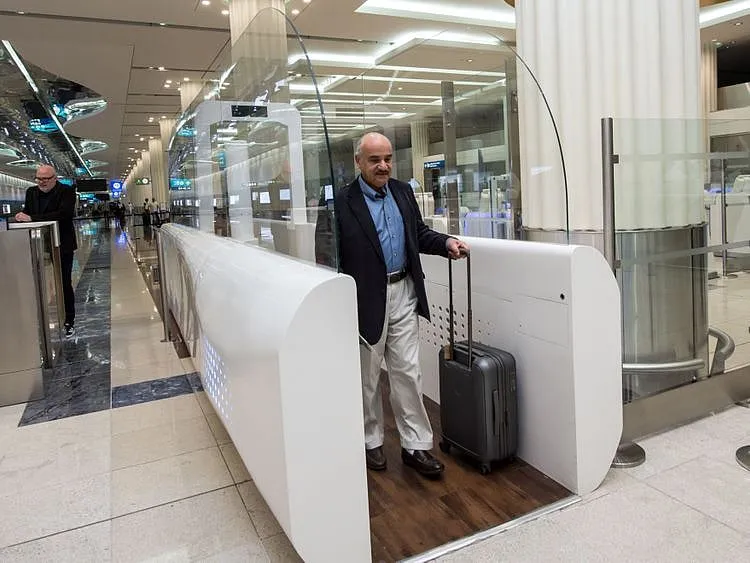
Dubai International's Terminal 3 already has more than 200 biometric cameras. Developed with Dubai's immigration authority, the service lets registered passengers identify themselves by face at participating check-in desks, immigration checkpoints, lounges and boarding gates.
Enrollment still requires a passport: passengers verify its details, have a photograph taken and consent to the use of their biometric information. They can enroll at Dubai check-in desks, while facial recognition for boarding is available at selected departure gates. These services reduce the need to show a passport during airport checks; they do not yet let travelers leave it at home.
Earlier services have used facial and iris recognition to let UAE citizens, residents and visitors complete airport procedures without presenting passports or IDs, provided their information had been registered with the General Directorate of Residency and Foreigners Affairs (GDRFA) since 2019. Officials said biometric records were retained for later trips. Passengers could clear passport control without an exit stamp, although anyone traveling to a country requiring one could request it from an officer.
Dubai's Red Carpet system processed 745,188 passengers from January through August 2026. It combines facial recognition with artificial intelligence so travelers can pass through a designated corridor without showing a passport or boarding pass.
Another service, Click and Travel, debuted in September 2026. Officers use connected mobile devices and biometric verification to conduct passport-control procedures near passengers. Deployment depends on operational needs, including queues and busy periods.
Building credentials that work across borders
The International Civil Aviation Organization's Digital Travel Credential (DTC) provides the international standard underpinning passport-free travel. ICAO describes it as a way to securely extend an ICAO-compliant passport to a passenger's mobile device, with global interoperability and fewer points at which travelers must present their credentials. The organization is developing the specifications and working with regional pilots on security and interoperability.
Europe has already changed how it records border crossings. According to the European Commission, the EU's Entry/Exit System became fully operational on April 10, 2026, at the external borders of 29 European countries. For non-EU nationals, it replaces passport stamps with electronic arrival and departure records and collects biometrics, including fingerprints and facial images.
The EU is also developing a Digital Travel Application to hold digital passport or ID-card data on phones and in the European Digital Identity Wallet. A FRONTEX presentation at ICAO TRIP 2026 said use would be voluntary, but every Schengen country would accept digital travel credentials. Availability is planned from 2030, with national systems potentially arriving earlier.
Adoption will vary by destination
Griffiths acknowledged in Monday's post that countries would adopt these changes at different speeds. Extending a digital identity from border clearance to rental-car collection and hotel check-in would require governments to work with aviation and tourism businesses.
"Ultimately, our guests would spend less time proving who they are and more time enjoying their trip," he wrote. "Your passport has an expiry date. I believe the need to carry it has one too."